
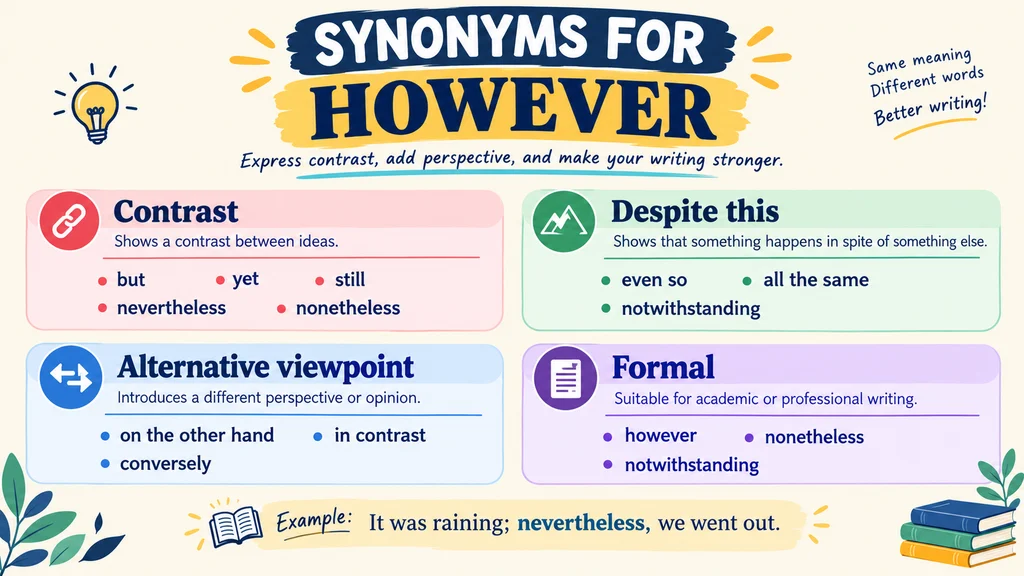
Do you use however repeatedly in essays, emails, or everyday writing? Choosing the right alternative can make your sentences sound more natural without changing your intended meaning. The best synonyms for however include nevertheless, nonetheless, still, yet, even so, and on the other hand, but each expression serves a slightly different purpose.
For example, “The exam was difficult; nevertheless, she passed” emphasizes success despite a challenge, while “The exam was difficult, but she passed” expresses the contrast more directly.
Whether you are writing an academic essay, preparing a professional report, or improving your everyday English, learning alternatives to however can help you connect ideas more effectively. However, these words are not always interchangeable. Nevertheless and even so often emphasize an unexpected outcome, while on the other hand introduces a contrasting perspective.
In this guide, you’ll discover synonyms and related expressions for however, with simple meanings, practical example sentences, and tips for choosing the right alternative in formal, academic, and casual writing.

50 Synonyms of However With Simple Meanings and Examples
Nevertheless
Meaning:
Nevertheless means in spite of what was just said; signals a surprising contrast.
Examples:
- The plan had many risks; nevertheless, the team moved forward.
- The exam was tough; nevertheless, she passed with top marks.
Nonetheless
Meaning:
Nonetheless means a near-twin of nevertheless, common in academic writing.
Examples:
- The data was incomplete. Nonetheless, the results pointed the same way.
- He kept driving too fast nonetheless, despite being warned twice.
Notwithstanding
Meaning:
Notwithstanding means a formal way to say “despite this,” often used in legal writing.
Examples:
- The storm was brutal; notwithstanding, the match went ahead.
- The budget was small; notwithstanding, they built the playground.
Even so
Meaning:
Even so means admits a point, then gently pushes back against it.
Examples:
- The course was boring. Even so, I finished every lesson.
- Even so, I finished every lesson despite the boring course.
Be that as it may
Meaning:
Be that as it may means accepts what was said but refuses to let it decide the outcome.
Examples:
- Be that as it may, we still have a deadline to meet.
- Be that as it may, the rules apply to all players equally.
All the same
Meaning:
All the same means a calm, slightly old-fashioned way to disagree without arguing.
Examples:
- He was exhausted; all the same, he stayed to help.
- She had a cold; all the same, she sang at the concert.
For all that
Meaning:
For all that means admits everything against your point, then stands firm anyway.
Examples:
- For all that, she believed the idea was worth trying.
- For all that, he stayed loyal to his old friend.
Just the same
Meaning:
Just the same means softer than “but”; works naturally in writing and speech.
Examples:
- The movie was long. Just the same, I enjoyed every minute.
- Just the same, we ate every bite of the bland food.
Still and all
Meaning:
Still and all means a warm, folksy way to admit a flaw and insist on the point at once.
Examples:
- The trip was chaotic; still and all, it was wonderful.
- The line was long; still and all, the show was worth it.
Howbeit
Meaning:
Howbeit means an old, literary word for “however” that surprises modern readers.
Examples:
- Howbeit the evidence was thin, the jury was convinced.
- Howbeit the night was dark, the travelers pressed on.
Withal
Meaning:
Withal means archaic for “with all that”; adds old-world charm to a contrast.
Examples:
- He failed twice; withal, he never lost his confidence.
- She lost the match; withal, she smiled and shook hands.
Not the less
Meaning:
Not the less means a poetic, old-fashioned contrast, close to “no less determined.”
Examples:
- She was tired, but not the less eager to start.
- He was nervous, but not the less determined to try.
Per contra
Meaning:
Per contra means a formal, Latin-rooted word meaning “on the contrary.”
Examples:
- Per contra, several experts argue the policy will backfire.
- Per contra, some doctors recommend rest over more tests.
In any event
Meaning:
In any event means “Whatever happens,” dressed in a formal coat.
Examples:
- In any event, we will need more time to decide.
- In any event, the picnic is cancelled because of rain.
In any case
Meaning:
In any case means it closes the debate and moves the conversation forward.
Examples:
- In any case, the decision has already been made.
- In any case, we should thank everyone who helped.
At any rate
Meaning:
At any rate means waves a minor detail aside and refocuses on what actually matters.
Examples:
- The venue was pricey, but at any rate the night was perfect.
- The flight was delayed, but at any rate we arrived safely.
Regardless
Meaning:
Regardless means sets the previous point aside and keeps going anyway.
Examples:
- The rules changed. Regardless, our promise still stands.
- People kept buying tickets regardless of the rising prices.
Conversely
Meaning:
Conversely means flips the logic around completely, showing the mirror image.
Examples:
- Conversely, a calm team often handles crises better.
- Conversely, too much praise can make children lazy.
Contrariwise
Meaning:
Contrariwise means a playful, formal way to flip an argument.
Examples:
- Contrariwise, many founders say failure taught them the most.
- Contrariwise, the quiet student scored the highest marks.
On the contrary
Meaning:
On the contrary means directly corrects what someone assumes to be true.
Examples:
- On the contrary, I found the lecture fascinating.
- On the contrary, the new teacher is very kind.
Synonyms for Wrong: 53+Find the Word That Fits
In contrast
Meaning:
In contrast means spotlights a clear difference between two things.
Examples:
- In contrast to his loud brother, Tom is quiet.
- In contrast to her sister, Maria loves rainy days.
By contrast
Meaning:
By contrast means nearly identical to “in contrast”; prefers full clauses.
Examples:
- By contrast, the new version runs twice as fast.
- By contrast, the old phone lasts a whole week.
In comparison
Meaning:
In comparison means frames the difference against something already mentioned.
Examples:
- In comparison, her old apartment felt tiny.
- In comparison, this year’s festival was much bigger.
But
Meaning:
But means the simplest, most honest contrast word in English.
Examples:
- I wanted to go, but it started raining.
- She was hungry, but the fridge was completely empty.
Yet
Meaning:
Yet means like “but,” with an extra touch of surprise.
Examples:
- He is wealthy, yet he lives so simply.
- He looks tired, yet he refuses to take a day off.
Still
Meaning:
Still means quietly insists that the contrast matters.
Examples:
- It was midnight; still, she kept reading.
- The rain stopped; still, the streets stayed flooded.
Though
Meaning:
Though means gentle and flexible; slides into almost any sentence.
Examples:
- Though tired, he smiled and waved.
- Though she arrived late, the letter brought wonderful news.
Although
Meaning:
Although means the more formal sibling of “though,” best in writing.
Examples:
- Although it rained, the crowd stayed.
- Although she is young, she plays the piano beautifully.
Even though
Meaning:
Even though means stronger than “although”; stresses how surprising the contrast is.
Examples:
- Even though she was scared, she spoke up.
- Even though tired, the dog kept wagging its tail.
Albeit
Meaning:
Albeit means one elegant word for “although it is.”
Examples:
- He accepted the job, albeit with some doubts.
- She joined the choir, albeit a little shyly.
Anyway
Meaning:
Anyway means casual and confident; moves straight past objections.
Examples:
- It is risky. Anyway, I am going to try.
- We will walk to the venue anyway, since the road is closed.
Anyhow
Meaning:
Anyhow means “Anyway’s” relaxed cousin; great in conversation.
Examples:
- Anyhow, we found a way to finish on time.
- Anyhow, the cake turned out delicious in the end.
That said
Meaning:
That said means the modern internet’s favorite pivot after making a point.
Examples:
- That said, the sequel is still worth watching.
- That said, the first book in the series is better.
Having said that
Meaning:
Having said that means a touch more formal than “that said.”
Examples:
- Having said that, I do understand your concern.
- Having said that, the hotel staff were very friendly.
That being said
Meaning:
That being said means politely softens a disagreement before it lands.
Examples:
- That being said, the results were better than expected.
- That being said, we still need to cut costs.
With that said
Meaning:
With that said means signals a smooth turn, common in speeches and essays.
Examples:
- With that said, let us look at the other side.
- With that said, I welcome your questions now.
Then again
Meaning:
Then again means pauses and rethinks, out loud.
Examples:
- Then again, maybe a short break would help.
- Then again, the blue one might suit you better.
On second thought
Meaning:
On second thought means admits a change of mind mid-sentence.
Examples:
- On second thought, let us take the longer route.
- On second thought, I will bring an umbrella too.
At the same time
Meaning:
At the same time means it holds two true ideas in your hands at once.
Examples:
- At the same time, we cannot ignore the costs.
- At the same time, we must protect the old trees.
Meanwhile
Meaning:
Meanwhile means shifts the spotlight to what else is happening.
Examples:
- Meanwhile, her rival was training twice as hard.
- Meanwhile, the children were playing in the garden.
On the other hand
Meaning:
On the other hand means the classic builder of two-sided arguments.
Examples:
- The job pays well; on the other hand, the commute is brutal.
- The flat is small; on the other hand, it is very cheap.
On the flip side
Meaning:
On the flip side means the casual, modern twin of “on the other hand.”
Examples:
- On the flip side, working late means free mornings.
- On the flip side, rainy days are perfect for reading.
While
Meaning:
While means contrasts two facts in one smooth move.
Examples:
- While some people loved it, others hated it.
- While some cheered loudly, others sat in silence.
Whereas
Meaning:
Whereas means formal contrast between two clearly opposite sides.
Examples:
- Whereas Ann likes mornings, I like nights.
- Whereas he loves spicy food, she prefers mild dishes.
Mind you
Meaning:
Mind you means a conversational nudge that adds a balancing fact.
Examples:
- The house is small, mind you, but the garden is huge.
- The trip was short, mind you, but full of adventure.
Instead
Meaning:
Instead means points to the option that was actually chosen.
Examples:
- Instead of arguing, they listened to each other.
- Instead of watching TV, they played cards together.
Rather
Meaning:
Rather means prefers one thing over another, gently.
Examples:
- Rather than complain, she fixed the problem herself.
- Rather than wait, he walked to the station.
Alternatively
Meaning:
Alternatively means offers another route, politely and clearly.
Examples:
- Alternatively, you could ask a friend for help.
- Alternatively, we could meet at the library tomorrow.
In spite of that
Meaning:
In spite of that means admits the obstacle, then walks straight past it.
Examples:
- In spite of that, the team hit its target.
- In spite of that, she finished the marathon smiling.
Despite that
Meaning:
Despite that means the tighter, punchier version of “in spite of that.”
Examples:
- Despite that, he arrived early and fully prepared.
- Despite that, they welcomed us with open arms.
When to Use Which Synonym of However
Picking the right synonym of however is less about the dictionary and more about the room you are in. For formal writing — essays, reports, applications — reach for nevertheless, nonetheless, notwithstanding, conversely, or whereas; they sound measured and precise. In casual chat, texts, and captions, but, anyway, that said, and on the flip side keep things natural.
In emotional moments — apologies, heart-to-hearts, motivational posts — softer pivots like still, yet, and at the same time acknowledge feelings before redirecting them.
Synonyms for Complacent: 58+Words for Every Nuance

Frequently Asked Questions
What is the best synonym of however for essays?
Nevertheless and nonetheless are the safest choices for academic essays, followed by conversely and in contrast when comparing ideas. They sound formal without sounding stiff.
Can I start a sentence with “but”?
Yes — starting a sentence with “but” is perfectly fine in modern English, especially in casual, creative, and business writing. The old rule against it has faded; just keep it occasional in very formal academic papers.
What is the difference between “however” and “nevertheless”?
Both introduce a contrast, but nevertheless carries a stronger sense of “despite everything just said.” Think of however as a neutral turn and nevertheless as a turn with extra determination behind it.
Is “that said” correct English?
Yes, “that said” is standard, widely accepted English, especially in speech, blogs, journalism, and business writing. It works best in semi-formal and informal contexts.
What is a formal synonym of however for reports?
Notwithstanding, nevertheless, and per contra sit at the formal end. For most reports, nevertheless or conversely hits the right balance of polish and clarity.
How do I stop repeating “however” in my writing?
Pick three or four favorites from different registers — say yet, still, on the other hand, and that said — and rotate them while you draft. Soon the variety becomes automatic.
Conclusion
“However” is a fine word, but fine words do not make memorable writing. Every time you swap it for a sharper contrast — nevertheless in an essay, that said in a post, on the contrary in a debate — you train your brain to think in richer shades of meaning. That is how vocabulary grows: not by memorizing lists, but by reaching for a better word in a real sentence, again and again.
Keep this list handy while you draft, and watch how quickly your sentences start to breathe.
Author

Daniel Brooks is a language enthusiast and contributing writer at SynonymCore. He writes about word meanings, usage, and the subtle differences between similar words.
Pingback: Synonyms for Went: Find the Right Word for Each Sentence