
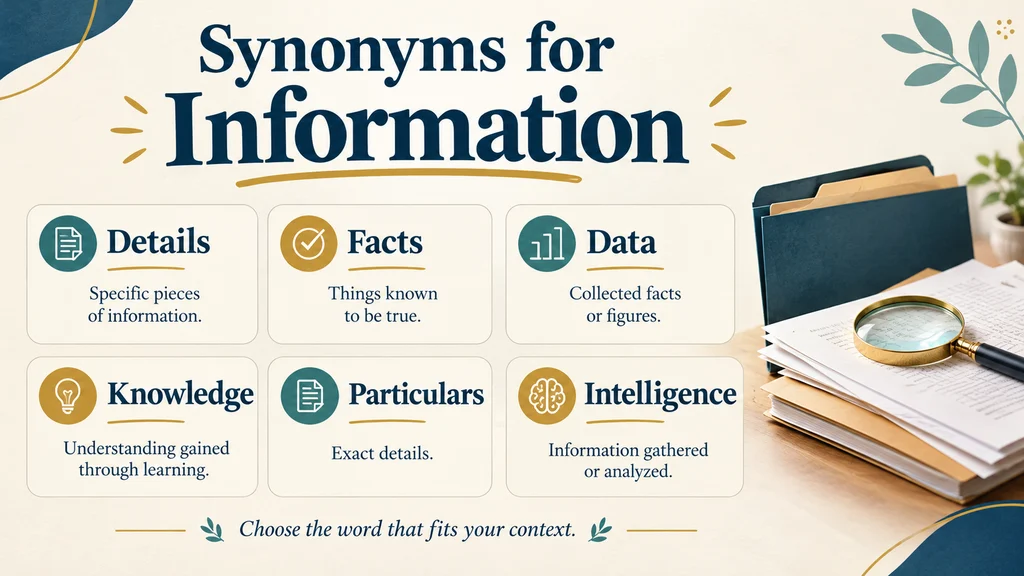
Repeating the word information can make your writing sound dull, but choosing a different word is not always as simple as it seems. Information means facts, details, or knowledge about a person, topic, event, or situation.
Common synonyms and related alternatives include details, facts, data, knowledge, findings, and particulars. However, each word has its own use. For example, details refers to specific pieces of information, data often means collected facts or measurements, and findings usually describes results from research or investigation.
Whether you are writing an essay, preparing a business report, creating website content, or improving your everyday vocabulary, the right alternative can make your message clearer and more precise. In this guide, you’ll explore synonyms for information, understand their simple meanings, and learn how to use them in natural sentences. You’ll also discover which words work best in academic, professional, technical, and everyday writing, helping you avoid repetition without changing the meaning of your message.

Data
Meaning:
Data means raw facts and numbers collected for analysis.
Examples:
- The scientists analyzed the data before publishing their results.
- The survey data revealed a surprising trend.
Facts
Meaning:
Facts means things that are known to be true.
Examples:
- Check your facts before arguing about it online.
- The documentary presents the facts about climate change.
Details
Meaning:
Details means small, specific pieces of information.
Examples:
- She gave me all the details about the wedding.
- The contract’s fine details took hours to review.
Particulars
Meaning:
Particulars means specific facts about someone or something, often used formally.
Examples:
- Please provide your particulars on the registration form.
- The detective noted down the suspect’s particulars.
News
Meaning:
News means newly received information about recent events.
Examples:
- Have you heard the news about the new park?
- The evening news covered the election results.
Knowledge
Meaning:
Knowledge means understanding gained through learning or experience.
Examples:
- His knowledge of history is truly impressive.
- She shared her knowledge of gardening with the neighbors.
Intelligence
Meaning:
Intelligence means information collected to support important decisions.
Examples:
- The agency gathered intelligence on the potential threat.
- The spy passed vital intelligence to the headquarters.
Input
Meaning:
Input means opinions or facts shared to help shape a decision.
Examples:
- The manager asked for everyone’s input on the plan.
- We value your input on the new design.
Content
Meaning:
Content means the information contained in something, like an article or video.
Examples:
- This website has great content for beginners.
- The course content covers ten different topics.
Word
Meaning:
Word means news or a message passed along informally.
Examples:
- Word has it that she’s getting promoted.
- Word spread quickly that the concert was canceled.
Tidings
Meaning:
Tidings means news, with a warm or slightly old-fashioned tone.
Examples:
- He brought glad tidings from the family.
- The letter brought tidings of peace from abroad.
Message
Meaning:
Message means a piece of information sent from one person to another.
Examples:
- I left a message on your voicemail.
- She sent a message thanking him for the gift.
Records
Meaning:
Records means official information kept for future reference.
Examples:
- The hospital keeps detailed records of every patient.
- The library archives hold records dating back centuries.
Documentation
Meaning:
Documentation means written information that explains or proves something.
Examples:
- Read the documentation before installing the software.
- The product’s documentation explained every feature clearly.
Evidence
Meaning:
Evidence means information that proves something is true.
Examples:
- The lawyer presented new evidence in court.
- The footprints were key evidence in the investigation.
Statistics
Meaning:
Statistics means numbers and percentages that describe a situation.
Examples:
- The statistics show a rise in online shopping.
- The latest statistics reveal falling unemployment.
Findings
Meaning:
Findings means information discovered through research or study.
Examples:
- The study’s findings surprised even the researchers.
- The committee published its findings last week.
Results
Meaning:
Results means information about what happened or what was achieved.
Examples:
- Your test results will be ready tomorrow.
- The election results were announced at midnight.
Report
Meaning:
Report means a written or spoken account giving information.
Examples:
- She wrote a report on the latest market trends.
- The annual report highlighted record profits.
Announcement
Meaning:
Announcement means official information shared publicly.
Examples:
- The company made an announcement about the merger.
- The school’s announcement surprised every parent.
Statement
Meaning:
Statement means a formal expression of facts or opinions.
Examples:
- The police released a statement to the press.
- The CEO’s statement addressed the rumors directly.
Briefing
Meaning:
Briefing means a short meeting or document sharing key information.
Examples:
- The pilot attended a briefing before the flight.
- The morning briefing covered the day’s security alerts.
Memo
Meaning:
Memo means a short written message shared inside an organization.
Examples:
- He sent a memo to the whole team.
- The office memo announced the new holiday policy.
Bulletin
Meaning:
Bulletin means a short official news report.
Examples:
- The hospital issued a bulletin on the patient’s condition.
- The weather bulletin warned of an approaching storm.
Reference
Meaning:
Reference means information you consult when you need facts.
Examples:
- Keep this guide as a quick reference.
- The dictionary is an essential reference for writers.
Overview
Meaning:
Overview means a general summary giving the main points.
Examples:
- The professor gave an overview of the course.
- The article provides an overview of the housing market.
Summary
Meaning:
Summary means a short version containing only the key information.
Examples:
- Write a summary of the chapter in your own words.
- The meeting ended with a brief summary of decisions.
Digest
Meaning:
Digest means information condensed into an easy-to-read form.
Examples:
- I read a daily news digest every morning.
- The weekly digest covers the top stories in tech.
Compendium
Meaning:
Compendium means a collection of information on one subject, in a single place.
Examples:
- The book is a compendium of gardening tips.
- The volume is a compendium of traditional recipes.
Dossier
Meaning:
Dossier means a file of detailed information about a person or topic.
Examples:
- The journalist built a dossier on the scandal.
- The lawyer prepared a dossier for the trial.
Profile
Meaning:
Profile means a written description giving key information about someone.
Examples:
- The magazine published a profile of the young inventor.
- Her online profile lists her skills and experience.
Synonyms of Neurodivergent: Find the Right Words
Account
Meaning:
Account means a written or spoken description of events.
Examples:
- He gave a vivid account of his travels.
- The witness gave a detailed account of the accident.
Rundown
Meaning:
Rundown means a quick, informal summary of the main points.
Examples:
- Give me a rundown of what happened at the meeting.
- The coach gave a quick rundown of the new rules.
Breakdown
Meaning:
Breakdown means facts split into parts to make them easier to grasp.
Examples:
- The bill includes a breakdown of all charges.
- The report offers a breakdown of costs by department.
Scoop
Meaning:
Scoop means exciting new information, especially in the news world.
Examples:
- The reporter got the scoop on the celebrity wedding.
- She shared the scoop about the surprise party.
Lowdown
Meaning:
Lowdown means the full, honest facts about something, told casually.
Examples:
- Give me the lowdown on the new boss.
- He got the lowdown on the neighborhood before moving.
Dirt
Meaning:
Dirt means secret or scandalous information about someone.
Examples:
- The tabloid printed dirt about the actor.
- The rival dug up dirt from his college days.
Intel
Meaning:
Intel means informal word for useful, often insider information.
Examples:
- My friend in HR gave me some intel about the opening.
- The agent shared valuable intel with the team.
Clues
Meaning:
Clues means pieces of information that help solve a mystery.
Examples:
- The detective found new clues at the scene.
- The puzzle’s clues pointed to the hidden treasure.
Leads
Meaning:
Leads means pieces of information that point you toward an answer.
Examples:
- The police are following up on several leads.
- The reporter chased every lead on the story.
Tips
Meaning:
Tips means helpful pieces of information or advice.
Examples:
- Thanks for the tips on fixing my bike.
- The guidebook offers tips for first-time travelers.
Heads-up
Meaning:
Heads-up means advance information that warns you about something.
Examples:
- Thanks for the heads-up about the road closure.
- She gave me a heads-up before the price increase.
Insight
Meaning:
Insight means deep understanding gained from information.
Examples:
- The survey gave us real insight into customer needs.
- The data offered fresh insight into the market.
Wisdom
Meaning:
Wisdom means knowledge built up over a lifetime of experience.
Examples:
- Her grandmother’s wisdom guided every decision.
- The old proverb carried timeless wisdom.
Guidance
Meaning:
Guidance means information or advice that helps you decide.
Examples:
- The counselor offered guidance on choosing a career.
- The manual provides guidance for new drivers.
Notice
Meaning:
Notice means a warning or alert that tells you something is happening.
Examples:
- The school sent a notice about the holiday.
- The bank posted a notice about the branch closure.
Update
Meaning:
Update means new information that brings you up to date.
Examples:
- I’ll send you an update after the meeting.
- The app’s latest update fixed the login bug.
Dispatch
Meaning:
Dispatch means an official message carrying important information.
Examples:
- The agency received a dispatch from the field office.
- The urgent dispatch arrived just before dawn.
Brief
Meaning:
Brief means a short document with the essential information.
Examples:
- The lawyer prepared a brief for the case.
- The architect submitted a design brief to the client.
Background
Meaning:
Background means extra information that helps you understand a situation.
Examples:
- Let me give you some background on the project first.
- The article explains the background of the conflict.
Synonyms of Naive: 57+ Words That Fit Better
When to Use Which: Choosing the Right Synonyms of Information
Not every alternative fits every moment, so here’s a quick guide to these words similar to information. For formal writing and reports, reach for documentation, evidence, findings, or statistics — they sound authoritative and precise. In casual conversation, the scoop, the lowdown, a heads-up, or intel keep things relaxed and friendly. For essays and academic work, knowledge, insight, reference, and overview carry the right weight. And in personal or emotional moments, wisdom, tidings, or word add warmth. The trick is simple: match the word’s tone to your audience, and you’ll never sound off.

Frequently Asked Questions
What are the best synonyms of information for formal writing?
For formal or professional writing, use documentation, evidence, findings, statistics, or records. These carry an authoritative tone and work well in reports, research papers, and business communication.
What’s a casual way to say “information”?
In casual conversation, try the lowdown, the scoop, intel, tips, or a heads-up. They’re friendly and natural — perfect for chats with friends or informal messages at work.
Is “data” the same as “information”?
Not exactly. Data refers to raw, unprocessed facts and numbers, while information is data that has been organized and given meaning. In everyday speech they’re often used interchangeably, but in technical writing the distinction matters.
What is another word for information in an essay?
Great essay options include knowledge, insight, evidence, findings, and reference. They sound academic without being stiff, and they help you avoid repeating “information” in every paragraph.
Can I use “intelligence” instead of “information”?
Only in the right context. “Intelligence” usually means information gathered for decision-making — think spy agencies or business strategy. For everyday use, stick with simpler alternatives like details or news.
What’s the difference between “knowledge” and “information”?
Information is what you receive; knowledge is what you keep. Information becomes knowledge once you understand it and can use it. That’s why we say someone has knowledge but gets information.
Conclusion
Building a richer vocabulary is one of the fastest ways to make your writing stand out, and now you have fresh synonyms of information to work with. Start small — swap the word in your next email or essay and notice how much sharper it sounds.
Author

Sophia Lane is an English learning contributor at SynonymCore. She creates easy-to-understand guides on synonyms, antonyms, and everyday vocabulary.
Pingback: 58+Synonyms for Flexible: From Adaptable to Versatile