
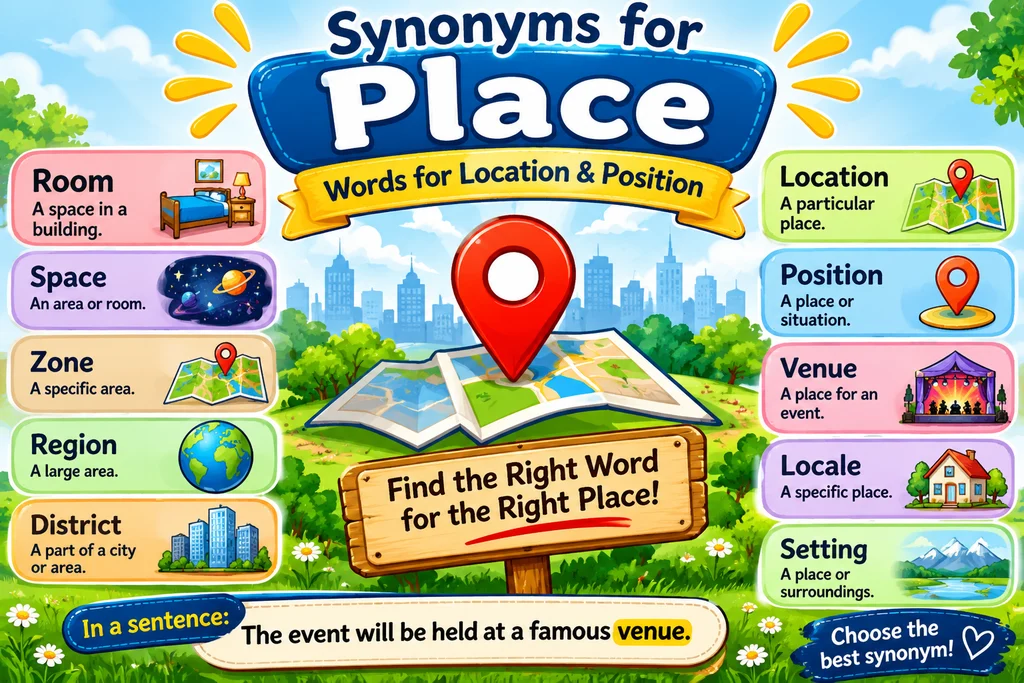
Need another word for place when describing a beautiful location, someone’s home, or where an object belongs? The best alternative depends on what you want to express. Place can refer to a physical location, a particular area, someone’s position, or a role. It can also function as a verb meaning to put or position something somewhere.
Useful synonyms for place include location, spot, site, venue, destination, setting, area, position, and locality. For example, venue describes a location where an event takes place, while residence refers to someone’s home. Similarly, position can describe someone’s place in an organization or group. These words have different meanings and cannot always replace one another.
Whether you’re writing an essay, describing a location, or improving your everyday vocabulary, these synonyms for place will help you choose more precise and natural expressions.

Location
Meaning:
Location means a specific point or area where something is.
Examples:
- She shared her location so we could meet her halfway.
- The treasure hunt’s final location was hidden behind the waterfall.
Spot
Meaning:
Spot means a small, particular place.
Examples:
- We found a sunny spot in the park for our picnic.
- We found a quiet spot near the river to watch the sunset.
Site
Meaning:
Site means a place where something is built, happened, or will happen.
Examples:
- The museum was built on the site of an old factory.
- Archaeologists discovered ancient tools at the dig site.
Venue
Meaning:
Venue means the place where an event happens, like a concert or a wedding.
Examples:
- They booked a rooftop venue for the launch party.
- The wedding venue overlooked the lake and the distant hills.
Destination
Meaning:
Destination means the place you are traveling toward.
Examples:
- Kyoto was the final destination on our Japan trip.
- Paris was always her dream destination for a winter holiday.
Locale
Meaning:
Locale means a place with a particular character or atmosphere.
Examples:
- The novel is set in a rainy coastal locale.
- The film was shot in a tropical locale with palm trees everywhere.
Locality
Meaning:
Locality means the general area around a place.
Examples:
- The clinic serves everyone in the locality.
- A new pharmacy opened to serve the growing locality.
Position
Meaning:
Position means the exact point where something is, relative to other things.
Examples:
- Hold the lamp in that position and it lights the whole desk.
- He shifted his position on the bench to see the stage better.
Area
Meaning:
Area means a region or part of a place, usually larger and less exact than a spot.
Examples:
- The dining area seats about fifty guests.
- The kids turned the backyard into a play area with old boxes.
Setting
Meaning:
Setting means the place and surroundings where something happens.
Examples:
- A mountain cabin makes a perfect setting for a mystery novel.
- A beach bonfire makes a romantic setting for the evening.
Scene
Meaning:
Scene means where an event or activity happens.
Examples:
- The market was a riot of color and noise — quite the scene.
- The kitchen was a busy scene of chopping, stirring, and laughter.
Point
Meaning:
Point means a precise spot, often on a map or along a route.
Examples:
- Meet me at the point where the two trails cross.
- The bus stops at the exact point where the road bends.
Small & Cozy Corners
Corner
Meaning:
Corner means a small, tucked-away part of a room, street, or town.
Examples:
- She curled up in the corner of the café with her book.
- The cat slept in the sunny corner of the living room.
Nook
Meaning:
Nook means a cozy, sheltered little corner made for comfort.
Examples:
- The attic had a reading nook with a round window.
- She found a cozy nook behind the bookshelf for her plants.
Niche
Meaning:
Niche means a small recessed space — or a specialized corner of a market.
Examples:
- The bakery found its niche selling sourdough in a pizza town.
- The tiny shop found its niche selling handmade candles online.
Haven
Meaning:
Haven means a safe, peaceful place you escape to when life gets loud.
Examples:
- The cabin in the woods was her haven after long weeks.
- The quiet garden was his haven from the noisy city streets.
Retreat
Meaning:
Retreat means a quiet place you go to rest, think, or recover.
Examples:
- They spent the weekend at a lakeside retreat.
- The couple booked a mountain retreat to celebrate their anniversary.
Refuge
Meaning:
Refuge means a place that shelters you from danger, stress, or bad weather.
Examples:
- The library became his refuge during exam season.
- The old church became a refuge for travelers caught in the storm.
Haunt
Meaning:
Haunt means a place someone visits often and loves.
Examples:
- That corner bookstore was her favorite weekend haunt.
- The riverside café was his regular haunt every Friday evening.
Hideaway
Meaning:
Hideaway means a small, secret, out-of-the-way place.
Examples:
- They rented a beach hideaway for their honeymoon.
- They escaped to a forest hideaway with no phones or internet.
Neighborhood
Meaning:
Neighborhood means the area around where people live.
Examples:
- Our neighborhood has a farmers’ market every Saturday.
- Our neighborhood organized a cleanup drive last Sunday morning.
District
Meaning:
District means a defined section of a city with its own purpose or character.
Examples:
- The financial district empties out after six.
- The theater district comes alive with lights after dark.
Zone
Meaning:
Zone means an area marked for a specific use or rule.
Examples:
- The airport has a strict no-parking zone.
- The school is in a quiet zone where honking is not allowed.
Quarter
Meaning:
Quarter means an old-fashioned word for a district, often with cultural flavor.
Examples:
- We wandered the old quarter until midnight.
- We got lost in the old quarter’s maze of narrow streets.
Region
Meaning:
Region means a large area with shared features, like climate or culture.
Examples:
- The wine region draws visitors every autumn.
- The coastal region is famous for its fresh seafood dishes.
Territory
Meaning:
Territory means a large area controlled, claimed, or protected by someone.
Examples:
- The national park is protected territory.
- The lion marked its territory with deep scratches on the trees.
Sector
Meaning:
Sector means a distinct part of an area.
Examples:
- The western sector of the city is all warehouses.
- The tech sector of the town employs thousands of young engineers.
Province
Meaning:
Province means a large administrative region — or a whole field of activity.
Examples:
- They drove across the entire province in one day.
- They spent a week touring the northern province by train.
Vicinity
Meaning:
Vicinity means the area near or around a place.
Examples:
- There is no gas station in the immediate vicinity.
- Is there a pharmacy in the vicinity of the railway station?
Environs
Meaning:
Environs means the surrounding area, especially around a town.
Examples:
- The castle and its environs are open to visitors.
- The palace and its environs attract history lovers every year.
Whereabouts
Meaning:
Whereabouts means the general location of a person or thing, often unknown.
Examples:
- His whereabouts are still a mystery.
- Nobody knew his whereabouts after he left the village suddenly.
57+Synonyms for Plan: Strategy, Purpose, or Proposal?
Premises
Meaning:
Premises means a building and its land, especially a business.
Examples:
- No smoking anywhere on the premises.
- Dogs are not allowed on the school premises during class hours.
Grounds
Meaning:
Grounds means the land around a large building, like a school or hotel.
Examples:
- The wedding was held on the hotel grounds.
- The children played football on the green grounds of the estate.
Plot
Meaning:
Plot means a small piece of land, often for building or gardening.
Examples:
- They bought a plot outside the city to build a cottage.
- They planted mango trees on the small plot behind their house.
Lot
Meaning:
Lot means a piece of land in a town — or a parking area.
Examples:
- We parked in the empty lot behind the store.
- The empty lot next door is perfect for our cricket matches.
Tract
Meaning:
Tract means a large stretch of land, often undeveloped.
Examples:
- The developer bought a vast tract of farmland.
- The farmer sold a small tract of his land to build a school.
Address
Meaning:
Address means the exact location where someone lives or works.
Examples:
- Write your return address on the envelope.
- Please send the letter to my new office address downtown.
Station
Meaning:
Station means an assigned or fixed place — or where trains stop.
Examples:
- The guard stayed at his station all night.
- The nurse stayed at her station until the morning shift arrived.
Post
Meaning:
Post means an assigned position or place of duty.
Examples:
- She took up her post at the front desk.
- The soldier remained at his post through the cold night.
Seat
Meaning:
Seat means a place where something is based — power, learning, or government.
Examples:
- The old university town is a seat of learning.
- The old city is a seat of art, music, and culture.
Formal & Literary Choices
Base
Meaning:
Base means the place you operate from or return to.
Examples:
- We made the cabin our base for exploring the valley.
- They made the seaside town their base for a week of hiking.
Home
Meaning:
Home means the place where you live and feel you belong.
Examples:
- After a month abroad, home never felt so good.
- After the long trip, home felt warmer than ever before.
Abode
Meaning:
Abode means a home or residence.
Examples:
- He welcomed us into his humble abode.
- She invited us into her humble abode for tea and cake.
Dwelling
Meaning:
Dwelling means a place where someone lives.
Examples:
- The old dwelling had stood for two centuries.
- The ancient dwelling was turned into a small folk museum.
Pad
Meaning:
Pad means a casual, playful word for someone’s apartment or home.
Examples:
- His new pad is two blocks from the beach.
- His tiny pad near the college is always full of friends.
Domain
Meaning:
Domain means a territory or field someone rules.
Examples:
- The garden was entirely the cat’s domain.
- The old oak tree was the squirrel’s private domain.
Realm
Meaning:
Realm means a kingdom or sphere of activity.
Examples:
- In the realm of dreams, anything is possible.
- In the realm of sports, teamwork matters more than talent.
Sphere
Meaning:
Sphere means an area of activity, influence, or knowledge.
Examples:
- She is well known in the sphere of education.
- He is a respected name in the sphere of wildlife photography.
Milieu
Meaning:
Milieu means the social or cultural environment of a place.
Examples:
- He thrived in the artistic milieu of the city.
- She blossomed in the creative milieu of the design school.
Backdrop
Meaning:
Backdrop means the setting behind an event, like scenery on a stage.
Examples:
- The mountains made a stunning backdrop for the photos.
- The old fort made a dramatic backdrop for the film’s final scene.
Choosing the Right Synonyms for Place
With 50 options, context is everything. Here’s a quick guide:
- Formal writing & business: location, site, premises, vicinity, locality. They sound precise and professional.
- Casual chat & texts: spot, pad, corner, haunt. They feel friendly and natural.
- Essays & exams: setting, locale, milieu, domain, realm. They show range without sounding forced.
- Emotional or descriptive moments: haven, retreat, refuge, nook, backdrop. They carry feeling.
- Stories & novels: scene, hideaway, environs, quarter. They paint pictures.

58+Synonyms for Popular: Famous, Beloved, or Common?
Frequently Asked Questions About Synonyms for Place
What is the best synonym for place in formal writing?
Location is the safest all-purpose choice, and site works well for construction, archaeology, or events. For business contexts, premises and vicinity add a polished, official tone. Pick the one that matches how precise you need to be.
What is a casual, everyday synonym for place?
Spot is the friendliest everyday swap — “a nice spot for lunch” sounds instantly natural. Pad works for someone’s home among friends, and corner or haunt add personality without sounding stiff.
What is the difference between “place” and “location”?
Place is broader and warmer — it can mean a spot, a home, a role, or even a moment (“in the first place”). Location is more technical and exact, pointing to where something is on a map or in space. In casual writing they often overlap, but location sounds more precise.
Can “place” also be used as a verb?
Yes. As a verb, to place means to put something somewhere deliberately — “She placed the vase on the shelf.” Verb synonyms include put, position, set, and lay. This guide focuses on place as a noun, which is how people search for it most.
What is a good synonym for place in an essay?
Setting, locale, and milieu all elevate academic writing without sounding forced. Locality suits geography or sociology essays, while domain and realm work when you mean a field of activity rather than a physical spot.
What is the opposite of “place”?
There isn’t a perfect single opposite, since place is so broad. Depending on context, opposites include nowhere (no place at all), absence, or void. For the verb sense, remove or displace work as opposites.
Conclusion
Words are tools, and “place” is a blunt one — useful, but rarely memorable. This list of synonyms for place gives you 50 sharper alternatives, from the everyday spot to the literary milieu, each ready to make your sentences more precise and more alive. The trick isn’t memorizing the whole list; it’s trying one new word a day until variety becomes habit. Bookmark this place synonyms guide, start with the five that fit your writing most, and keep exploring. Your readers — and your grades, clients, or followers — will notice the difference.
Author

Sophia Lane is an English learning contributor at SynonymCore. She creates easy-to-understand guides on synonyms, antonyms, and everyday vocabulary.