
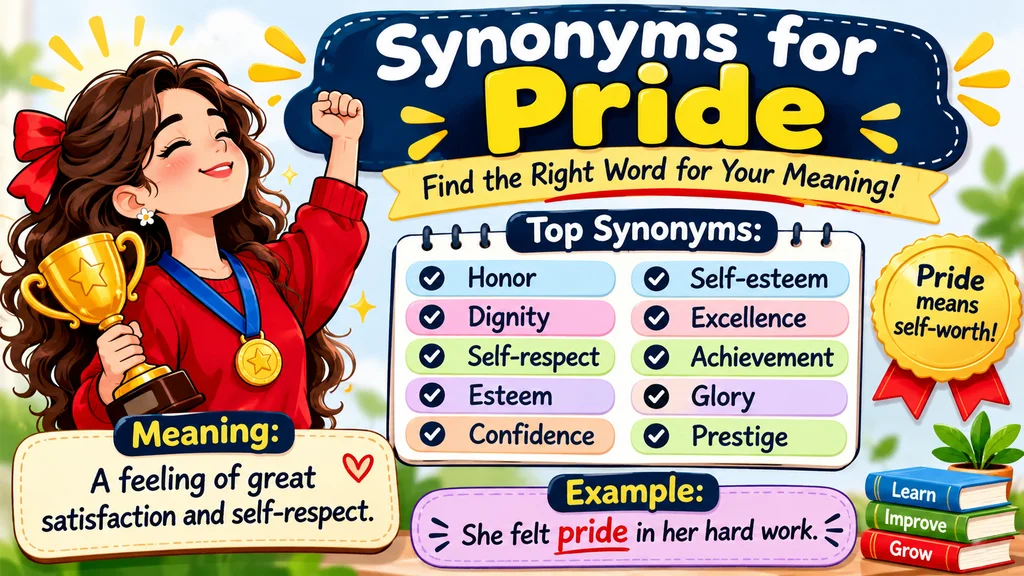
Have you ever struggled to find the right word for pride when describing a personal achievement, someone’s success, or an overly confident attitude? The challenge is that pride can express both positive feelings and negative behavior, so choosing the wrong alternative can change your message.
Pride is a feeling of pleasure or satisfaction in your achievements, qualities, or relationships, but it can also describe excessive self-importance. Depending on the context, useful synonyms for pride include self-respect, dignity, satisfaction, fulfillment, self-esteem, accomplishment, arrogance, and vanity. However, these words are not interchangeable.
Satisfaction describes pleasure in an achievement, dignity reflects self-respect, and arrogance suggests an exaggerated sense of superiority. Whether you’re writing an essay, describing someone’s personality, or expressing a sense of achievement, these synonyms for pride will help you choose words that convey exactly what you mean.
The Best Synonyms for Pride
Looking for another word for pride? Top picks: arrogance (negative, looking down on others), vanity (excessive focus on self), dignity (quiet, respectful pride), self-respect (healthy pride in yourself), triumph (proud joy of winning), and confidence (belief in your abilities).

Arrogance
Meaning:
Arrogance means an exaggerated sense of your own importance, often looking down on others.
Examples:
- His arrogance made it hard for anyone on the team to give him honest feedback.
- His arrogance showed when he dismissed the expert’s advice.
Vanity
Meaning:
Vanity means excessive pride in your appearance or achievements.
Examples:
- Her vanity showed in the way she checked the mirror before every single photo.
- His vanity kept him posting selfies every single hour.
Hubris
Meaning:
Hubris means extreme, overconfident pride that often leads to a painful fall.
Examples:
- The CEO’s hubris blinded him to every warning sign before the company crashed.
- The general’s hubris led his army into a disastrous trap.
Conceit
Meaning:
Conceit means an overly high opinion of yourself and your abilities.
Examples:
- Despite his obvious talent, his conceit annoyed everyone in the class.
- Her conceit made her believe she needed no practice.
Egotism
Meaning:
Egotism means the habit of talking mostly about yourself and putting your own interests first.
Examples:
- His constant egotism drained the energy out of every dinner conversation.
- His egotism turned the interview into a long monologue.
Ego
Meaning:
Ego means your sense of self-importance, especially when it bruises easily.
Examples:
- Losing the final match was a serious blow to his ego.
- The criticism bruised her ego more than she admitted.
Narcissism
Meaning:
Narcissism means self-obsession paired with an excessive need for admiration.
Examples:
- Her narcissism turned every group project into a one-woman show.
- His narcissism filled his office walls with framed portraits of himself.
Self-importance
Meaning:
Self-importance means believing that you matter far more than everyone else.
Examples:
- His self-importance was clear from the way he interrupted every speaker.
- Her self-importance grew with every promotion she received.
Smugness
Meaning:
Smugness means a quiet, self-satisfied pride that other people can sense.
Examples:
- There was a hint of smugness in his smile when the results were announced.
- A quiet smugness crept into his voice after the debate.
Self-satisfaction
Meaning:
Self-satisfaction means a calm, quiet contentment with what you have accomplished.
Examples:
- She felt a deep self-satisfaction after crossing the marathon finish line.
- He sat back with deep self-satisfaction after fixing the engine.
Complacency
Meaning:
Complacency means a smug satisfaction with things as they are, which stops you from improving.
Examples:
- The team’s complacency after last season’s win cost them the championship.
- The company’s complacency let smaller rivals steal its customers.
Haughtiness
Meaning:
Haughtiness means arrogant pride shown through a cold, superior manner.
Examples:
- Her haughtiness made the new interns too afraid to ask any questions.
- Her haughtiness surfaced whenever she dealt with waiters.
Snobbery
Meaning:
Snobbery means pride based on feeling socially or intellectually superior to others.
Examples:
- His snobbery about music ruined what should have been a fun evening.
- His snobbery about restaurants bored his dinner guests.
Disdain
Meaning:
Disdain means a proud feeling of contempt toward something or someone.
Examples:
- She looked at the careless proposal with open disdain.
- He treated the cheap souvenirs with obvious disdain.
Condescension
Meaning:
Condescension means treating others as if they are less intelligent or important than you.
Examples:
- His condescension toward the junior staff created real resentment in the office.
- Her condescension toward the new volunteers drove several away.
Pretentiousness
Meaning:
Pretentiousness means trying to appear more important or cultured than you really are.
Examples:
- The restaurant’s pretentiousness showed in its tiny portions and enormous prices.
- The gallery’s pretentiousness alienated most ordinary art lovers.
Pomposity
Meaning:
Pomposity means pompous, self-important behavior or speech.
Examples:
- The principal’s pomposity made the morning assembly drag on for nearly an hour.
- The manager’s pomposity turned every meeting into a lecture.
Superciliousness
Meaning:
Superciliousness means pride shown by acting as if other people are beneath you.
Examples:
- Her superciliousness in meetings discouraged anyone else from speaking up.
- His superciliousness toward the interns earned him few friends.
Swagger
Meaning:
Swagger means a confident, sometimes arrogant way of walking or carrying yourself.
Examples:
- He walked into the interview with the swagger of someone who already had the job.
- He carried the swagger of a champion into the ring.
Boastfulness
Meaning:
Boastfulness means the habit of bragging about yourself and your achievements.
Examples:
- His boastfulness about the promotion wore thin within a single week.
- His boastfulness about the new car annoyed the neighbors.
Braggadocio
Meaning:
Braggadocio means loud, empty boasting that rarely matches reality.
Examples:
- Behind all his braggadocio, he was secretly nervous about the exam.
- Behind his braggadocio hid a deep fear of failure.
Vainglory
Meaning:
Vainglory means excessive pride in your achievements, shown through empty boasting.
Examples:
- His speech was full of vainglory rather than genuine thanks.
- The athlete’s vainglory overshadowed the team’s collective effort.
Ostentation
Meaning:
Ostentation means showing off wealth or success purely to impress others.
Examples:
- The ostentation of the wedding surprised even their closest friends.
- The ostentation of his mansion impressed few visitors.
Showiness
Meaning:
Showiness means a flashy display designed to attract admiration.
Examples:
- The showiness of his new car drew stares from across the parking lot.
- The showiness of her jewelry sparked gossip at the party.
Grandiosity
Meaning:
Grandiosity means an inflated sense of your own importance or of your plans.
Examples:
- The grandiosity of his promises made the investors quietly cautious.
- The grandiosity of the building’s design stunned every visitor.
Self-admiration
Meaning:
Self-admiration means admiring yourself a little more than is healthy.
Examples:
- His self-admiration was hard to miss in every single team photograph.
- Long mirror sessions revealed the depth of his self-admiration.
Self-glorification
Meaning:
Self-glorification means praising yourself in order to look impressive.
Examples:
- The memoir felt more like self-glorification than an honest life story.
- The documentary felt like pure self-glorification by the director.
Self-righteousness
Meaning:
Self-righteousness means the proud belief that you are always morally right.
Examples:
- Her self-righteousness ended the debate before it had really begun.
- His self-righteousness poisoned every family discussion about politics.
Synonyms for Quiet: Silent, Serene, Subdued, and More
Superiority
Meaning:
Superiority means the feeling or claim that you are better than other people.
Examples:
- His constant air of superiority made teamwork almost impossible.
- Her air of superiority silenced the brainstorming session.
Presumption
Meaning:
Presumption means boldly assuming something in a way that shows overconfidence.
Examples:
- It was pure presumption to announce the winner before the votes were counted.
- It was sheer presumption to use her office without asking.
Overconfidence
Meaning:
Overconfidence means confidence pushed too far, past what the facts actually support.
Examples:
- Overconfidence led the team to skip practice before the final match.
- Overconfidence made him attempt the dive without checking the depth.
Self-assurance
Meaning:
Self-assurance means calm, steady confidence in yourself and your abilities.
Examples:
- Her self-assurance helped her stay composed through the toughest questions.
- Her self-assurance steadied the team during the crisis.
Confidence
Meaning:
Confidence means a strong, healthy belief in your own abilities.
Examples:
- Years of daily practice gave him the confidence to perform on the big stage.
- Winning the debate gave him new confidence in public speaking.
Self-esteem
Meaning:
Self-esteem means your overall sense of your own worth as a person.
Examples:
- Volunteering at the shelter did wonders for her self-esteem.
- Learning the guitar slowly rebuilt her damaged self-esteem.
Self-confidence
Meaning:
Self-confidence means trust in your own judgment and abilities.
Examples:
- The public speaking course slowly built his self-confidence.
- Landing the summer internship boosted his self-confidence enormously.
Self-respect
Meaning:
Self-respect means a healthy pride in yourself that stops you from accepting poor treatment.
Examples:
- She turned down the unfair offer out of pure self-respect.
- Out of self-respect, she refused to gossip about colleagues.
Self-worth
Meaning:
Self-worth means the value you believe you hold as a person.
Examples:
- The award reminded him of his self-worth after a very difficult year.
- The unexpected promotion restored his battered sense of self-worth.
Dignity
Meaning:
Dignity means quiet, self-respecting pride in how you carry yourself.
Examples:
- He accepted the defeat with dignity and shook his opponent’s hand.
- She faced the harsh criticism with remarkable dignity.
Honor
Meaning:
Honor means deep pride tied to integrity and a good reputation.
Examples:
- Defending his family’s honor mattered more to him than any amount of money.
- The soldier served with honor for twenty years.
Glory
Meaning:
Glory means great pride and admiration earned through an achievement.
Examples:
- The team basked in the glory of their championship victory.
- The young scientist shared the glory with her whole team.
Triumph
Meaning:
Triumph means the proud joy of winning after a long struggle.
Examples:
- Crossing the finish line felt like a moment of pure triumph.
- Winning the scholarship was a triumph for the whole family.
Exultation
Meaning:
Exultation means a sudden burst of joyful pride.
Examples:
- You could hear the exultation in her voice when she shared the good news.
- There was pure exultation in the crowd after the goal.
Jubilation
Meaning:
Jubilation means loud, joyful celebration of a success.
Examples:
- Jubilation filled the stadium as the final whistle blew.
- Jubilation erupted in the office when the deal closed.
Elation
Meaning:
Elation means a light, soaring feeling of proud happiness.
Examples:
- He felt pure elation when he saw his name on the selected list.
- She felt elation as the plane touched down in Paris.
Satisfaction
Meaning:
Satisfaction means quiet pride in a job done well.
Examples:
- She looked at the finished garden with deep satisfaction.
- He reviewed the completed report with quiet satisfaction.
Fulfillment
Meaning:
Fulfillment means a deep, lasting pride that comes from meaningful achievement.
Examples:
- Teaching gave him a sense of fulfillment that nothing else could match.
- Raising her children brought her the deepest fulfillment.
Joy
Meaning:
Joy means warm happiness that naturally comes with pride.
Examples:
- The parents watched with joy as their daughter received her degree.
- The grandparents beamed with joy at the wedding.
Delight
Meaning:
Delight means bright, cheerful pride in something wonderful.
Examples:
- She took delight in showing her grandmother the gold medal.
- He watched the evening fireworks with childlike delight.
Pleasure
Meaning:
Pleasure means simple, warm pride in an achievement.
Examples:
- He took great pleasure in finishing the project ahead of schedule.
- She took pleasure in baking for the neighborhood.
Contentment
Meaning:
Contentment means peaceful, settled pride with how things have turned out.
Examples:
- After years of hard work, he finally felt true contentment.
- The old couple lived in quiet contentment by the sea.
When to Use Which Synonym for Pride
Choosing the right word depends on the situation. For formal writing and essays, lean on dignity, honor, hubris, vainglory, and self-righteousness, which carry weight and precision. In casual conversation, words like swagger, smugness, boastfulness, and showiness sound natural and relatable.
For emotional or heartfelt moments, triumph, jubilation, fulfillment, self-respect, and elation capture the warmth of the feeling. And when you want to criticize gently, softer words like complacency, overconfidence, or self-satisfaction point out the problem without sounding harsh.

59+Synonyms for Prioritize: Rank, Emphasize, Favor, or Focus?
Frequently Asked Questions About Pride
What is the best synonym for pride?
It depends on the shade of meaning you want. For positive pride, dignity, self-respect, and triumph are excellent choices. For negative pride, arrogance, vanity, and conceit work best. Always match the word to the tone of your sentence.
What is the opposite of pride?
The most common opposites of pride are humility, modesty, and humbleness. While pride lifts the self up, humility keeps it grounded, and choosing between them changes the entire mood of what you write.
Is pride a positive or negative word?
Pride is both, which is what makes it tricky. Taking pride in honest work or in your family is healthy and positive. But pride becomes negative when it turns into arrogance, disdain, or looking down on others.
What is the difference between pride and arrogance?
Pride can be a healthy satisfaction in what you or others have achieved, while arrogance is pride that puts other people down. You can feel proud of your team without believing you are better than everyone else, and that line is what separates the two words.
What is a formal synonym for pride?
In formal writing, dignity, honor, self-respect, and hubris are strong choices. Dignity and honor suit respectful contexts like speeches and essays, while hubris is perfect for literary or academic discussions of excessive pride.
What word means having too much pride?
Hubris is the classic word for excessive, dangerous pride, especially in literature and formal writing. For everyday use, arrogance, conceit, or overconfidence say the same thing more simply.
Conclusion
Pride is a word with two faces, and now you have ways to describe each one. Whether you need the quiet strength of dignity, the healthy glow of self-respect, or a sharp word like arrogance for pride gone wrong, the right synonym for pride is always within reach. Keep using these words in your writing and conversations, and your vocabulary will grow stronger with every sentence. The best way to remember new words is to use them right away, so try dropping one into your next essay, email, or chat and notice how much sharper your message feels.
Author

Sophia Lane is an English learning contributor at SynonymCore. She creates easy-to-understand guides on synonyms, antonyms, and everyday vocabulary.