
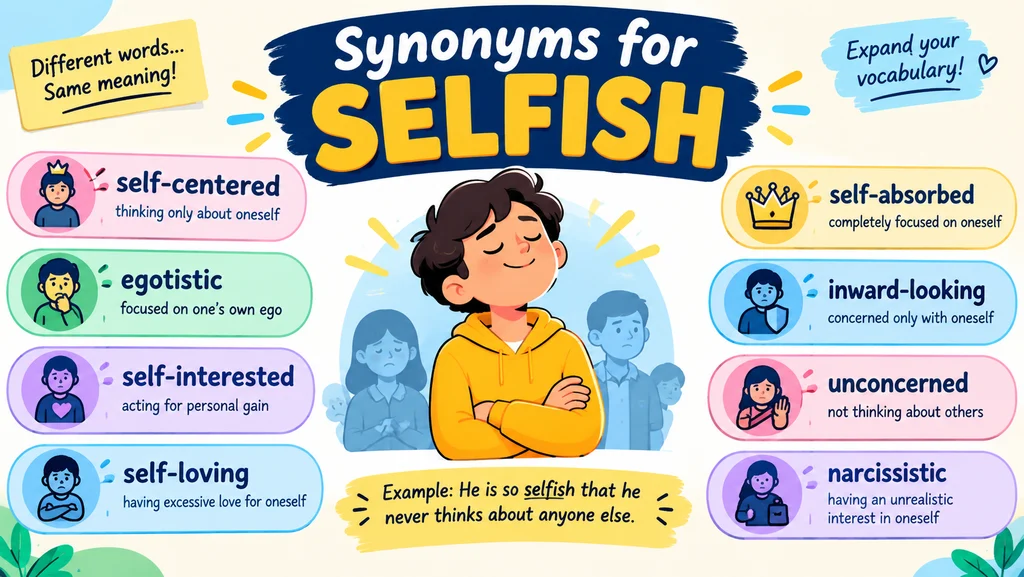
Tired of calling everyone who annoys you “selfish”? It is the word we all reach for when a friend cancels plans at the last minute, a coworker steals your credit, or a stranger cuts the line — but repeating it over and over makes your writing sound flat and your point feel weaker. Luckily, there are dozens of sharper synonyms for selfish that capture exactly what you mean, from mild self-centeredness to full-blown greed. Once you learn to identify exactly which flavor of selfishness you are describing, your words stop sounding generic and start hitting their target.
In this guide, you will find 50 hand-picked alternatives to “selfish,” each with a plain-English meaning and a real-life example. Whether you are writing an essay or firing off a frustrated text, the perfect word is waiting for you below.
Looking for another word for selfish? Top picks: self-centered, egotistical, greedy, stingy, inconsiderate, and self-serving. Scroll on for more, each with a simple meaning and example.

Not every selfish person is selfish in the same way. Some simply put themselves first without noticing; others grab, hoard, or refuse to share. The list is loosely grouped by flavor: everyday self-focus, greed, stinginess, and disregard for others.
Self-centered
Meaning:
Self-centered means focused mainly on your own needs and feelings, rarely thinking of others.
Examples:
- My self-centered neighbor threw a loud party on a weeknight without warning anyone.
- My self-centered roommate never cleans the kitchen.
Self-absorbed
Meaning:
Self-absorbed means so wrapped up in your own life that you barely notice what others feel.
Examples:
- He was too self-absorbed to ask how my interview went.
- She was too self-absorbed to notice his sadness.
Self-obsessed
Meaning:
Self-obsessed means constantly thinking and talking about yourself, to an unhealthy degree.
Examples:
- Her self-obsessed posts make every group photo about her.
- His self-obsessed rants bored the entire table.
Self-involved
Meaning:
Self-involved means deeply occupied with your own thoughts, plans, and problems.
Examples:
- My self-involved brother never once asked about my new job.
- The self-involved actor ignored the crew completely.
Egocentric
Meaning:
Egocentric means behaving as if the world revolves around you and your interests.
Examples:
- The egocentric manager scheduled every meeting around his own convenience.
- The egocentric host talked only about himself.
Egotistical
Meaning:
Egotistical means acting as if you are more important or talented than everyone else.
Examples:
- His egotistical speech thanked nobody but himself.
- Her egotistical demands exhausted the staff.
Egoistic
Meaning:
Egoistic means driven by your own ego and personal interest rather than fairness.
Examples:
- Taking credit for the whole team’s work was an egoistic move.
- His egoistic decisions hurt the whole team.
Narcissistic
Meaning:
Narcissistic means showing extreme self-admiration combined with very little empathy.
Examples:
- Her narcissistic behavior slowly ruined every friendship she had.
- The narcissistic star fired three assistants.
Me-first
Meaning:
Me-first means always insisting on getting what you want before anyone else.
Examples:
- His me-first attitude showed when he grabbed the biggest slice of cake.
- Her me-first mindset ruined the group project.
Self-seeking
Meaning:
Self-seeking means always looking for personal gain in every situation you enter.
Examples:
- Her self-seeking compliments were really just fishing for favors.
- His self-seeking flattery fooled nobody.
Self-serving
Meaning:
Self-serving means doing things mainly to benefit yourself, even while pretending otherwise.
Examples:
- His self-serving apology only came after he got caught.
- The CEO’s self-serving speech ignored workers.
Self-interested
Meaning:
Self-interested means motivated by what benefits you personally rather than what is right.
Examples:
- Voting against the new park was a purely self-interested decision.
- His self-interested vote surprised the council.
Self-indulgent
Meaning:
Self-indulgent means giving in to your own desires without thinking about the cost.
Examples:
- Ordering dessert for himself while everyone else waited was self-indulgent.
- She took a self-indulgent spa weekend.
Vain
Meaning:
Vain means caring far too much about how you look or what others think.
Examples:
- Her vain habit of checking the mirror mid-conversation annoyed everyone.
- His vain selfies filled the entire feed.
Conceited
Meaning:
Conceited means having an unrealistically high opinion of your own abilities.
Examples:
- Next, the hungrier side of selfishness: people who always want more.
- The conceited chef refused all feedback.
Greedy
Meaning:
Greedy means wanting far more than you need, especially money, food, or praise.
Examples:
- The greedy landlord raised the rent twice in a single year.
- The greedy child grabbed all the candy.
Grasping
Meaning:
Grasping means eagerly trying to grab wealth, power, or opportunities for yourself.
Examples:
- His grasping business tactics scared away every honest partner.
- His grasping ambition alienated his colleagues.
Avaricious
Meaning:
Avaricious means extremely greedy for money and possessions (formal word).
Examples:
- The avaricious banker hoarded bonuses while cutting staff pay.
- The avaricious landlord evicted elderly tenants.
Acquisitive
Meaning:
Acquisitive means always hungry to acquire more things, often beyond any real need.
Examples:
- Her acquisitive streak filled the house with gadgets nobody ever used.
- Her acquisitive nature filled three storage units.
Covetous
Meaning:
Covetous means jealously wanting what rightfully belongs to someone else.
Examples:
- He gave a covetous look at his friend’s brand-new car.
- He cast covetous eyes on the promotion.
Money-grubbing
Meaning:
Money-grubbing means obsessed with making money, no matter who gets hurt along the way.
Examples:
- The money-grubbing contractor used cheap materials to boost his profits.
- The money-grubbing boss cut everyone’s bonuses.
Rapacious
Meaning:
Rapacious means aggressively greedy, seizing whatever you can get (formal word).
Examples:
- Rapacious developers bought up the entire neighborhood within months.
- Rapacious firms bought the farmland cheap.
Ravenous
Meaning:
Ravenous means hungrily eager for more, like a starving appetite for things.
Examples:
- His ravenous desire for fame slowly destroyed his privacy.
- The ravenous crowd stormed the sale.
Insatiable
Meaning:
Insatiable means never satisfied, no matter how much you already have.
Examples:
- Her insatiable thirst for attention exhausted all her friends.
- His insatiable curiosity led to discoveries.
Voracious
Meaning:
Voracious means devouring everything in sight, whether food, money, or compliments.
Examples:
- Greed is wanting more; this next group refuses to share what it already has.
- She is a voracious reader of novels.
Stingy
Meaning:
Stingy means unwilling to spend money or share what you have with others.
Examples:
- My stingy uncle ordered water at the restaurant and skipped the tip.
- The stingy tipper left only coins.
Miserly
Meaning:
Miserly means extremely stingy, hoarding money and hating to spend any of it.
Examples:
- The miserly millionaire wore the same coat for twenty years.
- The miserly miser counted every penny twice.
Tight-fisted
Meaning:
Tight-fisted means holding your money so tightly that you barely spend a single coin.
Examples:
- Our tight-fisted boss refused to buy coffee for the office.
- The tight-fisted manager rejected the party budget.
Parsimonious
Meaning:
Parsimonious means very unwilling to spend money; careful to the point of stinginess.
Examples:
- His parsimonious budgeting meant nobody received a holiday bonus.
- His parsimonious habits annoyed his generous wife.
Penurious
Meaning:
Penurious means extremely tight with money, as if every penny might be your last.
Examples:
- The penurious shopkeeper counted every coin twice before handing over change.
- The penurious clerk reused old envelopes.
Ungenerous
Meaning:
Ungenerous means not willing to give your time, money, or kindness to others.
Examples:
- It was ungenerous of her to keep all the credit for herself.
- It was ungenerous to exclude her from dinner.
Uncharitable
Meaning:
Uncharitable means lacking kindness and unwilling to help people in need.
Examples:
- His uncharitable remarks about the fundraiser shocked everyone.
- His uncharitable gossip hurt her reputation.
Mean
Meaning:
Mean means unwilling to give or share; stingy in a petty, small-minded way.
Examples:
- Don’t be mean with the pizza — there is plenty for everyone.
- The mean neighbor refused to lend tools.
Penny-pinching
Meaning:
Penny-pinching means trying to save every tiny amount of money, often in an annoying way.
Examples:
- Her penny-pinching ruined what should have been a fun road trip.
- Their penny-pinching spoiled the holiday.
Close-fisted
Meaning:
Close-fisted means keeping your hand firmly closed around money; refusing to share.
Examples:
- Finally, the people who simply do not care how their actions affect others.
- The close-fisted donor gave almost nothing.
Inconsiderate
Meaning:
Inconsiderate means not thinking about how your actions affect the people around you.
Examples:
- It was inconsiderate to play music that loud at midnight.
- It was inconsiderate to cancel last minute.
Thoughtless
Meaning:
Thoughtless means acting without stopping to think about other people’s feelings.
Examples:
- His thoughtless comment ruined her birthday dinner.
- His thoughtless parking blocked the driveway.
Unthinking
Meaning:
Unthinking means done automatically, without any regard for the consequences.
Examples:
- She gave an unthinking shrug when I asked her for help.
- She gave an unthinking yes to the request.
Uncaring
Meaning:
Uncaring means showing no concern or sympathy for anyone else.
Examples:
- The uncaring driver splashed water all over the waiting pedestrians.
- The uncaring landlord ignored the leak.
Heedless
Meaning:
Heedless means paying no attention to warnings or to other people’s needs.
Examples:
- Heedless of the long queue, she pushed straight to the counter.
- Heedless drivers endangered the cyclists.
Indifferent
Meaning:
Indifferent means feeling no interest or concern about other people’s problems.
Examples:
- He was completely indifferent to his team’s struggles.
- She seemed indifferent to the bad news.
Unsharing
Meaning:
Unsharing means refusing to share what you have with anyone else.
Examples:
- The unsharing kid hid all his toys when friends came over.
- The unsharing squirrel guarded its nuts.
Possessive
Meaning:
Possessive means wanting to keep people, things, or credit entirely to yourself.
Examples:
- His possessive grip on the project left no room for others.
- He grew possessive over the shared car.
Territorial
Meaning:
Territorial means guarding what you see as yours and pushing other people away.
Examples:
- She got territorial about her desk and snapped at anyone nearby.
- The cat got territorial over the sofa.
Opportunistic
Meaning:
Opportunistic means taking advantage of every situation purely for your own benefit.
Examples:
- His opportunistic friendship only appeared when he needed something.
- The opportunistic salesman exploited the crisis.
45+Synonyms for Showing: Beyond Displaying and Revealing
Exploitative
Meaning:
Exploitative means using other people unfairly for your own personal gain.
Examples:
- The exploitative contract paid the workers almost nothing.
- The exploitative ad targeted vulnerable teens.
Mercenary
Meaning:
Mercenary means motivated only by money, with no loyalty or principle involved.
Examples:
- The mercenary lawyer took whichever side paid him more.
- The mercenary soldier fought for the highest bidder.
Callous
Meaning:
Callous means cold and unfeeling toward other people’s pain or suffering.
Examples:
- His callous laugh at her mistake showed his true colors.
- His callous remarks upset the grieving family.
Grabby
Meaning:
Grabby means eagerly snatching things for yourself; greedy in a childish way.
Examples:
- The grabby toddler snatched every toy in the room.
- The grabby shopper hoarded free samples.
Unempathetic
Meaning:
Unempathetic means unable or unwilling to understand how other people feel.
Examples:
- His unempathetic response to her bad news ended the friendship.
- Her unempathetic tone ended the friendship.
When to Use Which Synonyms for Selfish
With 50 options on the table, here is a quick guide to picking the right one:
- Formal writing and essays: avaricious, parsimonious, acquisitive, mercenary, exploitative, egocentric.
- Casual conversation: stingy, grabby, me-first, thoughtless, mean, self-absorbed.
- Describing behavior without judging: self-centered, self-interested, opportunistic, indifferent.
- Strong or emotional moments: narcissistic, callous, rapacious, unempathetic.
- Light or humorous tone: penny-pinching, vain, conceited, self-obsessed.
One golden rule: match the word’s strength to the situation. Calling a friend “avaricious” for eating your fries is overkill, and calling a corrupt official “thoughtless” is far too kind.

63 Striking Synonyms for Showed That Make Your Writing Pop
Frequently Asked Questions About Synonyms for Selfish
What is another word for selfish?
The most common alternatives are self-centered, egotistical, and self-serving. If the person is greedy about money, try stingy or miserly; if they ignore other people’s feelings, inconsiderate or uncaring fit better.
What is the difference between selfish and self-centered?
Selfish describes actions — doing something that benefits you at someone else’s expense. Self-centered describes a personality pattern — habitually seeing everything through your own perspective. Someone can act selfishly once without being a self-centered person.
What is a strong word for selfish?
For maximum impact, try narcissistic, rapacious, or callous. Narcissistic suggests self-admiration with no empathy, rapacious paints aggressive greed, and callous adds a chilling lack of feeling.
What is the opposite of selfish?
The direct opposites are selfless and unselfish, both meaning you put others’ needs before your own. Generous works when the context is giving or sharing, and altruistic fits formal writing.
Is selfish always a negative word?
Almost always, yes — it carries a disapproving tone in standard English. Psychologists sometimes argue that healthy self-interest, like resting or setting boundaries, is not true selfishness. The word turns negative when your gain comes at someone else’s unfair expense.
What do you call a selfish person in formal writing?
Use egoistic, avaricious, parsimonious, or mercenary depending on the context. Egoistic fits psychology and philosophy, avaricious suits discussions of greed, parsimonious works for stinginess with resources, and mercenary describes money-driven motives.
Conclusion
Saying “selfish” fifty times a day does your vocabulary no favors — but now you have 50 sharper synonyms for selfish to choose from. The next time someone puts themselves first, pause and ask which shade fits: are they self-centered, greedy, stingy, or simply inconsiderate? Picking the precise word makes your writing clearer, stronger, and far more interesting to read.
Author

Emily Carter is a vocabulary specialist and content writer at SynonymCore. She loves breaking down the nuances of English words and helping readers find exactly the right word for every occasion.
Pingback: Synonyms for Sassy: Beyond Bold, Cheeky, and Snarky