
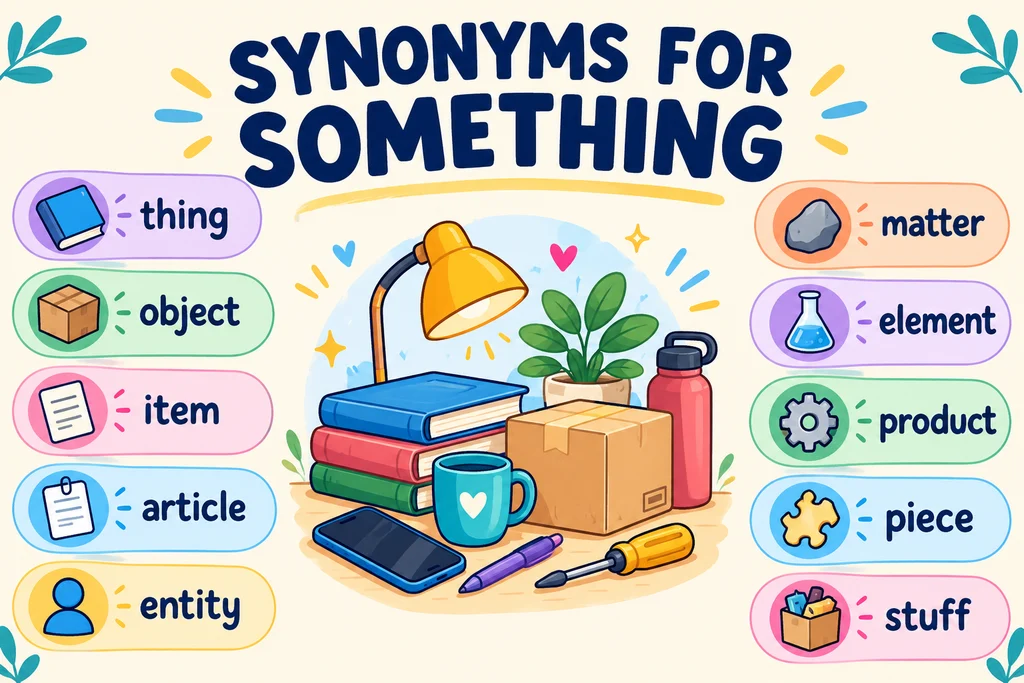
Do you find yourself using the word “something” too often when writing or speaking? Finding the right synonyms for something can make your sentences clearer, more specific, and less repetitive.
Depending on the context, alternatives include anything, an item, a thing, an object, or a detail—but these words do not always mean exactly the same thing. For example, “I need something to write with” could become “I need a pen,” while “Something is bothering me” might be clearer as “A concern is bothering me.” The best replacement depends on what you mean and how much detail you want to express.
Whether you’re writing an essay, creating content, or improving everyday English, this guide will help you explore useful alternatives, understand their differences, and choose the right word for each sentence.

Everyday Synonyms for Something
These are your safest, most natural swaps — words you can drop into everyday speech and writing without anyone raising an eyebrow. They cover the basic meaning of “a thing, unnamed.”
Thing
Meaning:
Thing means the most direct synonym — a general word for any object, idea, or matter.
Examples:
- “What’s that thing on the table?”
- I can’t find the thing I need for camping.
Object
Meaning:
Object means a physical item you can see or touch.
Examples:
- “The object in the photo looks like an old key.”
- An unidentified object was spotted in the sky.
Item
Meaning:
Item means a single thing, often part of a list or collection.
Examples:
- “Check this item off the grocery list.”
- This item is on sale this week only.
Entity
Meaning:
Entity means anything that exists as a separate, distinct unit.
Examples:
- “The company is a legal entity of its own.”
- The two charities merged into one legal entity.
Stuff
Meaning:
Stuff means informal word for things in general, great for casual conversation.
Examples:
- “I left all my stuff at your place.”
- We packed all our stuff for the move.
Matter
Meaning:
Matter means a subject or situation that needs attention.
Examples:
- “Let’s discuss this matter after lunch.”
- It’s a private matter, so please respect that.
Detail
Meaning:
Detail means a small, specific part of the whole.
Examples:
- “One detail in the report didn’t add up.”
- The fussy architect obsessed over every tiny detail.
Particular
Meaning:
Particular means a single fact or point, especially when being specific.
Examples:
- “He refused to share any particulars of the deal.”
- In particular, the slow ending really disappointed me.
Incident
Meaning:
Incident means a specific event, often unexpected or unusual.
Examples:
- “The incident at the station delayed every train.”
- The incident was reported to the local police.
Occurrence
Meaning:
Occurrence means a formal way to say something that took place.
Examples:
- “Rain in June is a rare occurrence here.”
- Such strange errors are a very rare occurrence.
Event
Meaning:
Event means a planned or notable happening.
Examples:
- “The charity event raised thousands.”
- The big outdoor event starts at seven sharp.
Affair
Meaning:
Affair means an event or matter, often one with some complexity.
Examples:
- “The whole wedding was a grand affair.”
- The anniversary dinner was a truly elegant affair.
Phenomenon
Meaning:
Phenomenon means a remarkable or noteworthy happening.
Examples:
- “The northern lights are a natural phenomenon.”
- Social media is a powerful modern cultural phenomenon.
Business
Meaning:
Business means an affair or matter, sometimes with a hint of oddness.
Examples:
- “This whole broken-pipe business has cost me a fortune.”
- Please just mind your own business, young man.
Synonyms for Something That Means an Idea or Thought
In essays and discussions, “something” often stands in for an idea. These words say that directly.
Concept
Meaning:
Concept means an abstract idea or general notion.
Examples:
- “The concept of free will divides philosophers.”
- The original concept took many years to develop.
Notion
Meaning:
Notion means a belief or idea about something.
Examples:
- “She had a strange notion that money buys happiness.”
- He rejected the notion of working on weekends.
Idea
Meaning:
Idea means a thought or suggestion formed in the mind.
Examples:
- “That’s a brilliant idea for the project.”
- Whose idea was this brilliant new marketing plan?
Subject
Meaning:
Subject means the topic or theme being discussed.
Examples:
- “Change the subject — this is getting awkward.”
- Math was never my favorite school subject either.
Topic
Meaning:
Topic means the specific matter under discussion.
Examples:
- “Today’s topic is renewable energy.”
- Let’s move on to the next topic now.
Theme
Meaning:
Theme means the central idea running through a story or work.
Examples:
- “The theme of the novel is forgiveness.”
- The birthday party had a fun tropical theme.
Point
Meaning:
Point means a single idea or argument.
Examples:
- “You’ve made a fair point.”
- The old needle has a dangerously sharp point.
Question
Meaning:
Question means a matter open for debate or discussion.
Examples:
- “The question of funding remains unresolved.”
- May I please ask just one quick question?
Issue
Meaning:
Issue means an important topic or problem under debate.
Examples:
- “Climate change is the defining issue of our time.”
- The magazine’s latest issue sold out very fast.
Concern
Meaning:
Concern means a matter that causes worry or attention.
Examples:
- “Safety is our biggest concern.”
- Her failing health is a growing family concern.
Parts, Pieces, and Components
Use these when “something” refers to a part of a larger whole.
Piece
Meaning:
Piece means a part separated from a whole.
Examples:
- “Hand me that piece of wood.”
- Would you like a piece of chocolate cake?
Bit
Meaning:
Bit means a small piece or amount.
Examples:
- “Add a bit of salt to the soup.”
- Every single bit of help counts here today.
Fragment
Meaning:
Fragment means a broken-off piece, often of something once whole.
Examples:
- “Archaeologists found fragments of ancient pottery.”
- Only a tiny fragment of the letter survived.
Portion
Meaning:
Portion means a share or part of a whole.
Examples:
- “She donated a portion of her earnings.”
- A large portion of the budget went to salaries.
Section
Meaning:
Section means a distinct part of a larger thing.
Examples:
- “Read the sports section of the newspaper.”
- The brass section played the grand finale beautifully.
Component
Meaning:
Component means a part that makes up a larger system or machine.
Examples:
- “The faulty component caused the crash.”
- Each tiny component was tested separately before assembly.
Element
Meaning:
Element means a basic part or aspect of a whole.
Examples:
- “Surprise is a key element of any good story.”
- The new design element improved the whole project.
Aspect
Meaning:
Aspect means one side or feature of a subject.
Examples:
- “We need to consider every aspect of the plan.”
- One difficult aspect of the job is travel.
Feature
Meaning:
Feature means a distinctive part or quality.
Examples:
- “The hotel’s best feature is its rooftop pool.”
- The car’s best feature is its great mileage.
Factor
Meaning:
Factor means one of the things that influence an outcome.
Examples:
- “Cost was a major factor in our decision.”
- Luck was a major factor in their success.
Essence
Meaning:
Essence means the most important quality that makes something what it is.
Examples:
- “Kindness is the essence of her character.”
- The essence of the argument is quite simple.
Synonyms for Specific: Exact, Precise, or Particular?
Tools, Gadgets, and Contraptions
When the “something” is a physical object with a purpose, these words add color.
Device
Meaning:
Device means a tool or machine made for a purpose.
Examples:
- “This device tracks your heart rate.”
- The old device needs charging every single night.
Gadget
Meaning:
Gadget means a small, clever mechanical or electronic tool.
Examples:
- “He loves kitchen gadgets he never uses.”
- This handy little gadget opens stubborn jars easily.
Tool
Meaning:
Tool means an instrument used to do a job.
Examples:
- “A good dictionary is a writer’s best tool.”
- The new software tool saves hours of work.
Instrument
Meaning:
Instrument means a precise tool, often for science, music, or medicine.
Examples:
- “The surgeon picked up a sharp instrument.”
- He skillfully plays three very different musical instruments.
Apparatus
Meaning:
Apparatus means a complex set of equipment for a purpose.
Examples:
- “The lab’s new testing apparatus arrived yesterday.”
- The gym installed expensive new exercise apparatus upstairs.
Contraption
Meaning:
Contraption means a strange or complicated device.
Examples:
- “He built a wild contraption to water his plants.”
- What is that strange contraption in the garage?
Commodity
Meaning:
Commodity means something bought and sold, a product of trade.
Examples:
- “Coffee is one of the world’s most traded commodities.”
- Crude oil remains a highly valuable global commodity.
Product
Meaning:
Product means something made or produced for sale.
Examples:
- “This product comes with a two-year warranty.”
- The exciting new product launches early next month.
Merchandise
Meaning:
Merchandise means goods for sale, especially branded items.
Examples:
- “The band sells merchandise after every concert.”
- The gift store displays its merchandise very attractively.
Article
Meaning:
Article means a particular object or item, often in formal or legal contexts.
Examples:
- “This article of clothing is handmade.”
- She wrote an interesting article about local honeybees.
Situations and Circumstances
Sometimes “something” hides a whole situation.
Situation
Meaning:
Situation means a set of circumstances at a given time.
Examples:
- “We need to handle this situation carefully.”
- The tense situation improved greatly after the talks.
Circumstance
Meaning:
Circumstance means the conditions surrounding an event.
Examples:
- “Under the circumstances, we did our best.”
- In no circumstance should you open that door.
Playful and Colloquial Swaps
For casual speech — use these when you can’t remember the name of the thing.
Thingamajig
Meaning:
Thingamajig means a humorous word for an object whose name you forgot.
Examples:
- “Pass me that thingamajig next to the sink.”
- Hand me the thingamajig for opening paint cans.
Whatchamacallit
Meaning:
Whatchamacallit means a silly stand-in for a forgotten name.
Examples:
- “He fixed the whatchamacallit under the hood.”
- The little whatchamacallit on the printer keeps jamming.
Doodad
Meaning:
Doodad means a lighthearted word for a small gadget or object.
Examples:
- “The desk drawer is full of useless doodads.”
- He collects tiny doodads from every foreign trip.
When to Use Which
The right synonym depends on your context. Here is a quick map:
- Formal writing and essays: entity, occurrence, circumstance, component, element, phenomenon, notion, matter. These sound precise and academic.
- Casual chat and texts: thing, stuff, doodad, thingamajig, gadget. Nobody will blink at these.
- Business and reports: item, article, product, merchandise, concern, issue, factor. They keep things professional.
- Storytelling and descriptions: incident, affair, phenomenon, essence, contraption. These add flavor and personality.
- When you forgot the name: thingamajig, whatchamacallit, doodad — honest, funny, and human. Just keep them out of formal writing.
Ask yourself what kind of “something” you mean — an object, an idea, an event, or a situation — and pick from that group. Precision is the whole point of a rich vocabulary.

56+Synonyms for Stated: Say It With Greater Precision
Frequently Asked Questions
What is the best synonym for “something” in formal writing?
It depends on the context, but entity, matter, occurrence, and circumstance are the safest formal choices. For example, write “the matter requires attention” instead of “something needs attention.” If you mean an event, incident works beautifully in academic and professional writing.
What can I say instead of “something” in an essay?
Try concept, notion, phenomenon, or aspect, depending on whether you mean an idea, a happening, or a part of your argument. Essays reward precision, so pick the word that names the exact kind of “something” you have in mind.
Is “stuff” a good synonym for “something”?
In casual conversation, absolutely — “bring your stuff” sounds natural and friendly. But avoid it in essays, reports, and formal emails, where it reads as lazy.
What is the difference between “thing” and “object”?
A thing can be abstract — a thought, a feeling, a situation — while an object is almost always physical, something you could touch. “A thing of beauty” sounds poetic; “an object of beauty” sounds like a museum label.
Can “something” ever be the right word?
Yes — sometimes vagueness is the point. “There’s something about her smile” is more evocative than “there’s an aspect of her smile.” When mystery, suspense, or emotional ambiguity is your goal, keep “something.” The trick is choosing it on purpose, not by default.
How do I stop repeating “something” in my writing?
During editing, search your draft for “something” and replace each one with a more precise word from this list. Ask yourself: do I mean an object, an idea, an event, or a situation? After a few weeks of this habit, your vocabulary will sharpen automatically — and your writing will feel noticeably stronger.
Conclusion
“Something” is a comfortable word, and that is exactly why it is dangerous. It lets you skip the hard work of saying what you actually mean. The good news: English hands you fifty sharper tools — from entity and phenomenon to contraption and doodad.
Start small: pick three favorites from this list and use them this week. Notice how your sentences gain weight and color. Vocabulary grows the same way muscles do — one deliberate repetition at a time.
Author

Daniel Brooks is a language enthusiast and contributing writer at SynonymCore. He writes about word meanings, usage, and the subtle differences between similar words.
Pingback: Synonyms for Soft: Better Words for Texture, Sound, and Touch