
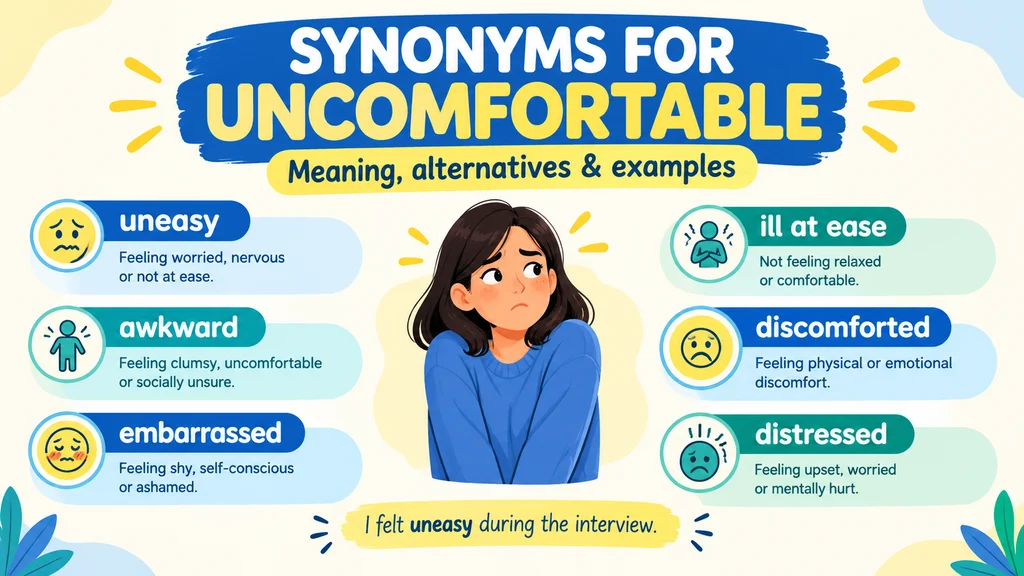
Ever struggled to describe an awkward moment, a nervous feeling, or physical discomfort without repeating the word “uncomfortable”? The right alternative can make your meaning clearer. The best synonyms for uncomfortable include uneasy, awkward, tense, ill at ease, unpleasant, and distressed—but each fits a different situation.
You might feel uneasy about an uncertain decision, awkward during an embarrassing conversation, or tense before an important interview. For physical discomfort, words such as sore or painful may be more precise, depending on what you mean. Choosing the right synonym helps you express your feelings accurately and make your writing more natural.
Explore these alternatives, their simple meanings, and practical examples to discover which word works best in everyday conversations, essays, and professional writing.

Awkward
Meaning:
Awkward means feeling clumsy or embarrassed in a social situation.
Examples:
- There was an awkward silence after he mentioned her ex-boyfriend at dinner.
- The awkward hug lasted a second too long.
Uneasy
Meaning:
Uneasy means a quiet, nagging feeling that something isn’t quite right.
Examples:
- She felt uneasy walking home through the dark, empty streets.
- She felt slightly uneasy about lending him money.
Self-conscious
Meaning:
Self-conscious means painfully aware of how other people see you.
Examples:
- Wearing the wrong outfit to the party made him self-conscious all evening.
- The new haircut made her self-conscious all day.
Embarrassed
Meaning:
Embarrassed means ashamed or shy after a small mistake.
Examples:
- Her phone rang loudly in the middle of the exam, leaving her embarrassed and bright red.
- He felt embarrassed tripping on the stage stairs.
Discomfited
Meaning:
Discomfited means made uneasy or unsettled — a strong formal choice.
Examples:
- The reporter’s blunt question clearly discomfited the mayor.
- The strange blunt question discomfited the quiet guest.
Disconcerted
Meaning:
Disconcerted means thrown off balance by something unexpected.
Examples:
- He was disconcerted by the sudden change in the interviewer’s tone.
- She was disconcerted by the dog’s sudden barking.
Flustered
Meaning:
Flustered means nervous and confused, losing your cool under pressure.
Examples:
- Flustered by the crowd, she forgot the words to her own speech.
- He grew flustered when the baby started crying.
Rattled
Meaning:
Rattled means shaken up by a scare or a shock.
Examples:
- The near-miss on the highway left her rattled for the rest of the drive.
- The loud crash left the cat rattled for hours.
Unsettled
Meaning:
Unsettled means lacking calm because something feels off.
Examples:
- The strange noises in the old house left him feeling unsettled.
- The odd vivid dream left her feeling unsettled.
Disquieted
Meaning:
Disquieted means disturbed at a deep, thoughtful level.
Examples:
- The troubling news disquieted her so much she couldn’t focus on her work.
- The letter’s cold tone disquieted him for days.
Agitated
Meaning:
Agitated means visibly restless and worked up.
Examples:
- The long delay made the waiting passengers agitated and loud.
- The loud barking dogs made the baby agitated.
Anxious
Meaning:
Anxious means worried about what might happen next.
Examples:
- He felt anxious the night before his first job interview.
- She felt deeply anxious before the driving test.
Tense
Meaning:
Tense means stiff with worry or pressure.
Examples:
- The tense atmosphere in the meeting room made everyone shift in their seats.
- His tense shoulders finally relaxed in the bath.
On edge
Meaning:
On edge means nervous and ready to snap at any moment.
Examples:
- After three sleepless nights, she was completely on edge.
- The strange sounds kept the campers on edge.
Jittery
Meaning:
Jittery means shaky with nervous energy.
Examples:
- Too much coffee left him jittery before the presentation.
- She felt jittery before her first solo flight.
Fidgety
Meaning:
Fidgety means unable to sit still.
Examples:
- The fidgety child kept kicking the seat in front of him.
- The fidgety young puppy chewed its leash constantly.
Restless
Meaning:
Restless means unable to relax or stay in one place.
Examples:
- Restless after the long flight, she paced around the hotel room.
- The restless little toddler refused to sit still.
Strained
Meaning:
Strained means tight and forced, like a smile nobody believes.
Examples:
- Their strained conversation made the whole dinner feel wrong.
- A strained polite smile hid her true feelings.
Troubled
Meaning:
Troubled means weighed down by worry.
Examples:
- He looked troubled as he read the medical report.
- He looked deeply troubled by the rising bills.
Bothered
Meaning:
Bothered means mildly annoyed or disturbed.
Examples:
- She was bothered by the flickering light in the office.
- The loud buzzing fly bothered the sleeping dog.
Perturbed
Meaning:
Perturbed means upset by something unexpected — a polished formal word.
Examples:
- The investors were perturbed by the sudden drop in profits.
- She was clearly perturbed by the rude email.
Sheepish
Meaning:
Sheepish means embarrassed and a little bit guilty.
Examples:
- He gave a sheepish grin when caught eating the last slice of cake.
- He gave a sheepish laugh after the wrong answer.
57+Synonyms for Unfair: From Biased to Unjust
Abashed
Meaning:
Abashed means ashamed and taken aback.
Examples:
- Abashed by the unexpected praise, she stared down at her shoes.
- Abashed, the boy apologized to the angry neighbor.
Chagrined
Meaning:
Chagrined means annoyed with yourself after a failure.
Examples:
- He was chagrined to realize he’d sent the email to the wrong person.
- She was chagrined to miss the morning bus.
Mortified
Meaning:
Mortified means extremely embarrassed — wishing the ground would swallow you.
Examples:
- She was mortified when her boss read her text message aloud.
- He was mortified by his forgotten lines onstage.
Ill at ease
Meaning:
Ill at ease means not relaxed in a situation.
Examples:
- The new student felt ill at ease among strangers on the first day.
- She felt ill at ease in the noisy bar.
Out of place
Meaning:
Out of place means feeling like you don’t belong.
Examples:
- In his torn jeans, he felt out of place at the formal wedding.
- The old sofa looked out of place in the lobby.
Squeamish
Meaning:
Squeamish means easily made uneasy by unpleasant sights or topics.
Examples:
- She’s too squeamish to watch horror movies.
- He’s far too squeamish to clean the fish.
Sore
Meaning:
Sore means aching from injury or overuse.
Examples:
- His legs were sore after the ten-mile hike.
- Her sore tired feet welcomed the warm bath.
Achy
Meaning:
Achy means a dull, lingering pain all over.
Examples:
- She woke up feeling achy with the flu.
- His achy old back needed a good stretch.
Stiff
Meaning:
Stiff means hard to move, tight in the joints.
Examples:
- He felt stiff after sitting at his desk for eight hours.
- The stiff collar irritated his neck all day.
Cramped
Meaning:
Cramped means squeezed into too little space.
Examples:
- We were cramped in the back seat for the whole six-hour trip.
- They felt badly cramped in the tiny elevator.
Itchy
Meaning:
Itchy means skin that begs to be scratched.
Examples:
- The wool blanket made his arms itchy and red.
- The nasty mosquito bites left her arms itchy.
Scratchy
Meaning:
Scratchy means rough and irritating against the skin.
Examples:
- She hated the scratchy tag inside her new shirt.
- The scratchy old towel dried his face roughly.
Prickly
Meaning:
Prickly means sharp little stings, like pins on the skin.
Examples:
- His face felt prickly after shaving too quickly.
- The tall prickly cactus guarded the dry garden.
Tender
Meaning:
Tender means sore when touched.
Examples:
- Her ankle was still tender a week after the sprain.
- His tender ribs ached every time he coughed.
Throbbing
Meaning:
Throbbing means pulsing pain in a steady beat.
Examples:
- His headache was throbbing behind his eyes.
- Her throbbing finger swelled after the bee sting.
Painful
Meaning:
Painful means causing real, noticeable hurt.
Examples:
- The sunburn on his shoulders was too painful to sleep on.
- Walking on the blister was far too painful.
Numb
Meaning:
Numb means no feeling at all, often from cold or pressure.
Examples:
- Her feet went numb during the long, freezing wait outside.
- His hands went numb in the icy wind.
Tight
Meaning:
Tight means squeezing uncomfortably.
Examples:
- His new shoes were so tight they hurt his toes.
- The tight stiff seatbelt pressed against her shoulder.
Queasy
Meaning:
Queasy means slightly sick to the stomach.
Examples:
- The rocking boat made him queasy within minutes.
- The long bumpy flight left her feeling queasy.
Clammy
Meaning:
Clammy means cold and damp to the touch.
Examples:
- His hands turned clammy before the big exam.
- Damp clammy sheets stuck to his feverish skin.
Stuffy
Meaning:
Stuffy means airless and hard to breathe in.
Examples:
- The small, windowless office felt stuffy by noon.
- The stuffy crowded bus smelled of old leather.
Overheated
Meaning:
Overheated means too hot for comfort.
Examples:
- The overheated classroom made the students drowsy.
- The overheated school gym emptied out by halftime.
Chilly
Meaning:
Chilly means unpleasantly cold.
Examples:
- The chilly waiting room made everyone shiver.
- A chilly night draft slipped under the door.
Excruciating
Meaning:
Excruciating means pain so bad it’s almost unbearable.
Examples:
- The toothache was excruciating all night.
- The bad burn on his hand was excruciating.
Unbearable
Meaning:
Unbearable means simply too much to stand.
Examples:
- The heat inside the parked car became unbearable after an hour.
- The loud noise from the construction was unbearable.
Wretched
Meaning:
Wretched means deeply miserable in body and mind.
Examples:
- He felt wretched with a fever and a pounding head.
- She felt utterly wretched after the all-night coughing.
Miserable
Meaning:
Miserable means thoroughly unhappy and ill at ease.
Examples:
- She spent a miserable night on the lumpy hotel mattress.
- The cold rainy camping trip turned utterly miserable.
Restive
Meaning:
Restive means impatient and hard to control, like a caged animal.
Examples:
- The restive crowd grew louder as the concert delay dragged on.
- The restive young horses stamped in their stalls.
When to Use Which Synonyms for Uncomfortable
With so many uncomfortable synonyms to choose from, the right pick depends on the moment. In formal writing — essays, reports, business emails — reach for discomfited, disconcerted, perturbed, or disquieted; they sound polished without sounding stiff. In casual chat, keep it natural with awkward, uneasy, jittery, on edge, or queasy. For essays and academic work, unsettled, troubled, and agitated carry the right weight. And in emotional moments — first dates, apologies, tough conversations — self-conscious, embarrassed, mortified, ill at ease, or out of place say exactly what you feel. When in doubt, match the word’s strength to the feeling’s strength: mild unease gets bothered, real distress gets unbearable.
45+Synonyms for Unity: From Oneness to Solidarity

Frequently Asked Questions
What is another word for uncomfortable in formal writing?
The best formal options are discomfited, disconcerted, perturbed, and disquieted. They describe unease or embarrassment with a polished tone that suits essays, reports, and professional emails.
What is the difference between uncomfortable and awkward?
Uncomfortable is the broader word — it covers physical pain, stuffy rooms, and emotional unease. Awkward is narrower: it almost always describes social clumsiness or embarrassment, like an awkward silence or an awkward hug.
What is a stronger word for uncomfortable?
For physical pain, use excruciating or unbearable. For emotional distress, mortified and wretched raise the intensity. Pick the strong word only when the feeling truly deserves it, or it will sound exaggerated.
What is the opposite of uncomfortable?
Common opposites include comfortable, at ease, relaxed, and cozy. For social situations, confident works too — it captures the opposite of that uneasy, self-conscious feeling.
Can uncomfortable describe feelings, not just physical things?
Absolutely. People say “I feel uncomfortable” about emotions all the time — before a confrontation, during an awkward conversation, or in an unfamiliar place. Words like uneasy, unsettled, and ill at ease are built exactly for that emotional side.
What is a polite way to say uncomfortable?
Ill at ease and not quite at ease are the gentlest options. Uneasy and a little unsettled also soften the message. These are perfect when you want to be honest without sounding harsh.
Conclusion
Vocabulary is a muscle — every new word you actually use makes your writing stronger. The next time “uncomfortable” pops into your head, pause and pick one of these synonyms for uncomfortable instead. Keep this list of words similar to uncomfortable bookmarked, and your readers will feel the difference, whether you’re describing a bad chair or a bad date.
Author

Daniel Brooks is a language enthusiast and contributing writer at SynonymCore. He writes about word meanings, usage, and the subtle differences between similar words.
Pingback: Synonyms for True: 50+ Alternatives With Examples