
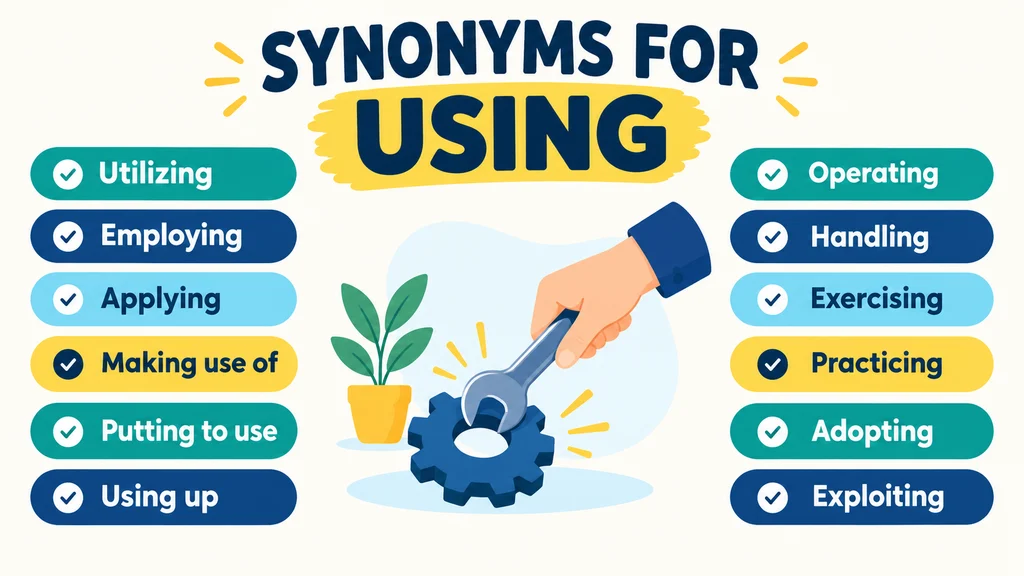
Repeating the word using can make your writing feel repetitive, but choosing a replacement without checking its meaning can create a different problem.
Common synonyms and alternatives for using include employing, applying, utilizing, operating, making use of, and exploiting, but the right choice depends on what you mean and how the word functions in your sentence. For example, you can apply knowledge, operate a machine, or make use of available resources. By contrast, exploit often suggests taking unfair advantage of a person or situation.
Whether you’re writing an essay, preparing a business report, explaining a process, or improving your everyday vocabulary, the right alternative can make your sentences more precise and natural. Some words describe putting tools or methods to work, others refer to consuming a substance, and some suggest manipulation or unfair treatment. These expressions are related, but they are not interchangeable in every context.
In this guide, you’ll discover synonyms and related alternatives for using, with simple definitions, practical examples, and guidance on choosing words that fit your intended meaning.

50 Synonyms for Using: The Complete List
Employing
Meaning:
Employing means to put something into service or action.
Examples:
- “The bakery is employing a new mixing method.”
- The modern hospital is employing robots for medicine deliveries.
Utilizing
Meaning:
Utilizing means to make practical use of something available.
Examples:
- “She is utilizing every spare minute to finish her novel.”
- She is wisely utilizing coupons to save grocery money.
Applying
Meaning:
Applying means to put a method or idea into effect.
Examples:
- “The nurse applied pressure to stop the bleeding.”
- The creative chef applied a brand-new seasoning blend.
Operating
Meaning:
Operating means to run or control a machine or system.
Examples:
- “He operates a forklift at the warehouse.”
- He faithfully operates the lighthouse beacon each foggy night.
Running
Meaning:
Running means to keep a machine or business working.
Examples:
- “She runs three coffee shops across town.”
- She runs a very tight ship at home.
Handling
Meaning:
Handling means to manage or deal with something skillfully.
Examples:
- “He handles customer complaints with real patience.”
- She handles the aggressive press with great calm skill.
Working
Meaning:
Working means to put skill and effort into something hands-on.
Examples:
- “She worked the dough until it was smooth.”
- He worked the lonely night shift for many years.
Managing
Meaning:
Managing means to use your skill to control or direct something.
Examples:
- “She manages the family budget down to the last coin.”
- He manages the huge warehouse inventory very efficiently.
Putting to use
Meaning:
Putting to use means to start using something for a purpose.
Examples:
- “They put the old barn to use as a workshop.”
- She put her art degree to use in advertising.
Making use of
Meaning:
Making use of means to use something in a helpful, practical way.
Examples:
- “We made good use of the rainy weekend by organizing the attic.”
- They made use of the free trial month.
Leveraging
Meaning:
Leveraging means to use something strategically for maximum advantage.
Examples:
- “The startup leveraged social media to reach its first million users.”
- The smart team leveraged data to win more games.
Harnessing
Meaning:
Harnessing means to control and use a force or resource.
Examples:
- “The town is harnessing wind power for its electricity.”
- The huge dam is harnessing the river’s mighty power.
Deploying
Meaning:
Deploying means to put resources or tools into active service.
Examples:
- “The team deployed new software across all offices.”
- The army deployed fresh troops along the tense border.
Exercising
Meaning:
Exercising means to make use of a right, skill, or power.
Examples:
- “She exercised her right to remain silent.”
- The dog exercised its legs in the park.
Implementing
Meaning:
Implementing means to put a plan or tool into practical effect.
Examples:
- “The school implemented tablets in every classroom.”
- The progressive city implemented a new recycling program.
Engaging
Meaning:
Engaging means to put something into action or involve it.
Examples:
- “He engaged the brakes just in time.”
- She engaged the bored audience with funny personal stories.
Enlisting
Meaning:
Enlisting means to get the help or use of someone.
Examples:
- “They enlisted a local architect for the renovation.”
- The busy coach enlisted parent volunteers for the fundraiser.
Adopting
Meaning:
Adopting means to take up and use a method or habit.
Examples:
- “Our office adopted a four-day workweek.”
- They happily adopted a rescue dog last spring.
Availing oneself of
Meaning:
Availing oneself of means to take advantage of an opportunity (formal).
Examples:
- “Guests may avail themselves of the free shuttle.”
- All travelers may avail themselves of free Wi-Fi.
Resorting to
Meaning:
Resorting to means to turn to something when nothing else works.
Examples:
- “After the blackout, we resorted to candles.”
- The lost hungry hikers resorted to eating wild berries.
Drawing upon
Meaning:
Drawing upon means to use knowledge or experience from the past.
Examples:
- “She drew upon her years of travel to write the book.”
- The veteran coach drew upon decades of rich experience.
Turning to
Meaning:
Turning to means to start using something for help or support.
Examples:
- “He turned to meditation during the stressful months.”
- She turned to watercolor painting after early retirement.
Calling upon
Meaning:
Calling upon means to ask for and use someone’s help.
Examples:
- “She called upon her friends to help her move.”
- The mayor publicly called upon citizens to volunteer.
Relying on
Meaning:
Relying on means to depend on something for regular support.
Examples:
- “He relies on his morning coffee to wake up.”
- The small farm relies heavily on rain for crops.
Wielding
Meaning:
Wielding means to hold and use a tool skillfully.
Examples:
- “The chef wielded her knife with practiced ease.”
- The brave knight wielded a heavy ancient iron sword.
Manipulating
Meaning:
Manipulating means to handle or control something with skill.
Examples:
- “The artist manipulated clay into lifelike shapes.”
- The skilled mechanic manipulated the tiny delicate engine parts.
Maneuvering
Meaning:
Maneuvering means to skillfully move or guide something.
Examples:
- “She maneuvered the boat through the narrow channel.”
- She carefully maneuvered the stroller through the dense crowd.
Piloting
Meaning:
Piloting means to operate an aircraft or vehicle as its guide.
Examples:
- “He piloted the drone over the construction site.”
- She piloted the small plane through the storm.
Steering
Meaning:
Steering means to guide the movement or direction of something.
Examples:
- “She steered the conversation toward safer topics.”
- He steered the old boat toward the dock.
Plying
Meaning:
Plying means to work steadily with a tool or trade.
Examples:
- “The tailor plied his needle late into the night.”
- The tired fishermen plied their heavy nets at dawn.
Driving
Meaning:
Driving means to operate and travel in a vehicle.
Examples:
- “She drives her grandfather’s old truck to work.”
- He drives a taxi through the busy city.
Firing up
Meaning:
Firing up means to start using a machine or engine.
Examples:
- “He fired up the grill for the barbecue.”
- She fired up her laptop for the meeting.
Consuming
Meaning:
Consuming means to use up a resource completely.
Examples:
- “The old truck consumes a tank of gas a week.”
- The project is consuming most of our budget.
Spending
Meaning:
Spending means to use up money, time, or energy.
Examples:
- “She spent the whole afternoon in the garden.”
- He foolishly spent his savings on a speedboat.
Using up
Meaning:
Using up means to finish a supply of something entirely.
Examples:
- “We used up all the flour making cookies.”
- The office printer used up all the black ink.
Going through
Meaning:
Going through means to use a lot of something in a short time.
Examples:
- “New parents go through diapers fast.”
- The busy office is going through paper very quickly.
Burning through
Meaning:
Burning through means to use something up quickly or wastefully.
Examples:
- “He burned through his savings in a single year.”
- The young startup burned through cash far too fast.
Eating up
Meaning:
Eating up means to consume time, money, or resources.
Examples:
- “Traffic ate up two hours of our day.”
- The rent is eating up half her salary.
Draining
Meaning:
Draining means to use up a supply until little is left.
Examples:
- “The project drained the team’s energy.”
- The long painful illness drained the family’s savings.
Depleting
Meaning:
Depleting means to seriously reduce a stock or supply.
Examples:
- “Overfishing is depleting the ocean’s tuna stocks.”
- The drought is depleting the town’s water supply.
68+Synonyms for Valuable: From Useful to Priceless
Exhausting
Meaning:
Exhausting means to use something until nothing remains.
Examples:
- “They exhausted every option before giving up.”
- The brutal summer marathon exhausted all the runners completely.
Wearing out
Meaning:
Wearing out means to use something until it breaks or fades.
Examples:
- “He wore out his favorite shoes in one summer.”
- The kids wore out the new carpet quickly.
Exploiting
Meaning:
Exploiting means to use something or someone unfairly for gain.
Examples:
- “The company was accused of exploiting cheap labor.”
- The hackers exploited a flaw in the software.
Taking advantage of
Meaning:
Taking advantage of means to use a situation or person for your benefit.
Examples:
- “We took advantage of the sale to stock up.”
- They happily took advantage of the sunny warm weather.
Capitalizing on
Meaning:
Capitalizing on means to use a situation to gain an advantage.
Examples:
- “The brand capitalized on the viral trend.”
- The clever store capitalized on the holiday shopping rush.
Profiting from
Meaning:
Profiting from means to gain benefit by using something.
Examples:
- “She profited from years of careful investing.”
- He quietly profited from selling rare old comic books.
Benefiting from
Meaning:
Benefiting from means to gain something good by using a resource.
Examples:
- “He benefited from his mentor’s advice.”
- The thirsty garden benefited from the spring rain.
Cashing in on
Meaning:
Cashing in on means to turn something into profit or benefit.
Examples:
- “The author cashed in on her sudden fame.”
- The studio cashed in on the sequel’s success.
Milking
Meaning:
Milking means to squeeze every last benefit from something (informal).
Examples:
- “He milked the minor injury for weeks of sympathy.”
- The comedian milked the joke for extra laughs.
Preying on
Meaning:
Preying on means to use someone’s weakness for your own gain.
Examples:
- “Scammers prey on lonely elderly people.”
- The sharks preyed on the school of fish.
57+Synonyms for Value: From Worth to Significance
When to Use Which Synonym for Using
For formal writing and essays, reach for employing, utilizing, deploying, harnessing, and exercising — they sound polished and precise. In business settings, leveraging, capitalizing on, and implementing feel natural and professional.
For everyday conversation, applying, running, handling, and managing keep things simple and warm. When you’re talking about tools or vehicles, wielding, operating, driving, and piloting paint a clear picture.
If you’re describing resources disappearing, burning through, eating up, draining, and exhausting add color. Words similar to using like exploiting, milking, and preying on carry a negative edge, so save them for the right context. A handy rule: match the word’s formality to your setting, and your writing will always feel intentional.

Frequently Asked Questions About Synonyms for Using
What is the best synonym for using in formal writing?
The strongest formal options are employing, utilizing, deploying, harnessing, and exercising. “Employing” is the safest all-round choice, “utilizing” fits technical contexts, and “exercising” works for rights or powers. Pick the one whose meaning matches your sentence most closely.
What is a casual way to say using?
In everyday conversation, try going through, eating up, putting to use, or making use of. Instead of “We are using a lot of sugar,” say “We’re going through a lot of sugar” — it sounds warmer and more natural.
What is the difference between “using” and “utilizing”?
The difference is mostly one of formality. “Utilizing” sounds slightly more technical and formal, while “using” is clearer and preferred in most everyday writing. Many style guides recommend sticking with “using” unless you’re writing in a technical or academic context where “utilizing” is the expected term.
Is “leveraging” just a fancy word for using?
Pretty much — “leveraging” means using something strategically to gain an advantage, and it comes from business jargon. It works well in professional writing but can sound stiff in casual conversation. Use it when strategy or advantage is the real point; otherwise, “employing” or “using” is cleaner.
What is the opposite of using?
The main opposites include neglecting, ignoring, wasting, abandoning, and misusing. “Neglecting” and “ignoring” mean not using something at all, while “misusing” means using it wrongly. For resources specifically, “saving” and “conserving” are natural opposites of consuming.
How do I stop repeating “use” in my writing?
Pick two or three synonyms that fit your most common situations and practice them for a week — for example, “employing” for everyday writing and “leveraging” for work emails. Read your draft aloud and swap “use” wherever a more precise word fits. Over time, variety becomes automatic.
Conclusion
Growing your vocabulary is a quiet superpower. Every time you trade “use” for a sharper word — deploying, harnessing, milking — you tell your reader exactly what you mean, and your writing feels more alive. Don’t try to memorize all fifty at once; pick three or four favorites and put them to work this week in emails, essays, or conversation. That is how words move from a list into your everyday language. Keep collecting strong words, and explore more of our synonym guides to keep your vocabulary growing.
Author

Sophia Lane is an English learning contributor at SynonymCore. She creates easy-to-understand guides on synonyms, antonyms, and everyday vocabulary.
Pingback: 57+Synonyms for Unfair: From Biased to Unjust