
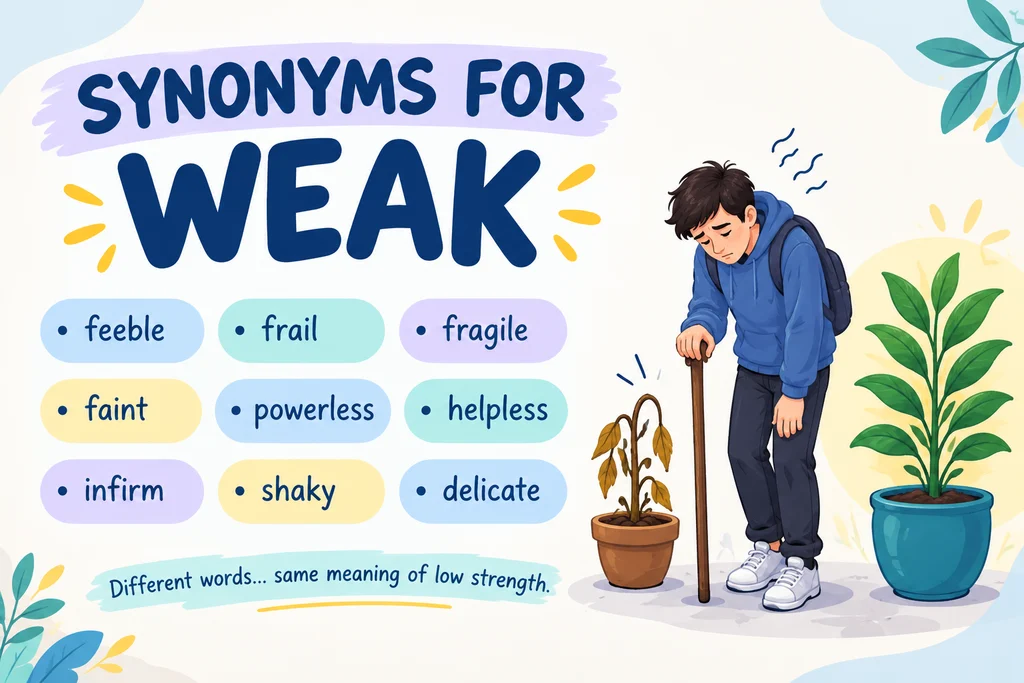
Choosing the right synonym for weak depends on what lacks strength, power, or effectiveness. Common synonyms for weak include feeble, frail, fragile, powerless, ineffective, and unconvincing, but each word describes a different kind of weakness.
Frail often describes someone physically delicate, fragile refers to something easily damaged, and ineffective describes something that fails to achieve its purpose. Meanwhile, unconvincing describes an argument that does not persuade others, while vulnerable means open to harm or attack.
Whether you are writing an essay, describing a person’s character, discussing poor performance, or improving your everyday vocabulary, choosing an accurate alternative can make your writing clearer and more expressive. In this guide, you’ll discover 50+ synonyms and related words for weak, with simple meanings and practical example sentences.
You’ll also learn which alternatives fit physical weakness, emotional struggles, weak arguments, poor results, and a lack of power, so you can select the right word without changing your intended meaning.

First, words for a weak body — the gentle, everyday options.
Frail
Meaning:
Frail means physically weak and delicate, often because of old age or illness.
Examples:
- After her surgery, my grandmother was too frail to climb the stairs alone.
- The frail bird could barely lift its wings.
Feeble
Meaning:
Feeble means lacking strength or force; it sounds even weaker than “weak” itself.
Examples:
- His feeble attempt at an apology only made the argument worse.
- His many feeble excuses convinced absolutely no one.
Delicate
Meaning:
Delicate means easily harmed or damaged; needs careful handling.
Examples:
- The newborn kitten was so delicate that we held it with both hands.
- The peace talks reached a delicate final stage.
Puny
Meaning:
Puny means small and weak in a way that invites a little pity.
Examples:
- The puny sapling bent sideways every time the wind picked up.
- The team put up a puny fight last night.
Faint
Meaning:
Faint means barely noticeable; a voice, signal, or hope with almost no strength left.
Examples:
- We heard only a faint knock coming from the back door.
- She felt quite faint after donating blood yesterday.
Limp
Meaning:
Limp means without stiffness or energy; hanging loose and lifeless.
Examples:
- She offered her hand, but the handshake was limp and distracted.
- The flag hung limp in the still air.
Lame
Meaning:
Lame means unable to walk properly; also used for a poor, unconvincing excuse.
Examples:
- The racehorse went lame after the second lap and was pulled out.
- He gave a lame excuse for missing work.
Ailing
Meaning:
Ailing means in poor health; slowly declining rather than suddenly sick.
Examples:
- The ailing factory finally shut its doors after sixty years.
- She visited her ailing uncle in the hospital.
Sickly
Meaning:
Sickly means often ill, or looking unhealthy and pale.
Examples:
- As a child he was sickly and spent most winters indoors.
- The sickly little plant needed more sunlight daily.
Enfeebled
Meaning:
Enfeebled means made weak over time, usually by age or long illness.
Examples:
- The enfeebled king could no longer hold court for more than an hour.
- The enfeebled regime collapsed within a few months.
Debilitated
Meaning:
Debilitated means seriously weakened, especially by disease or hardship.
Examples:
- Months of fever had left him too debilitated to return to work.
- The economy was debilitated by the long war.
Emaciated
Meaning:
Emaciated means abnormally thin from hunger or illness; skin stretched over bone.
Examples:
- The rescue team found the lost hiker emaciated but alive.
- The emaciated stray dog was taken to the shelter.
Wasted
Meaning:
Wasted means shriveled and weakened, like muscles that haven’t been used.
Examples:
- After months in bed, his legs looked wasted and thin.
- His completely wasted talent saddened his former coaches.
Weary
Meaning:
Weary means tired in body and spirit; strength worn down by effort.
Examples:
- She gave him a weary smile after the twelve-hour shift.
- The weary travelers rested at the quiet inn.
Exhausted
Meaning:
Exhausted means completely drained of energy; nothing left in the tank.
Examples:
- The marathon runners collapsed, exhausted, at the finish line.
- She felt exhausted after the long overnight flight.
Drained
Meaning:
Drained means emptied of energy or emotion, like a battery run flat.
Examples:
- One look at the bills left her feeling completely drained.
- All the color drained slowly from his face.
Decrepit
Meaning:
Decrepit means worn out and broken down by age; barely holding together.
Examples:
- The decrepit cottage leaned so badly the door wouldn’t close.
- The decrepit old bus broke down yet again.
Doddering
Meaning:
Doddering means moving unsteadily and slowly, usually from old age.
Examples:
- A doddering stranger shuffled across the road with his cane.
- The doddering old professor forgot his keys again.
Fragile
Meaning:
Fragile means easily broken or damaged; handle with care.
Examples:
- The delivery box was marked “fragile” in thick red letters.
- Their fragile new friendship needed careful, patient repair.
Flimsy
Meaning:
Flimsy means thin and unconvincing; an argument or object with no real substance.
Examples:
- Don’t trust that flimsy lock on the back gate.
- The flimsy tent collapsed in the strong wind.
Rickety
Meaning:
Rickety means badly built and likely to collapse; shaky with age.
Examples:
- We climbed the rickety ladder one careful step at a time.
- We crossed the old rickety bridge very slowly.
Unstable
Meaning:
Unstable means likely to fall, change, or collapse without warning.
Examples:
- The patient was still unstable, so the doctors kept him overnight.
- The unstable tower swayed dangerously in the storm.
Shaky
Meaning:
Shaky means trembling or unsteady; also describes a start that lacks confidence.
Examples:
- Her voice was shaky when she began the presentation.
- The new business had a shaky first year.
Wobbly
Meaning:
Wobbly means moving unsteadily from side to side, about to topple.
Examples:
- The toddler took three wobbly steps and sat down hard.
- The wobbly table needed a folded napkin underneath.
Slight
Meaning:
Slight means small in degree; barely enough to notice or matter.
Examples:
- There was a slight improvement in his test scores this term.
- There’s a slight chance of rain this afternoon.
Minor
Meaning:
Minor means of little importance; not worth making a fuss over.
Examples:
- It was only a minor scratch, so we drove on.
- He played a minor role in the play.
Insignificant
Meaning:
Insignificant means too small or unimportant to be worth considering.
Examples:
- A few insignificant typos won’t ruin an otherwise strong essay.
- The changes were insignificant to the final result.
Trivial
Meaning:
Trivial means of little value; not worth serious attention.
Examples:
- They argued for an hour over something completely trivial.
- The small error seemed trivial at the time.
Ineffective
Meaning:
Ineffective means not producing the result you wanted; it simply doesn’t work.
Examples:
- The new policy proved ineffective within its first month.
- The medicine proved ineffective against the new virus.
Ineffectual
Meaning:
Ineffectual means lacking the ability to get things done; weak in action, not just results.
Examples:
- The committee’s ineffectual response disappointed everyone.
- His weak, ineffectual leadership frustrated the entire staff.
Impotent
Meaning:
Impotent means completely powerless to act or change a situation.
Examples:
- He watched, impotent with rage, as the deal fell apart.
- They felt impotent against the harsh new regulations.
Synonyms for Went: Find the Right Word for Each Sentence
Anemic
Meaning:
Anemic means lacking energy or vitality; pale and lifeless, like weak blood.
Examples:
- The team gave an anemic performance and lost three-nil.
- The weak, anemic economy worried cautious foreign investors.
Watery
Meaning:
Watery means weak in flavor or color, as if diluted with water.
Examples:
- The soup was watery and needed more salt and time.
- The watery paint barely covered the old wall.
Diluted
Meaning:
Diluted means made thinner or weaker by adding something to it.
Examples:
- His diluted version of the story left out all the best parts.
- The diluted juice tasted bland to the kids.
Half-hearted
Meaning:
Half-hearted means done without real enthusiasm or effort.
Examples:
- She gave a half-hearted wave and went back to her phone.
- He made a half-hearted attempt to clean up.
Lukewarm
Meaning:
Lukewarm means showing little enthusiasm; neither hot nor cold about something.
Examples:
- The movie got a lukewarm reception from critics.
- The idea received a lukewarm welcome from investors.
Tepid
Meaning:
Tepid means only slightly warm; a lukewarm response with even less energy.
Examples:
- Investors gave the proposal a tepid response at best.
- She gave a tepid smile and looked away.
Lackluster
Meaning:
Lackluster means dull and uninspiring; missing any spark or shine.
Examples:
- After a lackluster first half, the concert finally came alive.
- The tired team delivered a lackluster performance again.
Spineless
Meaning:
Spineless means lacking courage; unwilling to stand up for anything.
Examples:
- A spineless manager lets the loudest voice in the room win.
- Angry critics called the mayor’s decision utterly spineless.
Cowardly
Meaning:
Cowardly means showing a shameful lack of bravery.
Examples:
- Spreading rumors behind someone’s back is a cowardly thing to do.
- The cowardly thief fled when the alarm sounded.
Timid
Meaning:
Timid means shy and nervous; afraid to speak up or take risks.
Examples:
- The timid puppy hid behind the sofa when guests arrived.
- The shy, timid student avoided all eye contact.
Meek
Meaning:
Meek means quiet and gentle; too submissive to push back.
Examples:
- Don’t mistake her meek manner for agreement — she disagrees strongly.
- The meek clerk finally asked for a raise.
Wimpy
Meaning:
Wimpy means informal and a bit mocking; weak in a way people tease.
Examples:
- He ordered the wimpy “mild” wings and regretted nothing.
- The wimpy wind barely moved the dry leaves.
Feckless
Meaning:
Feckless means lacking initiative and responsibility; drifting without purpose.
Examples:
- The feckless landlord never fixed the broken heating.
- The lazy, feckless committee achieved nothing all year.
Wishy-washy
Meaning:
Wishy-washy means unable to decide or commit; weak in opinion and action.
Examples:
- Voters punished the candidate’s wishy-washy answers in the debate.
- His vague, wishy-washy reply settled absolutely nothing today.
Powerless
Meaning:
Powerless means without power or control over what happens.
Examples:
- The small island nation felt powerless against the rising sea.
- The refugees felt powerless to stop the war.
Helpless
Meaning:
Helpless means unable to defend yourself or get out of trouble alone.
Examples:
- The stranded drivers felt helpless as the snow kept falling.
- The baby looked helpless in the big crib.
Vulnerable
Meaning:
Vulnerable means exposed to harm, attack, or criticism; an open target.
Examples:
- Elderly people living alone can feel especially vulnerable.
- The young plants are vulnerable to sudden frost.
Defenseless
Meaning:
Defenseless means with no protection at all against danger.
Examples:
- The baby birds were defenseless against the neighborhood cat.
- The small town was defenseless against the flood.
Unprotected
Meaning:
Unprotected means left without shelter, security, or backup.
Examples:
- Never leave your luggage unprotected at a busy station.
- The files were left unprotected on the shared drive.
48+ Brilliant Synonyms for World That Will Make Your Writing Unforgettable
When to Use Which Synonym for Weak
These weak synonyms overlap a lot, so picking the right one is mostly about the situation. In formal writing and essays, go with insignificant, ineffective, debilitated, or impotent — they sound precise and carry weight (“a flimsy argument”, “an ineffective policy”). In casual chat, wimpy, wishy-washy, and lame feel natural (“that excuse was so lame”).
For emotional or health contexts, choose softer words like frail, vulnerable, or drained — they show care instead of judgment. And when describing objects, food, or drink, fragile, rickety, watery, and diluted do the heavy lifting. Quick test: drop your chosen word into the sentence. If the meaning shifts, you’ve picked the wrong one.

Frequently Asked Questions About Synonyms for Weak
What is a polite word for a weak person?
Frail is the kindest choice — it suggests delicacy, often from age or illness, without judgment. Delicate works too. Avoid feeble, puny, or wimpy around people you respect, since all three can sound mocking.
What is the opposite of weak?
The most direct antonym is strong. Depending on context, sturdy (objects), robust (health or arguments), powerful (people), or resilient (character) may fit better.
What is a formal word for a “weak argument”?
In academic or professional writing, call it flimsy or trivial — both sound sharper than “weak” without changing your meaning. For a policy or plan that fails, ineffective or ineffectual is the precise formal pick.
Is “feeble” stronger or weaker than “weak”?
Weaker. Feeble describes something barely functioning at all — a feeble pulse, a feeble joke — while “weak” covers a wider, milder range. If “weak” is a dim flashlight, feeble is one with dying batteries.
How do you describe a weak signal or voice in writing?
Use faint for sounds and signals you can barely detect (“a faint voice on the line”). For a trembling voice, shaky adds the emotion that “weak” can’t.
Can “weak” describe food and drinks?
Yes — and this is where synonyms shine. Weak tea or coffee becomes watery or diluted, and those food-specific words paint a far clearer picture than “weak” ever could.
Conclusion
Here’s the truth: nobody ever got praised for calling everything “weak.” The writers who stand out are the ones who reach for the exact word — frail for the grandmother, flimsy for the excuse, vulnerable for the moment that matters. Pick three or four favorites from this list and start using them this week; your essays, stories, and emails will feel sharper almost immediately.
Author

Daniel Brooks is a language enthusiast and contributing writer at SynonymCore. He writes about word meanings, usage, and the subtle differences between similar words.
Pingback: Synonyms for Vast: 68+Powerful Words for Something Huge