
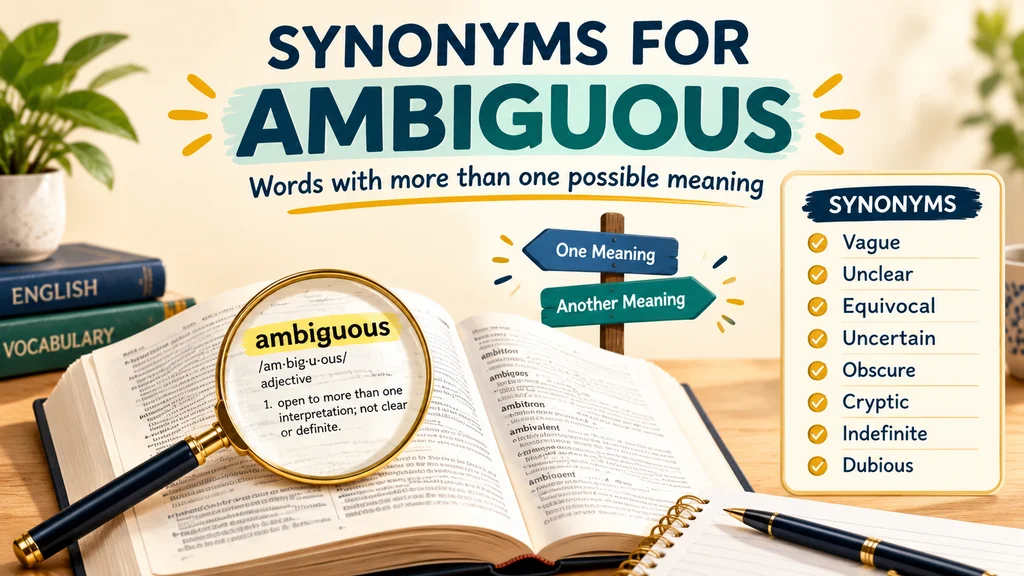
When a word, sentence, or statement can be understood in more than one way, finding the right description matters. The best synonyms for ambiguous include equivocal, unclear, vague, cryptic, and open to interpretation, depending on the context.
For example, an equivocal answer may deliberately avoid giving a clear position, a vague statement lacks specific details, and a cryptic message is difficult to understand because its meaning is hidden or indirect. Although these words are related, they are not interchangeable in every situation.
Whether you are writing an essay, analyzing literature, editing an important message, or improving your English vocabulary, choosing the right synonym for ambiguous can help you express your ideas more precisely.
In this guide, you’ll discover synonyms and related expressions, with simple meanings and practical example sentences. You’ll also learn which words work best for unclear statements, double meanings, confusing instructions, uncertain situations, and language that allows multiple interpretations, helping you choose an alternative that matches your exact meaning.

Unclear
Meaning:
Unclear means not easy to see or understand; something important seems to be missing.
Examples:
- The instructions for the test were unclear, so half the class asked for help.
- The contract terms were unclear to both parties.
Vague
Meaning:
Vague means not specific or detailed enough to be truly useful.
Examples:
- He gave a vague answer when I asked where he had been.
- She offered a vague promise to help someday.
Uncertain
Meaning:
Uncertain means not sure about something; the outcome could go either way.
Examples:
- We are still uncertain whether the event will happen this weekend.
- The weather tomorrow is still uncertain.
Indefinite
Meaning:
Indefinite means not clearly defined in extent, time, or meaning; left open.
Examples:
- The contract’s indefinite wording worried both sides.
- He took an indefinite leave from work.
Fuzzy
Meaning:
Fuzzy means not sharp or exact, like an out-of-focus photograph.
Examples:
- My memory of that night is a little fuzzy.
- The photo came out fuzzy and dark.
Hazy
Meaning:
Hazy means unclear, as if you are looking through a light mist.
Examples:
- The details of the plan are still hazy to me.
- My childhood summers feel hazy now.
Murky
Meaning:
Murky means dark and unclear, very hard to see through.
Examples:
- The company’s finances are murky, and investors are getting nervous.
- The lake water was cold and murky.
Cloudy
Meaning:
Cloudy means not transparent; full of confusion rather than clarity.
Examples:
- His explanation left the whole issue cloudy.
- His future at the company looks cloudy.
Blurry
Meaning:
Blurry means not in sharp focus; hard to make out properly.
Examples:
- Without my glasses, the street signs look blurry.
- The old video was blurry and silent.
Dim
Meaning:
Dim means weak or faint; difficult to perceive clearly.
Examples:
- I have only a dim memory of my first day at school.
- The hallway was lit by a dim bulb.
Obscure
Meaning:
Obscure means hard to understand, or known by very few people.
Examples:
- The poet used obscure references that few readers caught.
- He quoted an obscure Latin proverb.
Nebulous
Meaning:
Nebulous means unclear in shape or meaning, like a drifting cloud.
Examples:
- His business plan was still nebulous at that stage.
- Her plans for college remain nebulous.
Indistinct
Meaning:
Indistinct means not clearly seen, heard, or defined.
Examples:
- I could hear indistinct voices coming from the next room.
- An indistinct shape moved in the fog.
Shadowy
Meaning:
Shadowy means partly hidden in darkness; not fully visible.
Examples:
- A shadowy figure crossed the street at midnight.
- The shadowy alley made her nervous.
Equivocal
Meaning:
Equivocal means open to more than one interpretation, often deliberately.
Examples:
- The manager gave an equivocal response about the layoffs.
- His equivocal answer pleased nobody.
Ambivalent
Meaning:
Ambivalent means having mixed or contradictory feelings about something.
Examples:
- She felt ambivalent about moving to a new city.
- He felt ambivalent about the promotion.
Indeterminate
Meaning:
Indeterminate means not fixed or decided; impossible to pin down exactly.
Examples:
- The exact cause of the delay remains indeterminate.
- The test results were indeterminate.
Inconclusive
Meaning:
Inconclusive means not leading to a clear answer, decision, or result.
Examples:
- The medical tests were inconclusive, so the doctors ordered more.
- The debate ended inconclusively.
Unresolved
Meaning:
Unresolved means not yet settled, solved, or decided.
Examples:
- The disagreement between the two teams remains unresolved.
- The case remains unresolved after years.
Unsettled
Meaning:
Unsettled means not decided or calm; still hanging in doubt.
Examples:
- The question of who pays for dinner is still unsettled.
- The market feels unsettled this week.
Undefined
Meaning:
Undefined means without a clear meaning, role, or boundary.
Examples:
- His role in the project was undefined, which caused confusion.
- The rules of the game were undefined.
Unspecified
Meaning:
Unspecified means not stated clearly or in exact terms.
Examples:
- The letter promised an unspecified amount of money.
- The prize is an unspecified cash amount.
Questionable
Meaning:
Questionable means open to doubt; possibly not true, honest, or right.
Examples:
- His excuse for arriving late was questionable.
- His methods were ethically questionable.
Doubtful
Meaning:
Doubtful means full of uncertainty; unlikely to be true or to happen.
Examples:
- It is doubtful that the flight will take off in this storm.
- She looked doubtful about the plan.
Dubious
Meaning:
Dubious means suspicious and not to be trusted or relied upon.
Examples:
- She gave a dubious smile when he promised to pay her back.
- He made a dubious claim about winning.
Debatable
Meaning:
Debatable means open to argument; reasonable people disagree about it.
Examples:
- Whether homework really helps students is still debatable.
- The call was debatable among fans.
Open-ended
Meaning:
Open-ended means without a fixed answer, limit, or conclusion.
Examples:
- The teacher asked an open-ended question to start the discussion.
- The interview ended with an open-ended chat.
Enigmatic
Meaning:
Enigmatic means mysterious and difficult to interpret or explain.
Examples:
- Her enigmatic smile made everyone wonder what she was thinking.
- The artist was an enigmatic figure.
Cryptic
Meaning:
Cryptic means secretive and puzzling, like a message written in code.
Examples:
- He left a cryptic note on my desk that said only ‘soon’.
- She sent a cryptic text at midnight.
Mysterious
Meaning:
Mysterious means strange, unexplained, and full of wonder.
Examples:
- A mysterious sound came from the basement last night.
- A mysterious package arrived today.
Inscrutable
Meaning:
Inscrutable means impossible to read, understand, or interpret.
Examples:
- The judge kept an inscrutable expression throughout the trial.
- His inscrutable face revealed nothing.
Opaque
Meaning:
Opaque means not transparent; impossible to see through or grasp.
Examples:
- The legal language in the contract was completely opaque to me.
- The instructions were opaque to beginners.
Confusing
Meaning:
Confusing means difficult to follow, understand, or make sense of.
Examples:
- The new tax rules are confusing for most people.
- The map was confusing and outdated.
Perplexing
Meaning:
Perplexing means deeply puzzling; very hard to explain or solve.
Examples:
- It is perplexing how the phone vanished from a locked room.
- The sudden silence was perplexing.
Puzzling
Meaning:
Puzzling means strange enough to make you stop and think hard.
Examples:
- The sudden drop in sales was puzzling to the whole team.
- His behavior lately is puzzling.
Bewildering
Meaning:
Bewildering means so confusing that it leaves you feeling lost.
Examples:
- The airport’s layout was bewildering for first-time visitors.
- The new software was bewildering at first.
Baffling
Meaning:
Baffling means extremely confusing; it seems to defy explanation.
Examples:
- Doctors found her speedy recovery baffling but wonderful.
- The crime remains baffling to police.
Mystifying
Meaning:
Mystifying means filling people with a mix of wonder and confusion.
Examples:
- The magician’s mystifying tricks amazed the entire crowd.
- The illusionist’s act was truly mystifying.
58+Synonyms for Flexible: From Adaptable to Versatile
Muddled
Meaning:
Muddled means mixed up, jumbled, and confused.
Examples:
- His muddled explanation only raised more questions.
- His muddled thoughts slowed the report.
Tangled
Meaning:
Tangled means twisted together so it is hard to separate the parts.
Examples:
- The plot of the novel was too tangled for me to follow.
- The cables were tangled beyond repair.
Befuddled
Meaning:
Befuddled means confused and muddle-headed, unable to think clearly about things.
Examples:
- The befuddled tourist stared at the subway map for ten minutes.
- The early alarm left him befuddled.
Disorienting
Meaning:
Disorienting means making you lose your sense of direction, place, or clarity.
Examples:
- The maze of hotel corridors was completely disorienting.
- The dark maze was disorienting.
Evasive
Meaning:
Evasive means deliberately avoiding a direct or honest answer.
Examples:
- The politician was evasive when asked about the scandal.
- Her evasive reply raised more questions.
Noncommittal
Meaning:
Noncommittal means refusing to commit to a clear opinion or decision.
Examples:
- He gave a noncommittal shrug when asked which team he supports.
- He stayed noncommittal about the offer.
Imprecise
Meaning:
Imprecise means not exact, accurate, or carefully measured.
Examples:
- The recipe’s imprecise measurements ruined the cake.
- The sketch gave an imprecise outline.
Approximate
Meaning:
Approximate means close to the truth but not exactly right.
Examples:
- The approximate cost of the trip is two hundred dollars.
- The approximate time is three o’clock.
Loose
Meaning:
Loose means not tight or strict; used in a relaxed, inexact way.
Examples:
- He used the word ‘genius’ in a loose sense.
- The shirt hung loose on him.
Two-sided
Meaning:
Two-sided means carrying two possible meanings or aspects at once.
Examples:
- Her remark was two-sided: praise on the surface, criticism underneath.
- The debate was a two-sided affair.
Multilayered
Meaning:
Multilayered means having several levels of meaning stacked together.
Examples:
- The film’s ending was multilayered and sparked long debates.
- The novel has a multilayered plot.
Protean
Meaning:
Protean means constantly changing form, like a shape-shifter.
Examples:
- The word ‘cool’ has a protean meaning that shifts with each generation.
- He has a protean talent for languages.
61+Synonyms for Interest: Choose the Right Word
When to Use Which Synonym of Ambiguous
Not every synonym fits every moment. Here’s a quick guide to picking the right one:
- Formal writing (reports, academic papers, business emails): reach for equivocal, indeterminate, inconclusive, or unresolved. They sound precise and professional — “the findings were inconclusive” carries more weight than “the findings were unclear.”
- Casual conversation: stick with vague, unclear, fuzzy, or hazy. Nobody says “your text was equivocal” to a friend — “your text was vague” does the job.
- Essays and creative writing: this is where enigmatic, cryptic, nebulous, multilayered, and protean shine. They add color and depth that simple words can’t match.
- Emotional or personal moments: use ambivalent, uncertain, unsettled, or doubtful when describing feelings rather than facts — “I feel ambivalent about the move” says more than “I feel unclear.”
- Describing people who dodge answers: evasive and noncommittal are your best tools.

Frequently Asked Questions About Ambiguous Synonyms
What does “ambiguous” mean in simple words?
It means something can be understood in more than one way, so you’re not sure which meaning is correct. For example, if your friend says “let’s meet soon” without naming a day, that plan is ambiguous.
What is the difference between ambiguous and vague?
They’re close, but not identical. “Vague” means lacking detail — there’s too little information to be sure of anything. “Ambiguous” means there are two or more possible meanings competing with each other. A vague message says almost nothing; an ambiguous message says something that could mean two different things.
Can you give an example of an ambiguous sentence?
A classic one is: “I saw the man with the telescope.” Did you use the telescope to see him, or did the man have the telescope? Both readings work, which is exactly what makes the sentence ambiguous.
What is the opposite of ambiguous?
The most direct opposites are clear, explicit, unambiguous, and definite. If something is unambiguous, it has only one possible meaning and leaves no room for confusion.
Is being ambiguous ever a good thing?
Surprisingly, yes. Poets use ambiguity to create beautiful double meanings, diplomats use it to keep negotiations open, and comedians use it for jokes built on wordplay. Ambiguity is only a problem when clarity matters — like in contracts, instructions, or safety warnings.
Can a person be described as ambiguous?
Yes, though it usually means they’re hard to read or deliberately unclear. You might call a politician’s statement ambiguous, or describe someone with mixed signals as having an ambiguous attitude. For people who dodge questions on purpose, evasive or noncommittal are even better fits.
conclusion
Growing your vocabulary is one of the simplest ways to become a sharper thinker and a more confident writer. Every time you swap a tired, repeated word for a precise one — equivocal instead of unclear, enigmatic instead of mysterious-ish — your ideas land harder and your writing stands out.
Keep this list of synonyms of ambiguous bookmarked, try one new word in your writing this week, and watch how much more exact you sound.
Author

Emily Carter is a vocabulary specialist and content writer at SynonymCore. She loves breaking down the nuances of English words and helping readers find exactly the right word for every occasion.