
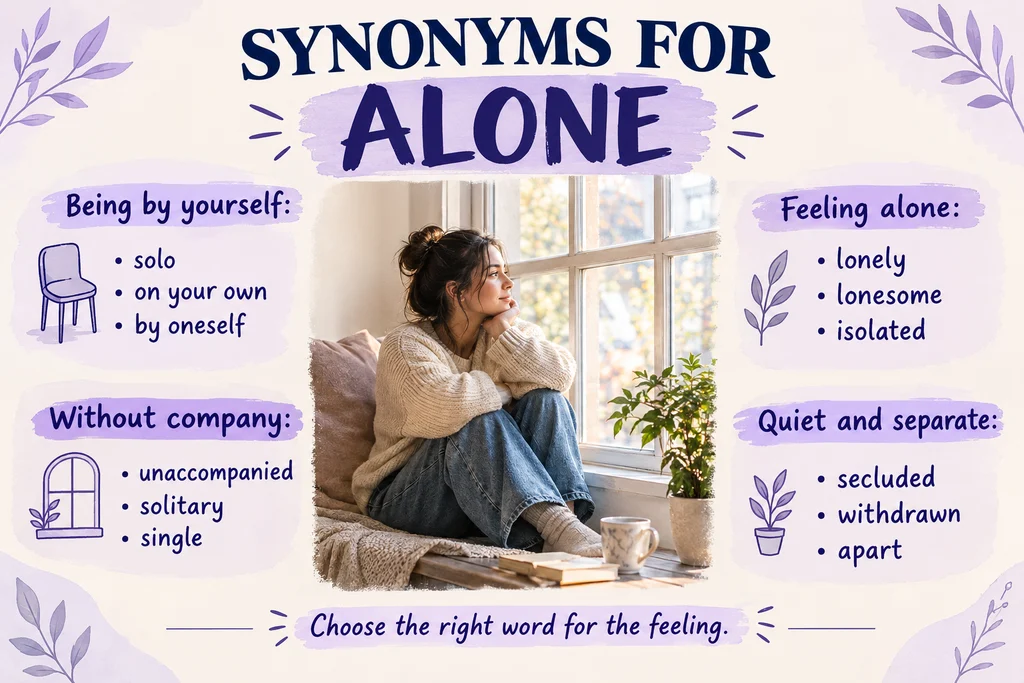
Looking for a better word than “alone”? The right choice depends on whether you mean being by yourself, having no company, or acting without help. Alone means being without other people or by yourself, but its alternatives express different shades of meaning. Solitary describes being alone or done alone, while unaccompanied means being without someone accompanying you. Isolated suggests separation from other people, whereas independent emphasizes the ability to act without help. Secluded often describes a place away from others, while lonesome expresses a feeling of loneliness.
These words are related, but they are not interchangeable in every sentence. You might take a solitary walk, travel unaccompanied, stay in a secluded cabin, or work independently on a project. You can also enjoy being alone without feeling lonely.
This guide explores useful synonyms for alone, with simple meanings and examples to help you describe solitude, separation, independence, and being without company in everyday conversations, academic writing, and creative work.
Solitary
Meaning:
Solitary means alone by choice or habit; often calm and peaceful.
Examples:
- “She enjoys solitary morning walks along the beach.”
- The solitary lighthouse keeper watched the waves for thirty years.
Lone
Meaning:
Lone means single and without company; usually placed before a noun.
Examples:
- “A lone traveler waited at the empty station.”
- A lone sunflower stood tall in the empty field.
Solo
Meaning:
Solo means done by one person, without help.
Examples:
- “He finished the entire project solo.”
- She released her first solo album last spring.
Single
Meaning:
Single means only one; not accompanied by others.
Examples:
- “A single lamp lit the empty room.”
- Not a single student answered the teacher’s question.
Unaccompanied
Meaning:
Unaccompanied means without anyone going along with you.
Examples:
- “Kids under twelve can’t fly unaccompanied.”
- Minors cannot enter the museum unaccompanied after dark.
Unescorted
Meaning:
Unescorted means without a companion or guide.
Examples:
- “Guests may not enter the building unescorted.”
- Visitors must not wander the construction site unescorted.
Unattended
Meaning:
Unattended means left without anyone watching over it.
Examples:
- “Don’t leave your luggage unattended.”
- The campfire should never be left unattended overnight.
Companionless
Meaning:
Companionless means without a friend or partner at your side.
Examples:
- “After the move, he felt companionless in the new city.”
- He spent a companionless winter in the mountain cabin.
Friendless
Meaning:
Friendless means having no friends around.
Examples:
- “The new student looked friendless on day one.”
- The stray kitten was thin, hungry, and friendless.
On one’s lonesome
Meaning:
On one’s lonesome means (informal) Alone, often with a touch of sadness.
Examples:
- “He spent the whole holiday on his lonesome.”
- She drove across the desert on her lonesome.
By oneself
Meaning:
By oneself means without help or company from others.
Examples:
- “She changed the flat tire by herself.”
- He fixed the leaking roof by himself last weekend.
On one’s own
Meaning:
On one’s own means independently; without others.
Examples:
- “He learned to cook on his own.”
- They started the business on their own without investors.
All alone
Meaning:
All alone means completely alone, with extra emphasis.
Examples:
- “With everyone gone, she was all alone in the house.”
- The puppy was all alone in the backyard.
All by oneself
Meaning:
All by oneself means the same idea, stated more strongly.
Examples:
- “He built the treehouse all by himself.”
- She painted the whole apartment all by herself.
Synonyms for Lonely: 55+ Words for Lonesome, Isolated & More
Single-handed
Meaning:
Single-handed means done by one person without help.
Examples:
- “She ran the charity drive single-handed.”
- He organized the entire wedding single-handed last June.
Single-handedly
Meaning:
Single-handedly means by your own efforts alone (adverb).
Examples:
- “He single-handedly saved the failing store.”
- She single-handedly carried the team to victory in overtime.
Unaided
Meaning:
Unaided means without any help or support.
Examples:
- “The climber reached the summit unaided.”
- The brave toddler walked down the stairs unaided.
Unassisted
Meaning:
Unassisted means without assistance from anyone.
Examples:
- “The old man crossed the busy road unassisted.”
- She completed the difficult puzzle unassisted in an hour.
Unchaperoned
Meaning:
Unchaperoned means without an adult or supervisor present.
Examples:
- “The teens were unchaperoned at the party.”
- The students were unchaperoned during the field trip.
Stag
Meaning:
Stag means (informal) Attending an event without a partner.
Examples:
- “With no date, he went stag to the party.”
- He attended the gala stag after his date canceled.
Isolated
Meaning:
Isolated means cut off from other people or places.
Examples:
- “The farmhouse stood isolated in the hills.”
- The mountain cabin was isolated by heavy snowfall.
Secluded
Meaning:
Secluded means hidden from others; private and quiet.
Examples:
- “They found a secluded spot for their picnic.”
- They booked a secluded villa for their honeymoon.
Sequestered
Meaning:
Sequestered means kept apart from others, often on purpose.
Examples:
- “The jury was sequestered during the trial.”
- The committee was sequestered until it reached a decision.
Cloistered
Meaning:
Cloistered means shut away from the world, like in a monastery.
Examples:
- “She lived a cloistered life in the countryside.”
- The monks lived a cloistered existence behind stone walls.
Remote
Meaning:
Remote means far away from people and towns.
Examples:
- “They settled in a remote mountain village.”
- She taught English in a remote island school.
Cut off
Meaning:
Cut off means separated, with no contact or access.
Examples:
- “The storm left the village cut off for days.”
- The flood cut the town off from the mainland.
Withdrawn
Meaning:
Withdrawn means pulled back from social contact.
Examples:
- “After the loss, he grew quiet and withdrawn.”
- The withdrawn child rarely spoke in class anymore.
Detached
Meaning:
Detached means emotionally or physically separated.
Examples:
- “She stayed detached from the office drama.”
- He kept a detached tone during the argument.
Aloof
Meaning:
Aloof means distant and uninterested in company.
Examples:
- “The new manager seemed aloof at first.”
- The cat remained aloof from the noisy guests.
Reclusive
Meaning:
Reclusive means avoiding people; fond of solitude.
Examples:
- “The reclusive author rarely gave interviews.”
- The reclusive painter lived quietly above his studio.
Hermit-like
Meaning:
Hermit-like means living like a hermit, away from society.
Examples:
- “He led a hermit-like life in the woods.”
- After retirement, he kept a strictly hermit-like routine.
Lonely
Meaning:
Lonely means sad because you have no company.
Examples:
- “The old house felt lonely without the children.”
- The long country road felt lonely at midnight.
Lonesome
Meaning:
Lonesome means lonely, especially from missing others.
Examples:
- “The nights felt lonesome without her family.”
- The empty playground looked lonesome in the rain.
Forlorn
Meaning:
Forlorn means sad, abandoned, and hopeless-looking.
Examples:
- “A forlorn puppy waited by the roadside.”
- She gave a forlorn glance at the closed shop.
Forsaken
Meaning:
Forsaken means deserted and left without hope.
Examples:
- “The forsaken playground stood silent.”
- The forsaken mill had stood empty since the war.
Abandoned
Meaning:
Abandoned means left behind completely.
Examples:
- “They explored an abandoned factory.”
- An abandoned car sat rusting by the curb.
Deserted
Meaning:
Deserted means empty because everyone has left.
Examples:
- “The streets were deserted at dawn.”
- The wide beach was completely deserted by sunset.
Desolate
Meaning:
Desolate means bleak, empty, and depressing.
Examples:
- “A desolate plain stretched to the horizon.”
- The desolate old station echoed with every footstep.
Bereft
Meaning:
Bereft means deprived of someone, especially through death.
Examples:
- “The bereft father held the old photograph.”
- The once-lovely garden looked bereft without its flowers.
Stranded
Meaning:
Stranded means left helpless somewhere.
Examples:
- “We were stranded at the airport overnight.”
- Their car broke down, leaving them stranded miles from town.
Marooned
Meaning:
Marooned means stuck somewhere with no way to leave.
Examples:
- “The sailors were marooned on the island.”
- The hikers were marooned by the sudden blizzard.
Exiled
Meaning:
Exiled means forced to live away from home.
Examples:
- “The exiled writer missed her country deeply.”
- The exiled king never returned to his homeland.
Outcast
Meaning:
Outcast means rejected by a group or society.
Examples:
- “He felt like an outcast at the new school.”
- The outcast wolf roamed the dark forest’s edge.
Sole
Meaning:
Sole means the only one; single.
Examples:
- “She was the sole survivor of the accident.”
- He was the sole breadwinner for his family.
Only
Meaning:
Only means no one or nothing else besides.
Examples:
- “He was the only guest who came.”
- She was the only one who finished on time.
Uninhabited
Meaning:
Uninhabited means with nobody living there.
Examples:
- “The island stayed uninhabited for decades.”
- The uninhabited log cabin slowly fell apart over the years.
Unpopulated
Meaning:
Unpopulated means with no people in the area.
Examples:
- “They drove through unpopulated desert.”
- They camped for a week in an unpopulated valley.
Empty
Meaning:
Empty means containing nobody or nothing.
Examples:
- “The classroom sat completely empty.”
- The old fridge was completely empty by morning.
Vacant
Meaning:
Vacant means not occupied; available.
Examples:
- “A vacant lot stretched behind the shops.”
- A vacant apartment waited on the third floor.
Unoccupied
Meaning:
Unoccupied means not being used by anyone.
Examples:
- “The unoccupied room gathered dust.”
- The unoccupied office still had its lights on.
Synonyms for Hungry: 56+ Alternatives From Peckish to Ravenous
When to Use Which Synonym for Alone
Not every word similar to “alone” fits every situation — tone and context decide everything. Here’s a quick guide to picking the right one:
- Formal writing and essays: solitary, sequestered, unaccompanied, desolate, uninhabited. “Sequestered” suits legal or academic contexts, while “solitary” fits reflective essays.
- Casual conversation: solo, by oneself, on one’s own, stag. These sound natural and relaxed — “I went solo” beats “I went alone” every time.
- Stories and emotional scenes: forlorn, bereft, lonesome, marooned, exiled. These carry sadness or drama that pulls readers straight into the moment.
- Describing places: secluded, remote, deserted, unpopulated. Choose “secluded” for cozy privacy and “deserted” for eerie emptiness.
- Positive solitude: solitary, secluded, reclusive suggest aloneness by choice. For painful loneliness, reach for lonely, forlorn, or forsaken instead — the emotional gap between them is huge.
Frequently Asked Questions
What’s the difference between “alone” and “lonely”?
“Alone” is a neutral fact — nobody else is around. “Lonely” is a feeling — sadness about being without company. You can be happily alone on a mountain hike, or deeply lonely in a crowded room. Writers who mix them up lose emotional precision, so keep the distinction sharp.
What is a formal synonym for alone?
Unaccompanied, solitary, and sequestered work best in formal writing. “Unaccompanied” fits rules, instructions, and official documents, while “solitary” suits essays, reports, and reflective pieces where a literary touch helps.
What is a positive word for being alone?
Solitary and secluded suggest peaceful, chosen solitude rather than sadness. Saying “a solitary weekend in the hills” sounds restorative and appealing, not depressing — context turns aloneness into a luxury.
Is “lonesome” the same as “alone”?
Not quite. “Lonesome” always carries an ache of missing someone, while “alone” is neutral. You can be alone and perfectly content, but lonesome implies you wish someone were there — it’s the emotional version of the word.
How can I say “alone” more politely?
“On your own,” “by yourself,” and “unaccompanied” all sound gentler than a blunt “alone.” They’re perfect for invitations, instructions, and customer-facing writing where a warm tone matters more than brevity.
What is the opposite of alone?
Together, accompanied, surrounded, crowded, and in company all describe being with others. Knowing the opposites helps you contrast ideas sharply — “from crowded to solitary” paints a far stronger picture than either word alone.
Final Thoughts: Mastering Synonyms for Alone
Building a richer vocabulary is one of the fastest ways to make your writing stand out — and now you own brilliant alternatives to one tired word. Start small: swap “alone” for “solitary” in your next paragraph, or “secluded” when describing a quiet place, and notice how much more alive your sentences feel. The more you experiment, the more naturally the perfect word will come to you, until choosing vivid language becomes second nature.
Author

Daniel Brooks is a language enthusiast and contributing writer at SynonymCore. He writes about word meanings, usage, and the subtle differences between similar words.
Pingback: Synonyms of Stoic: 40+ Words for Calmness and Resilience