
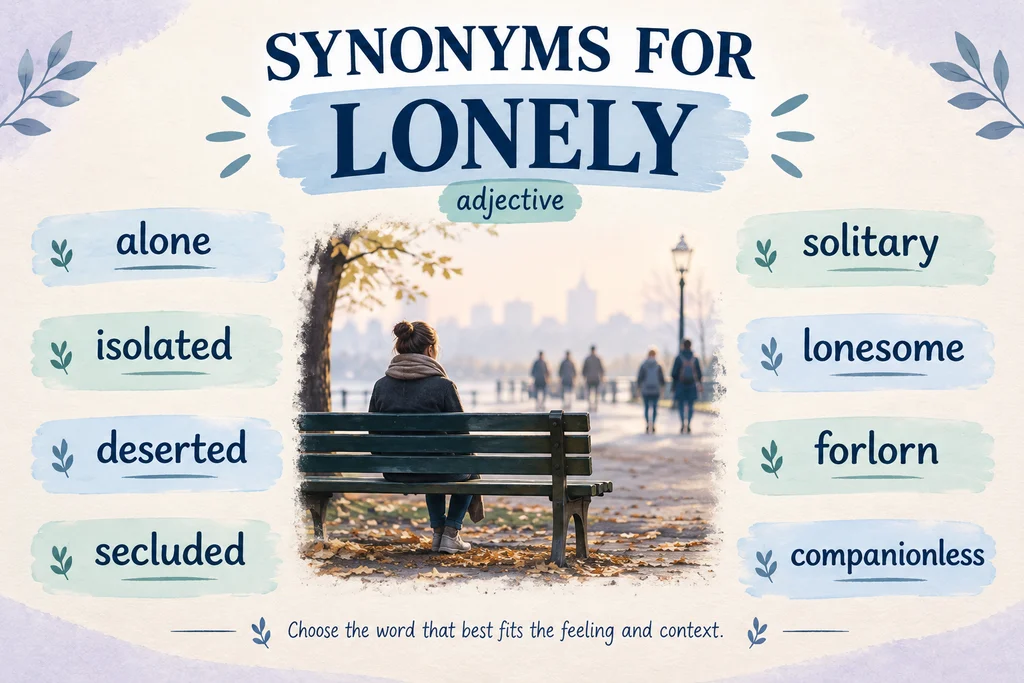
Feeling lonely is not always the same as being alone, and choosing the wrong word can change your meaning. Lonely describes feeling sad or emotionally disconnected because you lack the companionship or connection you want. The best synonym for lonely depends on the situation.
Lonesome emphasizes the feeling of missing company, while isolated suggests being separated from others physically or socially. Solitary describes being alone without necessarily feeling unhappy, whereas forlorn conveys deeper sadness or a sense of abandonment.
These words are related, but they are not interchangeable in every sentence. You might feel lonely in a crowded room, live in an isolated place, enjoy a solitary walk, or feel forlorn after someone leaves. Understanding these differences helps you describe loneliness, sadness, separation, and solitude more accurately.
This guide explores synonyms for lonely, with simple meanings and examples to help you choose the right word for emotional writing, everyday conversations, schoolwork, and creative expression.
The neutral ones — simply by yourself, no sadness required.
Alone
Meaning:
Alone means with no one else around; simple and neutral.
Examples:
- She spent the afternoon alone, happily reading.
- He ate dinner alone at a corner table.
Unaccompanied
Meaning:
Unaccompanied means without anyone going along with you.
Examples:
- He flew to Chicago unaccompanied for the first time.
- The child rode the train unaccompanied to visit grandma.
By oneself
Meaning:
By oneself means without help or company; an everyday phrase.
Examples:
- She fixed the leaky faucet by herself.
- He painted the whole room by himself over the weekend.
On one’s own
Meaning:
On one’s own means alone and handling things independently.
Examples:
- After college, he lived on his own.
- She learned to cook on her own after moving out.
Single
Meaning:
Single means without a partner or companion.
Examples:
- She booked a single table and enjoyed every bite.
- He traveled as a single passenger with a window seat.
Solo
Meaning:
Solo means done alone, with a hint of independence.
Examples:
- He took a solo road trip last summer.
- She gave a solo piano recital at the festival.
Partnerless
Meaning:
Partnerless means without a romantic partner or teammate.
Examples:
- She arrived partnerless but danced all night.
- He ran the partnerless relay as a one-man team.
Companionless
Meaning:
Companionless means without a companion beside you; slightly literary.
Examples:
- The sailor led a quiet, companionless life.
- The companionless widow kept two cats for company.
Friendless
Meaning:
Friendless means with no friends around; honest, a little sad.
Examples:
- New in town, she felt friendless all weekend.
- The friendless transfer student ate lunch in the library.
Solitary
Meaning:
Solitary means alone by habit or choice; often peaceful.
Examples:
- She enjoys long solitary walks in the pines.
- The solitary lighthouse keeper read by lantern light.
The aching ones — sad, wistful, and wishing for company.
Lonesome
Meaning:
Lonesome means lonely with a soft, longing ache.
Examples:
- The dog gave a lonesome howl at dawn.
- He spent a lonesome Christmas far from family.
Forlorn
Meaning:
Forlorn means sad and abandoned, as if forgotten.
Examples:
- The forlorn puppy waited by the door.
- The forlorn town square emptied after the factory closed.
Melancholy
Meaning:
Melancholy means a gentle, thoughtful sadness; poetic.
Examples:
- Autumn rain fills her with sweet melancholy.
- The old song carried a gentle melancholy of lost summers.
Blue
Meaning:
Blue means down or low in spirits; casual.
Examples:
- Rainy Mondays always leave him feeling blue.
- She felt blue after her best friend moved away.
Glum
Meaning:
Glum means quietly gloomy; duller than sad.
Examples:
- The kids looked glum when the picnic was canceled.
- He sat glum in the quiet waiting room.
Dejected
Meaning:
Dejected means downcast after hopes fell through.
Examples:
- Dejected, he walked home in silence.
- The team looked dejected after the final whistle.
Despondent
Meaning:
Despondent means having lost hope; heavier than dejected.
Examples:
- He grew despondent after months of rejections.
- The despondent crowd left the stadium in silence.
Downcast
Meaning:
Downcast means spirits low, eyes lowered.
Examples:
- She walked home downcast, clutching the letter.
- He left the job interview downcast and very quiet.
Downhearted
Meaning:
Downhearted means discouraged; warm and old-fashioned.
Examples:
- Don’t be downhearted — tomorrow is new.
- The downhearted fans still cheered for their team.
Heartsick
Meaning:
Heartsick means sick at heart with longing or grief.
Examples:
- Heartsick, she called her mother nightly.
- The heartsick soldier wrote letters home every day.
Wistful
Meaning:
Wistful means full of quiet longing for the past.
Examples:
- He smiled wistfully at old photographs.
- She gazed wistfully at the departing train from the platform.
Yearning
Meaning:
Yearning means a deep ache for connection.
Examples:
- Her voice held a yearning for home.
- His letters revealed a yearning for simpler days.
Pining
Meaning:
Pining means wasting away, longing for someone absent.
Examples:
- He spent the summer pining for her.
- She kept pining for the city she left behind.
Longing
Meaning:
Longing means a strong wish for something far off.
Examples:
- She felt a longing for her grandmother’s kitchen.
- He felt a longing for the sea during winter.
Sad
Meaning:
Sad means unhappy; the plainest word here.
Examples:
- The quiet apartment made her oddly sad.
- The sad movie made the whole theater cry.
Synonyms for Maybe: 46+ Words & Phrases for Uncertainty
Heartbroken
Meaning:
Heartbroken means shattered by loss; the strongest here.
Examples:
- Heartbroken, he avoided their old café.
- The heartbroken widow kept his photograph close to her heart.
Cut off and far away — separated by distance or silence.
Isolated
Meaning:
Isolated means separated from others; cut off.
Examples:
- The cabin stood isolated, miles from town.
- The farm was isolated by the heavy snowstorm for days.
Secluded
Meaning:
Secluded means hidden away; peaceful, not painful.
Examples:
- They found a secluded cove to swim in.
- The secluded cabin in the woods was perfect for writing.
Remote
Meaning:
Remote means far from people; describes places.
Examples:
- She grew up in a remote mountain village.
- The remote island had no internet access or phone signal.
Cut off
Meaning:
Cut off means separated from contact completely.
Examples:
- The flooded bridge cut off the town.
- The storm cut off power to the whole valley.
Detached
Meaning:
Detached means emotionally separated; cool, distant.
Examples:
- He felt detached from his old friends.
- She stayed detached during the heated family debate.
Withdrawn
Meaning:
Withdrawn means pulled back from company; hard to reach.
Examples:
- She grew withdrawn and stopped calling.
- The withdrawn teenager spent hours in his room.
Separated
Meaning:
Separated means apart by distance or circumstance.
Examples:
- Separated by an ocean, they wrote weekly.
- The separated twins reunited happily after twenty long years.
Distant
Meaning:
Distant means far in space or feeling.
Examples:
- He seemed distant at dinner, lost in thought.
- The distant mountains glowed pink at sunset yesterday.
Apart
Meaning:
Apart means away from others; short, direct.
Examples:
- The farmhouse stood apart, quiet and still.
- She held herself apart from the office gossip.
Left behind or pushed away — when loneliness comes from other people.
Abandoned
Meaning:
Abandoned means left behind; carries real hurt.
Examples:
- The abandoned dog found a loving home.
- The abandoned factory became a popular art gallery downtown.
Forsaken
Meaning:
Forsaken means deserted like a betrayal; literary.
Examples:
- He felt forsaken by trusted friends.
- The forsaken chapel stood empty for decades on the hill.
Deserted
Meaning:
Deserted means left empty of people.
Examples:
- The market stood deserted at midnight.
- The deserted beach stretched for miles along the coast.
Neglected
Meaning:
Neglected means ignored over time; a quiet hurt.
Examples:
- The neglected garden bloomed again that spring.
- The neglected puppy slowly learned to trust people again.
Rejected
Meaning:
Rejected means turned away; stings with shame.
Examples:
- Rejected everywhere, she self-published her novel.
- The rejected job applicant started his own company.
Unwanted
Meaning:
Unwanted means not wanted by anyone; deeply sad.
Examples:
- No child should ever feel unwanted.
- The unwanted kittens found loving homes within a week.
Unloved
Meaning:
Unloved means without love; raw and personal.
Examples:
- Feeling unloved shaped his whole life.
- The unloved doll sat forgotten in the attic.
Shunned
Meaning:
Shunned means deliberately avoided by a group.
Examples:
- After the rumor, classmates shunned her.
- The villagers shunned the stranger for weeks after his arrival.
Ostracized
Meaning:
Ostracized means formally excluded; official shunning.
Examples:
- The department ostracized the whistleblower.
- The club ostracized members who broke the rules.
Excluded
Meaning:
Excluded means kept out, by accident or design.
Examples:
- Excluded from the chat, he heard it late.
- She felt excluded from the happy family photos that day.
Stranded
Meaning:
Stranded means left helpless, unable to leave.
Examples:
- Stranded overnight, she made a new friend.
- The stranded travelers slept in the airport terminal.
Marooned
Meaning:
Marooned means abandoned somewhere remote; dramatic.
Examples:
- Marooned by the ferry, they camped out.
- The marooned sailors survived on coconuts for weeks.
Outcast
Meaning:
Outcast means thrown out by a group.
Examples:
- The new kid felt like an outcast.
- The outcast artist finally found fame many years later.
Outsider
Meaning:
Outsider means outside the circle; milder than outcast.
Examples:
- At the reunion she felt like an outsider.
- As an outsider, he saw the problem clearly.
Cast aside
Meaning:
Cast aside means thrown away as no longer needed.
Examples:
- He felt cast aside for a younger player.
- The old toys were cast aside for new gadgets.
When to Use Which Synonym for Lonely
Choosing among lonely synonyms is about matching the word to the moment. For formal writing and essays, choose solitary, isolated, secluded, or detached — measured and precise. In casual conversation, alone, lonesome, blue, or on your own never sound stiff. For emotional or poetic moments, forlorn, heartsick, wistful, and melancholy carry the ache beautifully. Describing places? Reach for remote, secluded, deserted, or isolated.
Sometimes loneliness is not about being apart, but about feeling different from everyone around you.
Synonyms for Lucky: 57+ Words for Good Fortune & Chance
Frequently Asked Questions About Synonyms for Lonely
What is another word for lonely?
The closest everyday alternative is lonesome — it means almost exactly the same thing. If the time alone was chosen, like a peaceful evening by yourself, solitary fits better. For a sadder, abandoned feeling, forlorn captures it.
What is the difference between alone and lonely?
Alone is a fact: nobody else is there. Lonely is a feeling: you wish someone were. You can be alone without being lonely, and you can feel lonely in a crowded room — which is exactly why English keeps both words.
Is there a formal synonym for lonely I can use in essays?
Yes — solitary, isolated, and detached all work well in academic writing because they sound neutral and precise. Forlorn suits literary essays, though it carries more emotion. Avoid blue or glum in formal work; they are too casual.
What is the opposite of lonely?
Opposites include connected, accompanied, surrounded, and together — all suggesting warmth and company.
Can lonely describe a place as well as a person?
Absolutely. A lonely road, a lonely house, or a lonely beach all sound natural. When places are the subject, remote, secluded, deserted, and isolated are the synonyms that fit most naturally.
What is a poetic way to say lonely?
Melancholy and wistful are the poets’ favorites — soft, reflective, and beautiful. Forlorn adds drama, while heartsick brings raw emotion. Any of these will lift a poem or a heartfelt letter above the ordinary.
Conclusion
Growing your vocabulary is really about collecting feelings you can finally name — and lonely has more shades than most words. Next time the feeling visits, try wistful instead of sad, or solitary instead of alone, and notice how much sharper your words become. Keep this list of synonyms for lonely bookmarked close and keep building: every new word is a new way to understand yourself — and to be understood. Share it with a friend who loves words, and explore our other synonym guides to keep growing every day. The right word is always worth the search.
Author

Daniel Brooks is a language enthusiast and contributing writer at SynonymCore. He writes about word meanings, usage, and the subtle differences between similar words.
Pingback: Synonyms for Alone: 52+ Alternatives for Every Context
Pingback: Synonyms for Hungry: 56+ Alternatives From Peckish to Ravenous