
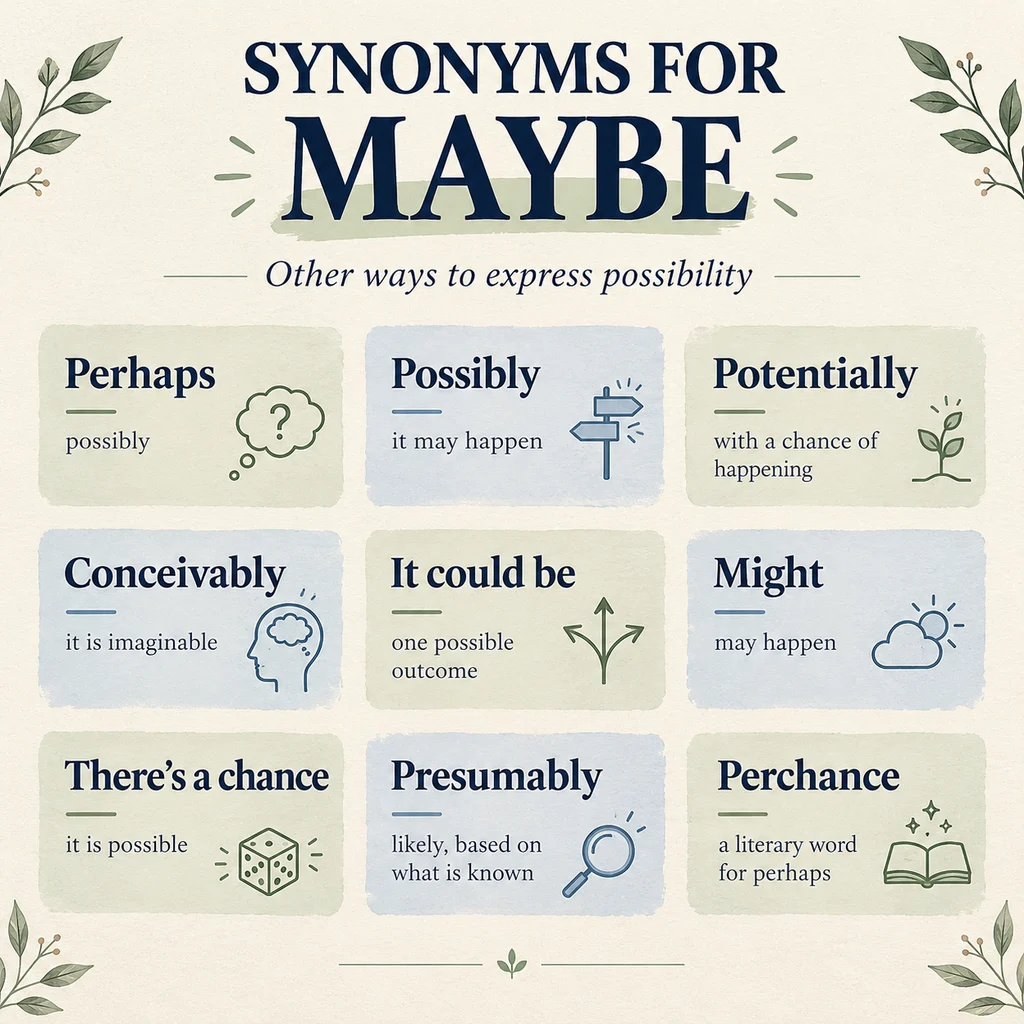
Repeating “maybe” can make your writing feel repetitive, but choosing the right alternative depends on how you want to express uncertainty. Maybe means something is possible but not certain. Perhaps is one of its closest alternatives and often works in both everyday and formal writing. Possibly emphasizes that something could happen or be true, while potentially highlights a possible result or effect. For a more formal or thoughtful tone, conceivably can express that something is imaginable or possible. Phrases such as might be and could be also work when the sentence needs a different grammatical structure.
These alternatives are related, but they are not interchangeable in every sentence. You might say “Perhaps we should wait” to make a suggestion, “It might rain later” to express uncertainty, or “This change could potentially improve the results” to describe a possible outcome.
This guide covers useful synonyms for maybe, including everyday, formal, conversational, academic, and context-based alternatives, with simple meanings and examples to help you choose the expression that best fits your sentence.

Let us start with the everyday heroes — the casual, conversational picks you can drop into texts, chats, and friendly conversations without a second thought.
Perhaps
Meaning:
Perhaps means the all-purpose classic, just a shade more polished than maybe.
Examples:
- Example: Perhaps we could meet for coffee on Saturday.
- Perhaps the train is simply running late today.
Possibly
Meaning:
Possibly means suggests something could happen but is far from certain.
Examples:
- Example: We could possibly finish the report by Friday.
- She will possibly join us after her meeting.
Might
Meaning:
Might means short, soft, and completely everyday.
Examples:
- Example: It might rain later, so bring an umbrella.
- We might visit the new museum this weekend.
Could Be
Meaning:
Could Be means a gentle way to float a guess without committing to it.
Examples:
- Example: That could be the delivery driver at the door.
- That strange noise could be the old pipes.
May Be
Meaning:
May Be means the original two-word form — slightly more deliberate than maybe.
Examples:
- Example: It may be the last train, so let us hurry.
- The answer may be simpler than we think.
Who Knows
Meaning:
Who Knows means a playful shrug of uncertainty, perfect for casual talk.
Examples:
- Example: “Will the traffic be bad?” “Who knows — let us leave early anyway.”
- Who knows what surprises tomorrow will bring us?
We’ll See
Meaning:
We’ll See means the classic non-answer that keeps every option open.
Examples:
- Example: “Are we going to the beach?” “We will see what the weather does.”
- We’ll see how the market reacts on Monday.
Maybe So
Meaning:
Maybe So means agreeable and open, with a warm tone.
Examples:
- Example: “Do you think she will come?” “Maybe so — she seemed interested.”
- Maybe so, but I would still double-check everything.
No Promises
Meaning:
No Promises means honest hedging when you do not want to let anyone down.
Examples:
- Example: “Can you fix my laptop?” “I will try — no promises.”
- I can try, but no promises this time.
Don’t Quote Me
Meaning:
Don’t Quote Me means a casual disclaimer before a shaky guess.
Examples:
- Example: “Is the meeting at three?” “Do not quote me, but I think so.”
- Don’t quote me, but the prices may rise.
Fingers Crossed
Meaning:
Fingers Crossed means a hopeful maybe, full of good wishes.
Examples:
- Example: “Did you get the job?” “The interview went well — fingers crossed!”
- Fingers crossed the good weather holds for Saturday.
With Any Luck
Meaning:
With Any Luck means optimistic hedging with a smile.
Examples:
- Example: “Will we catch the early train?” “With any luck, yes.”
- With any luck, we will land before noon.
Synonyms for Safe: 54+ Words for Secure, Harmless & More
If All Goes Well
Meaning:
If All Goes Well means conditional optimism for plans in progress.
Examples:
- Example: “Are you moving next month?” “If all goes well.”
- If all goes well, we open next month.
Time Will Tell
Meaning:
Time Will Tell means patient uncertainty — the answer will arrive on its own.
Examples:
- Example: “Will the new policy work?” “Time will tell.”
- Time will tell if the decision was right.
It’s Possible
Meaning:
It’s Possible means neutral, safe, and works almost anywhere.
Examples:
- Example: “Could she be at home?” “It is possible — her car is outside.”
- It’s possible the late flight was delayed again.
There’s a Chance
Meaning:
There’s a Chance means slightly more concrete than a vague maybe. Now the polished crowd. For essays, reports, or important emails, these next synonyms for maybe carry real weight.
Examples:
- Example: “Will it snow?” “There is a chance — the forecast just changed.”
- There’s a chance the store stays open late.
Conceivably
Meaning:
Conceivably means formal: something is imaginable, even if unlikely.
Examples:
- Example: The results could conceivably shift after a recount.
- The plan could conceivably work with more funding.
Potentially
Meaning:
Potentially means formal: capable of happening or becoming real.
Examples:
- Example: This deal is potentially worth millions.
- This new system could potentially save us a lot.
Feasibly
Meaning:
Feasibly means practical possibility, grounded in what can actually be done.
Examples:
- Example: We could feasibly launch the product by March.
- We could feasibly finish well before the deadline.
Plausibly
Meaning:
Plausibly means a believable possibility, one that holds up to scrutiny.
Examples:
- Example: He could plausibly have missed the email.
- He plausibly denied knowing anything about the meeting.
Theoretically
Meaning:
Theoretically means true in theory, though practice may disagree.
Examples:
- Example: Theoretically, the train takes forty minutes.
- Theoretically, the whole trip should take two hours.
Hypothetically
Meaning:
Hypothetically means an imagined scenario used to explore an idea, not describe reality.
Examples:
- Example: Hypothetically, what would you do with a million dollars?
- Hypothetically, where would you choose to travel first?
Arguably
Meaning:
Arguably means open to debate, but defensible with evidence.
Examples:
- Example: She is arguably the best player on the team.
- He is arguably the fastest runner alive today.
Presumably
Meaning:
Presumably means assumed to be true based on the evidence at hand.
Examples:
- Example: The package is presumably arriving today.
- All the wedding guests are presumably arriving this evening.
Supposedly
Meaning:
Supposedly means claimed by others, but not yet verified.
Examples:
- Example: This restaurant is supposedly amazing.
- The supposedly haunted old house drew many curious tourists.
Reportedly
Meaning:
Reportedly means according to reports or the news.
Examples:
- Example: The actor is reportedly joining the cast.
- The famous actor is reportedly buying a new yacht.
Allegedly
Meaning:
Allegedly means claimed without proof — often used in legal or serious contexts.
Examples:
- Example: He allegedly left the office before midnight.
- The driver allegedly skipped the important safety briefing.
Apparently
Meaning:
Apparently means as things seem from what you have heard.
Examples:
- Example: Apparently, the store opens at nine.
- Apparently the important meeting has been moved to Friday.
Seemingly
Meaning:
Seemingly means based on appearances alone, which can be deceiving.
Examples:
- Example: The task was seemingly simple, but it took all day.
- The seemingly easy crossword puzzle stumped the entire family.
Ostensibly
Meaning:
Ostensibly means appearing to be so, though it may not be the full story. A few old-fashioned treasures now. You will not use these every day, but they are wonderful for stories, speeches, or impressing a literature teacher.
Examples:
- Example: He visited ostensibly to help, but mostly to chat.
- She came ostensibly to study, certainly not to gossip.
Perchance
Meaning:
Perchance means poetic and old-fashioned, straight out of classic literature.
Examples:
- Example: We might meet again, perchance, in another city.
- We may meet perchance at the summer festival.
Mayhap
Meaning:
Mayhap means archaic charm for a gentle maybe.
Examples:
- Example: Mayhap the letter got lost in the mail.
- Mayhap the ancient stone bridge still stands today.
Belike
Meaning:
Belike means a very old word meaning “most likely.”.
Examples:
- Example: “Will he return?” “Belike — he always keeps his word.”
- Belike he will write to us again soon.
Haply
Meaning:
Haply means an old word meaning “by chance.”.
Examples:
- Example: Haply we shall find a better road tomorrow.
- Haply we shall meet again in better times.
Peradventure
Meaning:
Peradventure means extremely formal and archaic — perhaps at its fanciest. And finally, phrases for when your maybe depends on something else entirely — the conditional crew.
Examples:
- Example: Peradventure, fortune will favor us this time.
- Peradventure, good luck will smile upon our long journey.
If So
Meaning:
If So means depends on a condition just mentioned.
Examples:
- Example: “It might rain. If so, we will stay in.”
- If so, we should definitely bring extra supplies.
In That Case
Meaning:
In That Case means the answer changes with the situation.
Examples:
- Example: “The shop is closed? In that case, let us go home.”
- In that case, I will take the bus.
Should It Happen
Meaning:
Should It Happen means formal conditional, ready for anything.
Examples:
- Example: Should it happen, we already have a backup plan.
- Should it happen, please call me right away.
Barring Anything Unforeseen
Meaning:
Barring Anything Unforeseen means formal and thorough — yes, unless life intervenes.
Examples:
- Example: Barring anything unforeseen, we will be there at noon.
- Barring anything unforeseen, our flight leaves at dawn.
All Things Being Equal
Meaning:
All Things Being Equal means formal: if nothing changes the picture.
Examples:
- Example: All things being equal, I would pick the blue one.
- All things being equal, I would choose the cheaper option.
Odds Are
Meaning:
Odds Are means a confident guess, leaning toward yes.
Examples:
- Example: Odds are she has already heard the news.
- Odds are the mountain roads will be icy tonight.
Chances Are
Meaning:
Chances Are means like odds are, but slightly softer.
Examples:
- Example: Chances are it will be crowded on Saturday.
- Chances are he completely forgot about the appointment.
More Likely Than Not
Meaning:
More Likely Than Not means measured and careful — just over fifty percent.
Examples:
- Example: More likely than not, he will say yes.
- More likely than not, the package arrives today.
It Depends
Meaning:
It Depends means the conditional shrug — the answer is not fixed yet.
Examples:
- Example: “Are you free Friday?” “It depends — what is the plan?”
- It really depends on how the interview goes.
Up in the Air
Meaning:
Up in the Air means totally undecided, nothing settled.
Examples:
- Example: Our holiday plans are still up in the air.
- Our vacation plans are still up in the air.
On the Fence
Meaning:
On the Fence means stuck between two choices, unable to pick.
Examples:
- Example: I am on the fence about buying the car.
- She is on the fence about the offer.
Touch and Go
Meaning:
Touch and Go means a tense, uncertain outcome where things could still fall apart.
Examples:
- Example: It was touch and go whether the event would happen.
- It was touch and go for a while.
In the Balance
Meaning:
In the Balance means hanging in uncertainty, waiting to tip.
Examples:
- Example: The final decision hangs in the balance.
- The whole championship hangs in the balance tonight.
Fifty-Fifty
Meaning:
Fifty-Fifty means perfectly even odds — a true coin flip.
Examples:
- Example: It is fifty-fifty whether the flight lands on time.
- It is fifty-fifty whether he even shows up.
Toss-Up
Meaning:
Toss-Up means could go either way, genuinely unpredictable. When to Use Which Synonym for Maybe
Examples:
- Example: The election is a real toss-up.
- The championship game is a real toss-up tonight.
Synonyms for Lucky: 57+ Words for Good Fortune & Chance
When to Use Which Synonym for Maybe
How do you pick? Match the word to the moment:
- Formal writing and reports: reach for conceivably, potentially, presumably, or feasibly. They sound measured and professional.
- Casual chat and texts: who knows, we will see, no promises, and fingers crossed keep things friendly and light.
- Essays and debates: arguably, hypothetically, theoretically, and more likely than not show careful thinking.
- Emotional or delicate moments: time will tell, with any luck, and if all goes well offer comfort without false certainty.
- When you want flair: sprinkle in perchance or mayhap — sparingly, and only where the style fits.

Frequently Asked Questions About Synonyms for Maybe
What is the difference between maybe and perhaps?
They mean almost the same thing, but perhaps sounds slightly more formal and a little more British. Maybe is the everyday default in American English. In writing, perhaps sounds more thoughtful, while maybe feels breezier.
Is it “maybe” or “may be”?
Both exist, and they are different. Maybe (one word) is an adverb meaning “possibly.” May be (two words) is a verb phrase: “It may be raining.” A quick trick: if you can swap in “possibly,” use maybe; if you can swap in “might be,” use may be.
What is a more formal way to say maybe?
For formal writing, try conceivably, potentially, presumably, or feasibly. Each one shades the uncertainty slightly differently — presumably suggests evidence, while conceivably admits something is merely imaginable.
Can I start a sentence with maybe?
Absolutely. Starting with maybe is completely natural in both speech and writing: “Maybe we should ask her.” In formal writing, perhaps or conceivably fit the tone better, but no grammar rule bans it.
What is the opposite of maybe?
The true opposites are certainty words: definitely, certainly, surely, and without a doubt. Notice how swapping maybe for definitely changes the whole energy of a sentence — that contrast is exactly why choosing the right uncertainty word matters.
Is “maybe” rude in professional emails?
Not rude, but it can sound vague. In professional emails, replace a bare “maybe” with something more specific: “possibly,” “potentially,” or a clear conditional like “if that works for you.” Precision reads as confidence, even when you are unsure.
conclusion
Maybe is a tiny word with a big job — it softens, hedges, hopes, and keeps every door ajar. Now you have synonyms for maybe, each with its own shade of meaning, from the boardroom-ready conceivably to the fireside warmth of fingers crossed. The trick is not to memorize all fifty, but to notice which ones fit your voice and start using them. Swap one maybe a day, and soon your vocabulary will feel richer and more precise.
Author

Emily Carter is a vocabulary specialist and content writer at SynonymCore. She loves breaking down the nuances of English words and helping readers find exactly the right word for every occasion.
Pingback: Synonyms for Lonely: 55+ Words for Lonesome, Isolated & More