
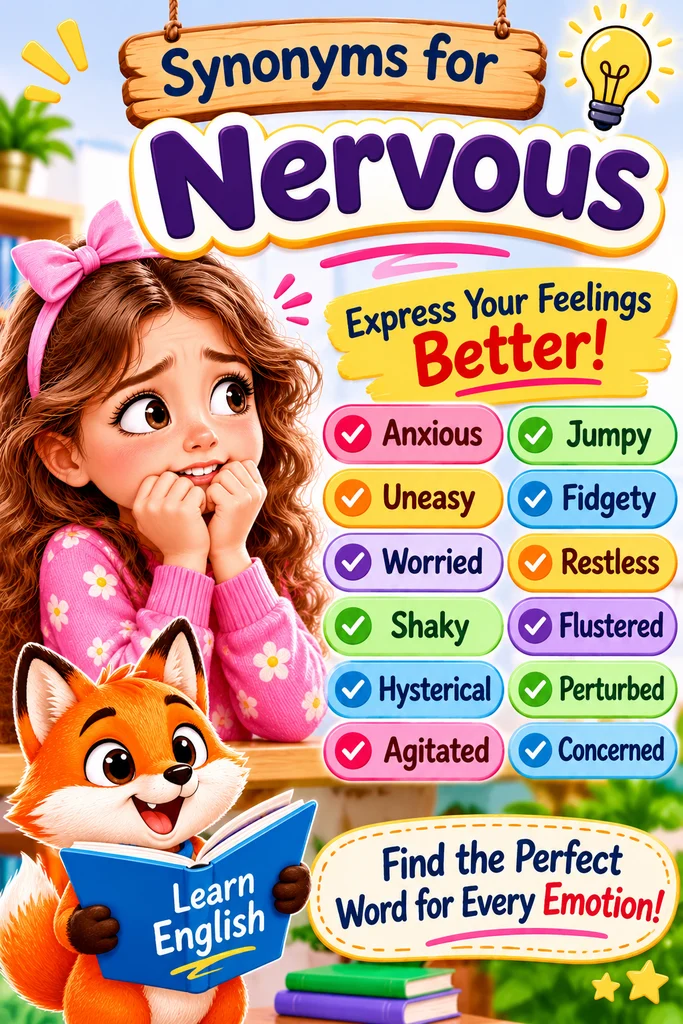
A job interview, an important exam, or an unexpected conversation can leave you feeling nervous, but not every uncomfortable feeling is exactly the same. Sometimes you’re worried about what might happen; other times, you’re tense, uneasy, or afraid of making a mistake.
Nervous generally describes a feeling of worry, uneasiness, or apprehension, especially when facing uncertainty or an important situation. Depending on the context, useful synonyms include anxious, apprehensive, uneasy, worried, tense, jittery, edgy, fearful, and on edge. However, each word carries a different shade of meaning. Apprehensive suggests concern about something approaching, jittery describes nervous energy, and fearful expresses a stronger sense of fear.
Choosing the right alternative can make emotional descriptions more precise and natural. Whether you’re writing an essay, describing a character, or improving your vocabulary, these 50+ synonyms for nervous will help you express exactly how someone feels.

Anxious
Meaning:
Anxious means feeling worried or uneasy about something that might happen.
Examples:
- “She felt anxious the night before her driving test.”
- The anxious parents waited outside the operating room.
Uneasy
Meaning:
Uneasy means mildly uncomfortable, with a sense that something isn’t quite right.
Examples:
- “The strange silence in the house made him uneasy.”
- She felt uneasy walking alone through the dark parking lot.
Apprehensive
Meaning:
Apprehensive means nervous about a future event, expecting something unpleasant.
Examples:
- “I was apprehensive about meeting her parents for the first time.”
- He was apprehensive about the surgery scheduled for Monday.
On edge
Meaning:
On edge means restless and tense, easily startled by small things.
Examples:
- “After three cups of coffee, he was completely on edge.”
- The whole neighborhood was on edge after the break-in.
Tense
Meaning:
Tense means stiff with worry, unable to relax your body or mind.
Examples:
- “Her shoulders were tense before the big presentation.”
- The tense silence in the courtroom was unbearable.
Jittery
Meaning:
Jittery means shaky and restless from nerves or too much caffeine.
Examples:
- “He felt jittery while waiting for the interviewer’s call.”
- Too much caffeine made her hands jittery and restless.
Fidgety
Meaning:
Fidgety means unable to sit still because of nervous energy.
Examples:
- “The fidgety kid kept tapping his pencil during the exam.”
- The fidgety toddler could not sit still at dinner.
Restless
Meaning:
Restless means unable to relax or stay calm, always wanting to move.
Examples:
- “She spent a restless night tossing and turning.”
- The restless crowd grew louder as the concert was delayed.
Edgy
Meaning:
Edgy means irritable and nervous, as if you might snap at any moment.
Examples:
- “Tight deadlines always make him edgy and short-tempered.”
- The edgy comedian kept the audience laughing nervously.
Keyed up
Meaning:
Keyed up means excited and nervous at the same time, full of energy.
Examples:
- “The whole team was keyed up before the championship match.”
- The kids were keyed up about the school trip.
Wound up
Meaning:
Wound up means tense and overexcited, like a spring ready to release.
Examples:
- “Don’t get so wound up; the results will come when they come.”
- She gets wound up whenever the phone rings unexpectedly.
Stressed
Meaning:
Stressed means overwhelmed by pressure, feeling unable to cope.
Examples:
- “She felt stressed juggling work and her final exams.”
- The stressed nurse barely slept during the night shift.
Frazzled
Meaning:
Frazzled means worn out and nervous from too much happening at once.
Examples:
- “After back-to-back meetings, he looked completely frazzled.”
- By Friday evening, the frazzled teacher needed a long rest.
High-strung
Meaning:
High-strung means naturally tense and easily made nervous.
Examples:
- “My high-strung cat hides under the bed whenever guests arrive.”
- His high-strung boss demanded updates every single hour.
Overwrought
Meaning:
Overwrought means extremely emotional and worked up beyond reason.
Examples:
- “She was overwrought after hearing the shocking news.”
- The overwrought actor wept through the entire acceptance speech.
Worried
Meaning:
Worried means thinking that something bad might happen.
Examples:
- “He was worried about his mother’s health.”
- The worried hiker checked his map every few minutes.
Fretful
Meaning:
Fretful means worrying constantly, even over small things.
Examples:
- “The fretful mother called the school three times that day.”
- The fretful baby finally slept in his mother’s arms.
Troubled
Meaning:
Troubled means disturbed by worry, unable to feel at peace.
Examples:
- “A troubled look crossed his face as he read the letter.”
- A troubled conscience kept him awake that night.
Concerned
Meaning:
Concerned means worried in a caring, thoughtful way.
Examples:
- “She was concerned about her friend’s long silence.”
- Neighbors were concerned when the lights stayed off.
Disquieted
Meaning:
Disquieted means deeply unsettled, with a worry you can’t shake off.
Examples:
- “He felt disquieted by the strange phone call.”
- The strange dream disquieted her for the rest of the week.
Shaky
Meaning:
Shaky means trembling slightly, often in your hands or voice.
Examples:
- “Her hands were shaky as she signed the contract.”
- His shaky voice betrayed how nervous he really was.
Trembling
Meaning:
Trembling means shaking involuntarily from fear or nerves.
Examples:
- “He was trembling so hard he could barely hold the microphone.”
- The trembling kitten hid behind the sofa cushions.
Quivering
Meaning:
Quivering means shaking lightly, often used for lips or a voice.
Examples:
- “With a quivering voice, she read her poem aloud.”
- She spoke with a quivering lip but steady eyes.
Twitchy
Meaning:
Twitchy means making small, jerky movements from nervousness.
Examples:
- “The twitchy witness kept glancing at the door.”
- The twitchy rabbit bolted at the slightest sound.
Panicky
Meaning:
Panicky means feeling sudden, intense fear that you can’t control.
Examples:
- “She felt panicky when she realized she’d lost her passport.”
- He felt panicky when the elevator suddenly stopped.
Fearful
Meaning:
Fearful means full of fear about what might happen next.
Examples:
- “He was fearful of failing the entrance exam.”
- The fearful deer froze at the sound of footsteps.
Frightened
Meaning:
Frightened means scared by something sudden or threatening.
Examples:
- “The frightened child clung to his mother during the storm.”
- The frightened horse reared up and galloped away.
Scared
Meaning:
Scared means feeling fear — the simplest everyday word for it.
Examples:
- “I’m scared of speaking in front of large crowds.”
- The scared little puppy whimpered throughout the thunderstorm.
Alarmed
Meaning:
Alarmed means suddenly worried because something seems wrong.
Examples:
- “She was alarmed by the smoke coming from the kitchen.”
- The guard was alarmed by the broken window.
Skittish
Meaning:
Skittish means easily frightened, jumping at small surprises.
Examples:
- “The rescue dog was skittish around strangers.”
- The skittish horse avoided the noisy construction site.
Jumpy
Meaning:
Jumpy means startling easily at sudden sounds or movements.
Examples:
- “After the horror movie, I felt jumpy all night.”
- The jumpy cat knocked over the flower vase.
Timid
Meaning:
Timid means shy and lacking confidence in social situations.
Examples:
- “The timid student rarely raised her hand in class.”
- The timid deer drank quietly at the stream.
Shy
Meaning:
Shy means nervous around people, uncomfortable being noticed.
Examples:
- “He was too shy to introduce himself at the party.”
- The shy kitten peeked out from under the bed.
Bashful
Meaning:
Bashful means shy in a sweet, self-conscious way.
Examples:
- “She gave a bashful smile when they praised her cooking.”
- The bashful groom blushed through his wedding vows.
Self-conscious
Meaning:
Self-conscious means nervous about how other people see you.
Examples:
- “He felt self-conscious about his accent in the new city.”
- She felt self-conscious wearing the bright red dress.
Hesitant
Meaning:
Hesitant means pausing because you’re unsure or nervous.
Examples:
- “She was hesitant to share her idea in the meeting.”
- The hesitant swimmer dipped one toe in the cold pool.
Wary
Meaning:
Wary means cautious and watchful, expecting possible trouble.
Examples:
- “He was wary of signing the contract too quickly.”
- The wary cat watched the new puppy from afar.
Cautious
Meaning:
Cautious means careful to avoid risk, moving slowly and thoughtfully.
Examples:
- “She took cautious steps onto the icy sidewalk.”
- The cautious driver slowed down in the heavy fog.
Flustered
Meaning:
Flustered means confused and nervous, losing your composure.
Examples:
- “He got flustered when the teacher asked a surprise question.”
- She got flustered when the zipper stuck on stage.
Rattled
Meaning:
Rattled means shaken up by something unexpected.
Examples:
- “The near-miss on the highway left her rattled.”
- The loud crash left the toddler rattled and tearful.
Unnerved
Meaning:
Unnerved means losing confidence because something unsettled you.
Examples:
- “The empty hallway unnerved him more than he’d admit.”
- The creaking stairs unnerved the babysitter that night.
Perturbed
Meaning:
Perturbed means bothered and slightly anxious about something.
Examples:
- “She was perturbed by the rude email from her boss.”
- The loud late-night music perturbed the elderly neighbors.
45+Synonyms for Obvious: Find a More Precise Word
Disconcerted
Meaning:
Disconcerted means thrown off balance, unsure how to react.
Examples:
- “He felt disconcerted by the stranger’s intense stare.”
- The sudden burst of applause disconcerted the shy speaker.
Agitated
Meaning:
Agitated means restless and upset, unable to settle down.
Examples:
- “The long delay left the passengers agitated.”
- The agitated bees swarmed around the fallen hive.
Unsettled
Meaning:
Unsettled means not calm or stable, feeling off balance inside.
Examples:
- “The news of layoffs left everyone unsettled.”
- The barking at night left the baby unsettled.
Butterflies
Meaning:
Butterflies means the fluttery feeling in your stomach before something exciting.
Examples:
- “She had butterflies before walking down the aisle.”
- He always gets butterflies before a big match.
Cold feet
Meaning:
Cold feet means sudden nervousness about a big commitment.
Examples:
- “He got cold feet the week before the wedding.”
- She got cold feet about the skydiving trip.
Stage fright
Meaning:
Stage fright means intense nervousness before performing in public.
Examples:
- “Even famous singers admit to having stage fright.”
- Stage fright made his knees shake before the audition.
A bundle of nerves
Meaning:
A bundle of nerves means someone so nervous they’re shaking all over.
Examples:
- “On her first day at work, she was a bundle of nerves.”
- Before the finals, he was a bundle of nerves.
Sweating bullets
Meaning:
Sweating bullets means extremely nervous, sweating from pure stress.
Examples:
- “He was sweating bullets while waiting for the exam results.”
- The driver was sweating bullets during the road test.
When to Use Which Synonym for Nervous
Picking the right word depends on the moment. For formal writing and essays, choose apprehensive, disquieted, perturbed, or disconcerted — they sound polished and precise. In casual conversation, go with on edge, jittery, wound up, or butterflies; they sound natural and relatable.
When describing emotional or vulnerable moments, anxious, unnerved, and a bundle of nerves carry real feeling. For physical symptoms, use shaky, trembling, quivering, or sweating bullets to show rather than tell. And in professional settings, softer words like concerned, cautious, or hesitant express nerves without sounding alarmed.

50+Synonyms for Night: From Dusk to the Dead of Night
Frequently Asked Questions About Synonyms for Nervous
What is the best synonym for nervous in formal writing?
Apprehensive is the safest choice for essays, reports, and professional writing. Disquieted and perturbed also work well when you want a more literary tone. These words sound measured rather than emotional, which suits academic and formal contexts.
What is a casual way to say nervous?
In everyday conversation, people say they’re on edge, jittery, or wound up. For excitement mixed with nerves, butterflies is perfect, and cold feet describes last-minute doubts about a commitment. These are all natural words similar to nervous that native speakers use daily.
What is the difference between anxious and nervous?
Nervous usually describes a short-term reaction to a specific event, like an interview or a first date. Anxious often suggests deeper, longer-lasting worry and is also used in medical contexts. In casual speech they overlap, but anxious generally sounds more serious.
How can I say I’m nervous without sounding unprofessional?
Try softer phrasing like “I’m feeling the pressure” or “I’m a little on edge about this.” The words concerned, cautious, and hesitant also express nerves while sounding thoughtful and in control — ideal for interviews and meetings.
What is the opposite of nervous?
Common antonyms include calm, relaxed, composed, confident, and at ease. If someone was panicky before, they might feel relieved after; if they were on edge, they become laid-back.
Can being nervous ever be a good thing?
Yes — nerves are often just energy. A little nervousness sharpens focus, boosts adrenaline, and shows you care about the outcome. That’s why performers welcome butterflies before a show: the feeling means the moment matters to them.
Conclusion
Growing your vocabulary is one of the simplest ways to express yourself with honesty and color. The next time your heart races or your palms sweat, skip the tired default and reach for a word that truly matches the moment — whether that’s jittery before good news or unnerved after a scare. Keep a few of these synonyms for nervous in your back pocket, and your writing and conversations will feel instantly more vivid.
Author

Emily Carter is a vocabulary specialist and content writer at SynonymCore. She loves breaking down the nuances of English words and helping readers find exactly the right word for every occasion.
Pingback: 48+Synonyms for Music: Beyond Songs and Melodies