
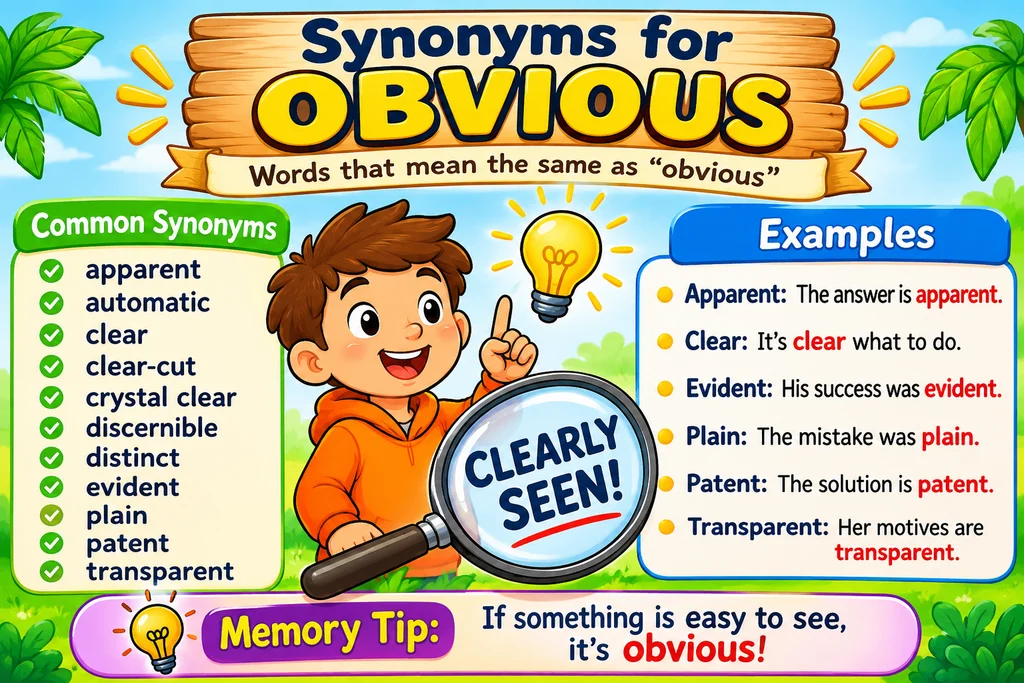
Sometimes obvious is the right word, but repeating it in an essay, conversation, or article can make your writing sound less precise. The best alternative depends on whether something is easy to see, simple to understand, or impossible to deny. Obvious means clear or easy to recognize without needing much explanation.
Depending on the context, useful synonyms include evident, apparent, noticeable, unmistakable, self-evident, manifest, plain, and conspicuous. However, each word carries a slightly different meaning. Conspicuous describes something that attracts attention, evident suggests that facts or signs make something clear, and self-evident describes something that needs no explanation.
Choosing the right alternative can make your message more accurate and natural. Whether you’re writing an essay, improving your vocabulary, or avoiding repetition, these 50+ synonyms for obvious will help you express your ideas more effectively.

Clear
Meaning:
Clear means easily understood; nothing confusing about it.
Examples:
- The instructions were clear enough for a beginner to follow.
- The sky was clear after the rain.
Evident
Meaning:
Evident means plainly visible or understood from the facts in front of you.
Examples:
- From the muddy shoes by the door, it was evident the kids had been outside.
- It was evident from her smile that she passed.
Apparent
Meaning:
Apparent means seeming true based on what you can see, though not always certain.
Examples:
- For no apparent reason, the lights went out during the movie.
- The solution became apparent after some thought.
Plain
Meaning:
Plain means simple and easy to see, with nothing hidden.
Examples:
- It was plain to everyone in the room that he was nervous before the interview.
- The truth was plain in her eyes.
Noticeable
Meaning:
Noticeable means easy to see or become aware of.
Examples:
- There was a noticeable improvement in her grades this semester.
- A noticeable stain marked the carpet.
Visible
Meaning:
Visible means able to be seen with the eyes.
Examples:
- The mountain was barely visible through the morning fog.
- The stars were barely visible tonight.
Distinct
Meaning:
Distinct means clearly different and easy to recognize.
Examples:
- He spoke with a distinct accent that everyone in the class remembered.
- The two twins have distinct personalities.
Recognizable
Meaning:
Recognizable means easy to identify because it clearly stands out.
Examples:
- His laugh was instantly recognizable across the crowded hall.
- The brand’s logo is instantly recognizable.
Unmissable
Meaning:
Unmissable means so noticeable that you cannot possibly overlook it.
Examples:
- The bright yellow sign was unmissable from the road.
- The red banner was unmissable.
Self-explanatory
Meaning:
Self-explanatory means so clear that it needs no further explanation.
Examples:
- The diagram was self-explanatory, even for the youngest students.
- The new remote is self-explanatory.
Blatant
Meaning:
Blatant means offensively obvious; done without any shame.
Examples:
- The referee missed a blatant foul right in front of him.
- He showed a blatant disregard for the rules.
Glaring
Meaning:
Glaring means standing out in a harsh, impossible-to-ignore way.
Examples:
- There was a glaring error in the second paragraph of the report.
- The report had a glaring typo on page one.
Conspicuous
Meaning:
Conspicuous means easily noticed because it stands out from everything around it.
Examples:
- He felt conspicuous wearing a suit to a casual beach party.
- The bright mural was conspicuous on the gray wall.
Striking
Meaning:
Striking means grabbing attention because it is unusual or strong.
Examples:
- The resemblance between the two sisters was striking.
- She wore a striking red dress.
Prominent
Meaning:
Prominent means standing out clearly; easily seen or important.
Examples:
- She played a prominent role in organizing the charity event.
- The tower is a prominent landmark.
Pronounced
Meaning:
Pronounced means very noticeable; stronger than usual.
Examples:
- He walked with a pronounced limp after running the marathon.
- She has a pronounced fear of heights.
Marked
Meaning:
Marked means clearly noticeable, often describing a change.
Examples:
- There has been a marked improvement in his confidence lately.
- There was a marked drop in temperature.
Stark
Meaning:
Stark means harshly clear; impossible to soften or ignore.
Examples:
- The report painted a stark picture of the company’s losses.
- The contrast between rich and poor was stark.
Vivid
Meaning:
Vivid means bright and strong in a way that is hard to ignore.
Examples:
- She gave a vivid description of the storm that hit the coast.
- He has vivid memories of childhood.
Graphic
Meaning:
Graphic means described in clear, sometimes shocking detail.
Examples:
- The witness gave a graphic account of the accident.
- The novel contains graphic battle scenes.
Manifest
Meaning:
Manifest means clear enough that it shows itself openly; often used in formal writing.
Examples:
- Her joy was manifest in the huge smile she wore all evening.
- His talent was manifest from an early age.
Patent
Meaning:
Patent means, in formal use, easy to see; not hidden at all.
Examples:
- The painting was a patent forgery, obvious even to an untrained eye.
- It was patent nonsense from the start.
Palpable
Meaning:
Palpable means so strong that you can almost feel it physically.
Examples:
- The tension in the room was palpable before the results were announced.
- Excitement was palpable before the concert.
Unmistakable
Meaning:
Unmistakable means impossible to mistake for anything else.
Examples:
- His voice had an unmistakable warmth that calmed the whole class.
- Her handwriting is unmistakable.
Transparent
Meaning:
Transparent means open and honest; nothing concealed.
Examples:
- She gave a transparent account of what went wrong with the project.
- The company keeps its pricing transparent.
Discernible
Meaning:
Discernible means just barely able to be seen or understood, sometimes with effort.
Examples:
- There was no discernible difference between the two fabric samples.
- A discernible pattern emerged in the data.
Perceptible
Meaning:
Perceptible means able to be noticed through the senses or the mind.
Examples:
- A perceptible chill filled the hall when the doors opened.
- A perceptible tension filled the meeting.
Unambiguous
Meaning:
Unambiguous means having only one clear meaning; not confusing at all.
Examples:
- The coach gave unambiguous instructions before the match began.
- The sign gave an unambiguous warning.
Unequivocal
Meaning:
Unequivocal means, in formal use, completely clear, leaving no room for doubt.
Examples:
- The manager’s answer to the proposal was an unequivocal yes.
- The test gave an unequivocal result.
Crystal-clear
Meaning:
Crystal-clear means perfectly easy to understand, like looking through clean glass.
Examples:
- Her explanation of the rules was crystal-clear to everyone.
- His intentions were crystal-clear.
Flagrant
Meaning:
Flagrant means shockingly obvious, usually about a rule being broken.
Examples:
- The player committed a flagrant foul and was sent off the field.
- The driver ran a flagrant red light.
Brazen
Meaning:
Brazen means shamelessly open about something bold or wrong.
Examples:
- She made a brazen attempt to copy his answers during the test.
- The thief made a brazen escape.
Barefaced
Meaning:
Barefaced means openly and shamelessly obvious, often about a lie.
Examples:
- He told a barefaced lie about where he had been all night.
- It was a barefaced attempt to cheat.
Overt
Meaning:
Overt means done openly, with no attempt to hide it.
Examples:
- There was no overt hostility, but the cold silence said plenty.
- Their support was overt and public.
Open
Meaning:
Open means not hidden; visible or known to everyone.
Examples:
- They kept their disagreements open instead of pretending everything was fine.
- The trial was open to the public.
Unconcealed
Meaning:
Unconcealed means not hidden at all; fully visible.
Examples:
- He watched the final match with unconcealed excitement.
- She watched with unconcealed joy.
Undisguised
Meaning:
Undisguised means shown plainly, without any attempt to cover it up.
Examples:
- She opened the gift with undisguised delight.
- He stared with undisguised curiosity.
Naked
Meaning:
Naked means, as in the naked truth, completely plain, with nothing covered up.
Examples:
- The documentary showed the naked reality of life in the refugee camp.
- The film showed the naked truth about war.
In-your-face
Meaning:
In-your-face means, in informal use, aggressively obvious; impossible to ignore.
Examples:
- The advertisement was so in-your-face that nobody could miss the sale.
- The band’s style is loud and in-your-face.
Plain as day
Meaning:
Plain as day means, as an idiom, completely obvious to everyone.
Examples:
- It was plain as day that the dog had eaten the homework.
- It was plain as day she was upset.
Beyond Any Doubt
Self-evident
Meaning:
Self-evident means so clear that it needs no explanation or proof.
Examples:
- That hard work pays off is a self-evident truth for most athletes.
- His guilt was self-evident.
Undeniable
Meaning:
Undeniable means impossible to deny; clearly true.
Examples:
- Her talent for music was undeniable from the very first note.
- The benefits of exercise are undeniable.
Indisputable
Meaning:
Indisputable means cannot be argued against because the facts are so clear.
Examples:
- It is indisputable that regular exercise improves your mood.
- Her victory was indisputable.
Unquestionable
Meaning:
Unquestionable means beyond doubt; no one would challenge it.
Examples:
- His loyalty to the team was unquestionable.
- His courage was unquestionable.
48+Synonyms for Opposite: More Than Just the Reverse
Irrefutable
Meaning:
Irrefutable means impossible to disprove with evidence.
Examples:
- The security footage provided irrefutable proof of what happened.
- The DNA gave irrefutable proof.
Incontrovertible
Meaning:
Incontrovertible means, in formal use, absolutely certain; cannot be disputed.
Examples:
- The scientists presented incontrovertible evidence of the discovery.
- The data provided incontrovertible facts.
Inescapable
Meaning:
Inescapable means impossible to avoid noticing.
Examples:
- After the storm passed, the damage to the village was inescapable.
- The smell of fresh bread was inescapable.
Unavoidable
Meaning:
Unavoidable means impossible to prevent; bound to be noticed.
Examples:
- The comparison between the two candidates was unavoidable.
- Delays were unavoidable during rush hour.
Definite
Meaning:
Definite means firm and clear; not vague in any way.
Examples:
- There was a definite change in his attitude after the trip.
- She gave a definite answer.
Decided
Meaning:
Decided means noticeably strong or clear.
Examples:
- She answered the question with a decided edge in her voice.
- He spoke with a decided confidence.
When to Use Which
Not every synonym for obvious fits every moment — here’s a quick guide:
- Formal writing and essays: reach for manifest, self-evident, unequivocal, or incontrovertible. They sound academic and carry real weight.
- Casual conversation: clear, plain, crystal-clear, and plain as day feel natural and friendly.
- Calling out bad behavior: blatant, flagrant, brazen, and barefaced add justified attitude.
- Describing feelings or atmosphere: palpable is the star — it turns something abstract into something you can almost touch.
- When something is barely there: discernible and perceptible suggest it takes a little effort to notice.

56+Synonyms for Place: Say It More Precisely
Frequently Asked Questions
What is the best synonym for obvious in formal writing?
For essays, reports, and academic work, manifest, self-evident, unequivocal, and incontrovertible are the strongest picks. They sound precise and authoritative without the casual edge that “obvious” sometimes carries. Save blatant or glaring for persuasive or opinion writing, where emotion is welcome.
What is a stronger word than obvious?
If you want more punch, try blatant, glaring, flagrant, or brazen. They don’t just say something is clear — they add judgment. Use them when you want your reader to feel the weight of what you’re saying.
What is the difference between apparent and obvious?
“Apparent” means something seems true based on the evidence, but it could turn out to be wrong — “the apparent winner” might still lose. “Obvious” leaves no room for doubt. If you want to sound careful and avoid overstating your case, “apparent” is the safer choice.
What is the opposite of obvious?
Good antonyms include subtle, hidden, obscure, ambiguous, and inconspicuous. Knowing the opposites helps you pick the right word too — if “subtle” fits better than “blatant,” you’ve just saved your sentence from sounding too loud.
Can I use obvious in academic writing?
You can, but sparingly. In academic writing, evident, manifest, and self-evident usually sound more polished. Saying “it is obvious that…” can also sound like you’re dismissing the reader, so softer alternatives keep your tone professional.
What is a casual way to say obvious?
In everyday conversation, try clear as day, plain as day, or simply clear — they sound natural and relaxed.
Conclusion
See how much life a single word can have? Swapping “obvious” for palpable, blatant, or self-evident doesn’t just avoid repetition — it tells your reader exactly how obvious something is, and how you feel about it. Start small: pick three favorites from these synonyms for obvious and use them this week. Before long, reaching for the precise word will feel as natural as reaching for “obvious” ever did. Keep exploring, keep upgrading your vocabulary, and watch your writing get sharper with every sentence.
Author

Emily Carter is a vocabulary specialist and content writer at SynonymCore. She loves breaking down the nuances of English words and helping readers find exactly the right word for every occasion.