
Have you ever called something random because you couldn’t find a more precise word to describe it? Although random is common in everyday English, its meaning changes depending on whether you’re describing a choice, an event, a pattern, or someone’s behavior.
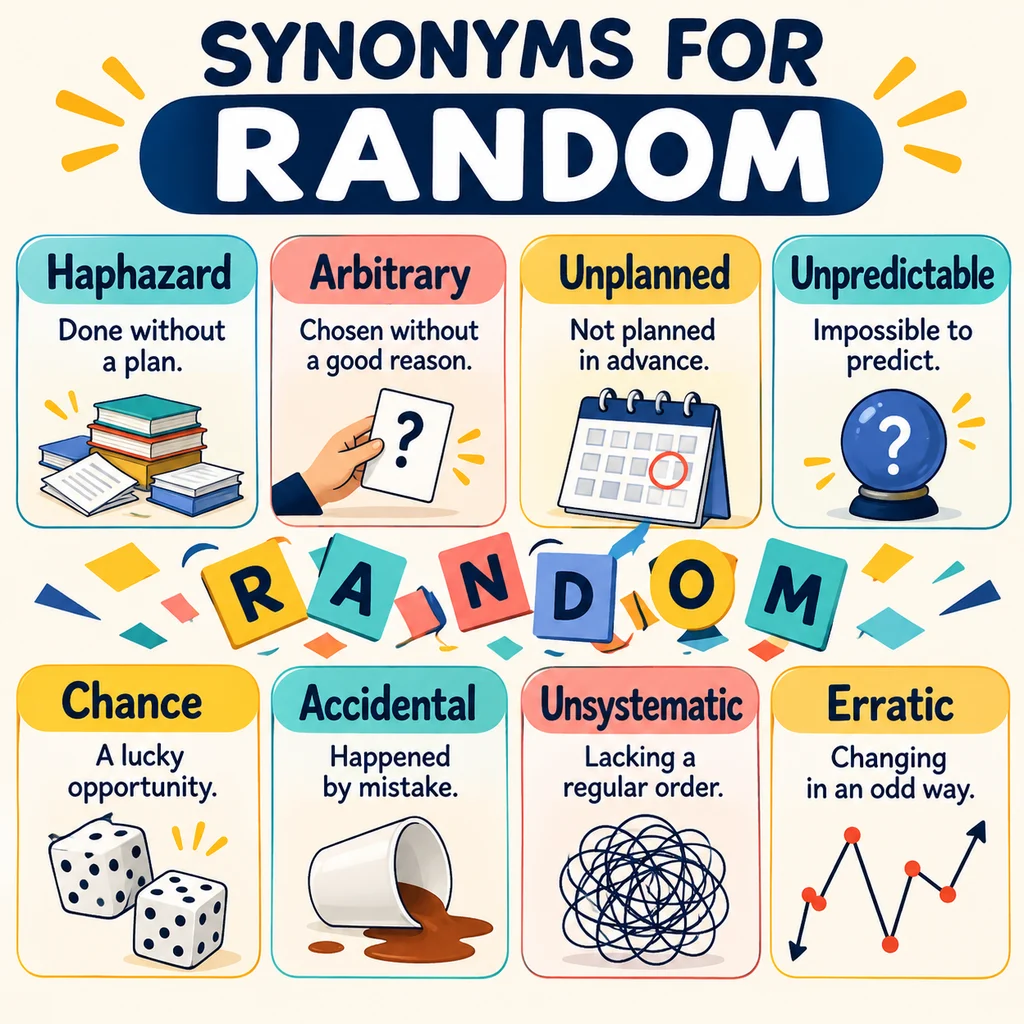
Random generally means happening, occurring, or being selected without a predictable plan, pattern, or deliberate order. Depending on the context, useful synonyms for random include arbitrary, haphazard, accidental, chance, unpredictable, unplanned, and unsystematic. However, these alternatives express different ideas. An arbitrary decision lacks a clear reason, an accidental event happens unintentionally, and a haphazard arrangement lacks organization.
Whether you’re writing an essay, describing an unexpected situation, or expanding your everyday vocabulary, these 50+ synonyms for random will help you choose more accurate and natural expressions.

50 Striking Synonyms for Random, Grouped by Meaning
These words similar to random are grouped by shade of meaning, from formal to playful, so you can grab the right one fast.
Arbitrary
Meaning:
Arbitrary means based on personal whim rather than any rule, reason, or system.
Examples:
- The teacher’s arbitrary seating plan put best friends on opposite sides of the room.
- The referee’s arbitrary decision angered both teams.
Haphazard
Meaning:
Haphazard means lacking any order or plan; messy and done carelessly.
Examples:
- His notes were scattered in haphazard piles across the entire desk.
- Clothes lay in haphazard heaps on the floor.
Accidental
Meaning:
Accidental means happening by chance, without being planned or intended.
Examples:
- Their accidental meeting at the airport turned into a lifelong friendship.
- The spilled paint created an accidental masterpiece.
Chance
Meaning:
Chance means occurring because of luck or coincidence rather than design.
Examples:
- A chance encounter with her old coach changed the direction of her career.
- A chance meeting led to a lifelong friendship.
Happenstance
Meaning:
Happenstance means a coincidence or chance event, often a pleasant surprise.
Examples:
- By pure happenstance, we booked the same hotel on the same weekend.
- By happy happenstance, they sat together again.
Coincidental
Meaning:
Coincidental means happening at the same time by chance, not by arrangement.
Examples:
- It was purely coincidental that we both wore the same shirt.
- Their arrival at the same café was purely coincidental.
Fortuitous
Meaning:
Fortuitous means happening by lucky chance, with a fortunate outcome.
Examples:
- The fortuitous rain saved the farmer’s entire harvest.
- A fortuitous delay saved them from the crash.
Serendipitous
Meaning:
Serendipitous means a happy accident; finding something wonderful unexpectedly.
Examples:
- Their serendipitous discovery in the old bookstore made the whole trip worthwhile.
- The trip led to a serendipitous reunion.
Lucky
Meaning:
Lucky means brought about by good fortune rather than careful planning.
Examples:
- He made a lucky guess and won the entire quiz round.
- She found a lucky coin on the sidewalk.
Unplanned
Meaning:
Unplanned means not thought out or arranged in advance.
Examples:
- Our unplanned road trip became the best weekend of the summer.
- Their unplanned picnic was absolutely perfect.
Unexpected
Meaning:
Unexpected means not predicted or foreseen; catching you by surprise.
Examples:
- The unexpected snowstorm forced the school to close early.
- The movie had an unexpected twist ending.
Unpredictable
Meaning:
Unpredictable means impossible to know in advance; changing without warning.
Examples:
- The mountain weather was so unpredictable that climbers packed for every season.
- Her moods are completely unpredictable.
Unpremeditated
Meaning:
Unpremeditated means done without prior thought, planning, or intention.
Examples:
- His unpremeditated joke made the whole classroom burst out laughing.
- His unpremeditated apology sounded sincere.
Unintentional
Meaning:
Unintentional means not done on purpose; happening without meaning to.
Examples:
- Her unintentional comment accidentally revealed the surprise party.
- The error was unintentional and quickly fixed.
Involuntary
Meaning:
Involuntary means happening without conscious control or choice.
Examples:
- An involuntary gasp escaped her when the magician revealed the card.
- An involuntary shiver ran down his spine.
Impulsive
Meaning:
Impulsive means acting suddenly on a whim, without stopping to think.
Examples:
- In an impulsive moment, she bought tickets to Paris.
- She made an impulsive decision to move abroad.
Spontaneous
Meaning:
Spontaneous means happening naturally, without being planned or forced.
Examples:
- Their spontaneous dance in the rain delighted everyone at the park.
- The crowd broke into spontaneous applause.
Capricious
Meaning:
Capricious means changing suddenly and unpredictably, often on a whim.
Examples:
- The capricious wind kept changing direction during the sailing race.
- The capricious weather ruined their picnic.
Whimsical
Meaning:
Whimsical means playfully odd or unpredictable, driven by fancy rather than reason.
Examples:
- The café’s whimsical decor featured teapots hanging from the ceiling.
- The garden had a whimsical fairy theme.
Fanciful
Meaning:
Fanciful means guided by imagination rather than logic; unrealistically free.
Examples:
- He painted a fanciful mural of whales flying over the city.
- He dreamed up fanciful plans for a treehouse.
Erratic
Meaning:
Erratic means irregular and unpredictable in movement, behavior, or pattern.
Examples:
- The erratic bus schedule made it impossible to plan the commute.
- The car made an erratic turn.
Sporadic
Meaning:
Sporadic means happening occasionally and at irregular intervals.
Examples:
- Sporadic showers are expected throughout the afternoon.
- Sporadic gunfire echoed in the distance.
Intermittent
Meaning:
Intermittent means starting and stopping repeatedly; never continuous.
Examples:
- The intermittent Wi-Fi kept dropping during the video call.
- They worked through intermittent power cuts.
Occasional
Meaning:
Occasional means happening from time to time, but not regularly.
Examples:
- She treats herself to an occasional slice of chocolate cake.
- He takes an occasional evening stroll.
Infrequent
Meaning:
Infrequent means not happening often; rare and widely spaced.
Examples:
- His infrequent visits always felt like special occasions.
- Her infrequent letters were always treasured.
Irregular
Meaning:
Irregular means not following a set pattern, rhythm, or schedule.
Examples:
- The irregular heartbeat worried the doctor during the checkup.
- He works irregular hours at the hospital.
Fleeting
Meaning:
Fleeting means passing quickly; here one moment and gone the next.
Examples:
- A fleeting smile crossed her face before she turned away.
- A fleeting shadow crossed the window.
Scattered
Meaning:
Scattered means spread out widely with no clear order or pattern.
Examples:
- Scattered toys covered every inch of the living room floor.
- Scattered applause filled the hall.
Disjointed
Meaning:
Disjointed means lacking connection or smooth order; falling apart.
Examples:
- The disjointed plot made the movie hard to follow.
- His disjointed speech confused the audience.
Unsystematic
Meaning:
Unsystematic means done without any organized method or system.
Examples:
- His unsystematic study habits left huge gaps in his knowledge.
- Her unsystematic filing annoyed coworkers.
Disorganized
Meaning:
Disorganized means messy and lacking structure or careful planning.
Examples:
- The disorganized files took hours to sort through.
- The disorganized desk hid important papers.
Chaotic
Meaning:
Chaotic means completely disordered and confusing, with no control.
Examples:
- The chaotic kitchen during the dinner rush was pure madness.
- The protest turned chaotic quickly.
Disorderly
Meaning:
Disorderly means lacking tidiness, discipline, or neat arrangement.
Examples:
- The disorderly crowd pushed forward when the gates opened.
- The disorderly queue annoyed everyone.
Unselective
Meaning:
Unselective means choosing without care or any specific criteria.
Examples:
- The unselective hiring process brought in a wildly mixed team.
- The club’s unselective membership grew fast.
Indiscriminate
Meaning:
Indiscriminate means done without distinguishing one thing from another.
Examples:
- The indiscriminate spraying harmed helpful insects too.
- The storm caused indiscriminate damage.
Unbiased
Meaning:
Unbiased means not favoring any side; choosing without prejudice.
Examples:
- The researcher used an unbiased method to select participants.
- The judge gave an unbiased ruling.
Randomized
Meaning:
Randomized means arranged by chance so every option has an equal shot.
Examples:
- The randomized test questions were different for every student.
- The study used randomized groups.
46+Synonyms for Represent: Beyond Show, Stand For, and Symbolize
Casual
Meaning:
Casual means relaxed and informal, without much thought or ceremony.
Examples:
- Over a casual lunch, they decided to start a business.
- They shared a casual chat over coffee.
Offhand
Meaning:
Offhand means said or done without preparation or deep thought.
Examples:
- His offhand remark about the movie sparked a long debate.
- I can’t answer offhand; let me check.
Incidental
Meaning:
Incidental means happening as a minor side effect, not the main aim.
Examples:
- The incidental music in the film added real emotion.
- The benefits were purely incidental.
Desultory
Meaning:
Desultory means lacking a clear plan or purpose; jumping between topics.
Examples:
- Their desultory conversation wandered from movies to travel to food.
- The meeting was desultory and unproductive.
Hit-or-miss
Meaning:
Hit-or-miss means sometimes good, sometimes bad; unreliable and unpredictable.
Examples:
- The café’s service is hit-or-miss depending on the day.
- The Wi-Fi here is hit-or-miss.
Shotgun
Meaning:
Shotgun means scattered widely in many directions all at once.
Examples:
- The startup took a shotgun approach, trying every marketing trick at once.
- They took a shotgun approach to marketing.
Wayward
Meaning:
Wayward means wandering off course; difficult to control or predict.
Examples:
- The wayward puppy dashed down three different streets.
- The wayward balloon floated away.
Stray
Meaning:
Stray means wandering away from the group or the intended path.
Examples:
- A stray thought about the beach distracted her during the meeting.
- A stray dog followed us home.
Wandering
Meaning:
Wandering means moving aimlessly with no fixed direction or goal.
Examples:
- We spent the afternoon wandering through the old market streets.
- A wandering minstrel played outside.
Odd
Meaning:
Odd means strange or unusual; not fitting the normal pattern.
Examples:
- There was an odd silence after he asked the question.
- He had an odd habit of humming.
Quirky
Meaning:
Quirky means unusually charming in an odd, unpredictable way.
Examples:
- Her quirky habit of narrating her cooking amused all her friends.
- The café has a quirky vintage vibe.
Unsifted
Meaning:
Unsifted means not sorted or filtered; taken just as it comes.
Examples:
- The unsifted comments poured in from every corner of the internet.
- Unsifted flour works fine for pancakes.
Aleatory
Meaning:
Aleatory means depending on chance or luck rather than deliberate design.
Examples:
- The composer left several passages to aleatory choice, so no two performances sound alike.
- The game relies on aleatory dice rolls.
When to Use Which Synonym for Random
Picking from these synonyms for random gets easy once you match the word to the moment. For formal writing — essays, reports, research — reach for arbitrary, indiscriminate, or unsystematic; they sound precise and carry weight. In everyday conversation, hit-or-miss, offhand, and casual feel natural and relaxed. Writing about luck or happy accidents? Serendipitous, fortuitous, and happenstance add warmth — much like our thoughtful synonyms for foster do for encouraging words. When something feels delightfully strange, quirky, whimsical, or odd capture that playful energy.

47 Eye-Opening Synonyms for Reason That Will Sharpen Your Thinking
Frequently Asked Questions
What is the best synonym for random in formal writing?
Arbitrary is the strongest choice for formal writing, followed by indiscriminate and unsystematic. These words carry a precise, academic tone that suits essays, reports, and research papers. For example, write “an arbitrary selection process” instead of “a random selection process” to sound more polished.
What is a casual way to say random?
In casual conversation, try hit-or-miss, offhand, or quirky depending on your meaning. “Hit-or-miss” suits unreliable things, “offhand” fits unplanned remarks, and “quirky” works for anything oddly charming. These keep your speech natural without sounding stiff.
Is “random” a negative word?
Not necessarily — random is neutral, and its tone depends entirely on context. “A random act of kindness” feels warm and positive, while “random violence” sounds alarming. To steer the tone, pick serendipitous for positive or chaotic for negative.
What is the difference between random and arbitrary?
Both describe a lack of plan, but they emphasize different things. Random stresses chance and unpredictability — no pattern at all. Arbitrary stresses a decision made on personal whim without reason or fairness. A coin flip is random; a referee’s unfair call is arbitrary.
What is the opposite of random?
Common antonyms include deliberate, planned, systematic, and intentional. These describe actions taken with purpose, order, and forethought. Knowing the opposites sharpens your contrasts — for instance, pairing a “systematic review” with “haphazard notes.”
Can random describe a person?
Yes, but informally — phrases like “some random guy” or “she’s so random” are common in casual speech. Here it usually means a stranger or someone unpredictable. For polished alternatives, try unfamiliar for a stranger or quirky for someone delightfully unpredictable.
Conclusion
Growing your vocabulary is one of the fastest ways to make your writing sharper, warmer, and more memorable. These synonyms for random give you a precise word for every situation — the formality of arbitrary, the luck of serendipitous, or the playfulness of quirky. Weave two or three into your writing this week and your sentences will gain color fast. Keep exploring, keep experimenting, and watch your word power grow.
Author

Sophia Lane is an English learning contributor at SynonymCore. She creates easy-to-understand guides on synonyms, antonyms, and everyday vocabulary.
Pingback: Synonyms for Quiet: Silent, Serene, Subdued, and More