
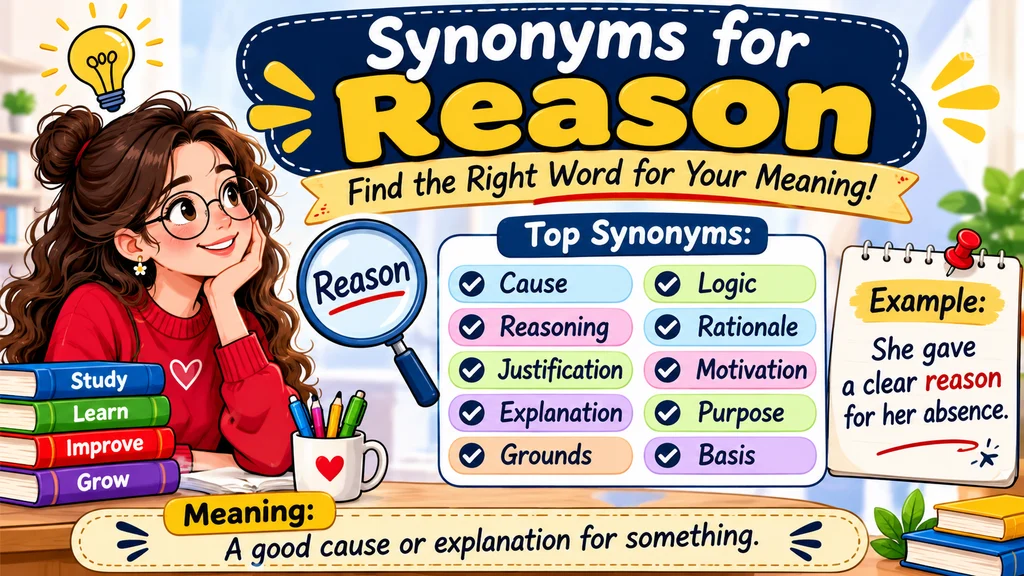
Do you struggle to find the right alternative to reason when explaining an event, describing someone’s actions, or supporting an opinion? The challenge is that one word can express several different ideas, and choosing the wrong replacement can change your sentence’s meaning.
Reason refers to a cause, explanation, purpose, motive, or justification behind something. Depending on the context, useful synonyms for reason include cause, explanation, motive, rationale, justification, basis, and grounds. However, each word serves a different purpose. A cause explains why something happens, a motive describes what drives someone’s actions, and a justification supports a decision.
Whether you’re writing an academic essay, preparing a professional report, or improving your everyday English, these 50+ synonyms for reason will help you choose more accurate words and communicate your ideas clearly.

Everyday words for daily conversation. Friendly, natural alternatives for texts and chats. Start here if you just need another word for reason without sounding like a textbook.
Cause
Meaning:
Cause means what makes something happen; the direct source of an event.
Examples:
- The cause of the delay was a broken signal on the track.
- The fire’s true cause remains under official investigation.
Motive
Meaning:
Motive means a hidden or personal drive behind someone’s actions.
Examples:
- The detective questioned his motive for leaving town suddenly.
- Jealousy was the secret motive behind the sudden crime.
Excuse
Meaning:
Excuse means a reason to justify a mistake or dodge blame.
Examples:
- Traffic was just an excuse; he simply woke up late.
- A headache was her excuse for skipping gym.
Trigger
Meaning:
Trigger means something that sets off a reaction or chain of events.
Examples:
- That old song was the trigger for so many childhood memories.
- Loud noises are a trigger for his anxiety.
Why
Meaning:
Why means the underlying reason behind something, framed as the big question.
Examples:
- Nobody could explain the why behind his sudden resignation.
- She never learned the why of his departure.
Purpose
Meaning:
Purpose means the intended aim of an action.
Examples:
- The purpose of the meeting is to finalize next year’s budget.
- The purpose of the fence is keeping deer out.
Point
Meaning:
Point means the central aim of doing something; the whole idea behind it.
Examples:
- The whole point of exercising is to stay healthy.
- The whole point of the game is teamwork.
Occasion
Meaning:
Occasion means a particular event or situation that gives rise to something.
Examples:
- The festival was the perfect occasion for a family reunion.
- Her graduation was a proud occasion for us.
Sense
Meaning:
Sense means sound judgment; the sensible case for doing something.
Examples:
- There is no sense in arguing with someone who won’t listen.
- It makes sense to check the weather first.
Brains
Meaning:
Brains means clever thinking; the mental ability to figure things out.
Examples:
- It took real brains to solve that puzzle in a minute.
- It took brains to fix the old radio.
Common sense
Meaning:
Common sense means practical, everyday judgment everyone should have.
Examples:
- It is common sense to save money for emergencies.
- Common sense says you should wear a helmet.
Explanation
Meaning:
Explanation means a statement that makes something clear.
Examples:
- His explanation for being late actually made sense.
- The strict teacher reluctantly accepted his honest explanation.
Rationale
Meaning:
Rationale means the logical basis behind a decision.
Examples:
- The manager outlined the rationale behind the new policy.
- The rationale for the fee increase was unclear.
Justification
Meaning:
Justification means a good reason proving something is right or necessary.
Examples:
- She offered no justification for skipping the meeting.
- There is absolutely no justification for cheating here.
Grounds
Meaning:
Grounds means facts or reasons supporting a belief or action.
Examples:
- He resigned from the board on the grounds of poor health.
- The court dismissed the case on legal grounds.
Basis
Meaning:
Basis means the underlying support on which an idea rests.
Examples:
- Mutual respect was the basis of their long friendship.
- Deep trust is the basis of any strong marriage.
Incentive
Meaning:
Incentive means something that encourages or motivates a person to act.
Examples:
- The cash bonus was a strong incentive to finish early.
- The discount was an incentive to buy now.
Impetus
Meaning:
Impetus means the force or energy that gets something moving.
Examples:
- Her early success gave the whole team fresh impetus.
- The unexpected award gave her career new impetus.
Inducement
Meaning:
Inducement means something attractive offered to persuade someone to act.
Examples:
- A free dessert was the inducement to join the tour.
- Tax breaks were the inducement for the factory.
Determinant
Meaning:
Determinant means a factor that decisively shapes or controls an outcome.
Examples:
- Price was the main determinant in their choice of hotel.
- Location was the key determinant of the rent.
Consideration
Meaning:
Consideration means a fact taken into account when making a decision.
Examples:
- Safety was the first consideration in choosing the car.
- Travel time was a major consideration in planning.
Factor
Meaning:
Factor means one of several things contributing to a result.
Examples:
- Hard work was a major factor in her promotion.
- Weather is a factor in every outdoor event.
Foundation
Meaning:
Foundation means the underlying base on which something is built.
Examples:
- Honest talk is the foundation of every strong relationship.
- Daily practice is the foundation of good music.
Argument
Meaning:
Argument means a reason or set of reasons supporting an opinion.
Examples:
- His strongest argument was last quarter’s sales data.
- Her strongest argument finally convinced the whole jury.
Drive
Meaning:
Drive means a strong inner urge pushing you relentlessly toward a goal.
Examples:
- Her drive to become a doctor kept her studying past midnight.
- Pure ambition was the drive behind his success.
Motivation
Meaning:
Motivation means the desire, enthusiasm, or willingness to do something.
Examples:
- He lost all motivation when the project was cancelled.
- Honest praise is a powerful motivation for kids.
Source
Meaning:
Source means where something comes from; the origin of an idea.
Examples:
- Curiosity was the source of all his great inventions.
- The river is the town’s main water source.
Root
Meaning:
Root means the basic, underlying origin of something.
Examples:
- Address the root of the problem, not just the symptoms.
- The root of the rumor was a misunderstanding.
Origin
Meaning:
Origin means the point or moment where something begins.
Examples:
- The origin of the rumor was a single careless tweet.
- The ancient festival’s origin dates back many centuries.
Genesis
Meaning:
Genesis means the very beginning or birth of something significant.
Examples:
- That tiny café was the genesis of their business.
- The clever idea’s genesis was a casual friendly chat.
Stimulus
Meaning:
Stimulus means something that provokes a response or fresh activity.
Examples:
- The new coach was exactly the stimulus the team needed.
- The check was a stimulus for the economy.
Catalyst
Meaning:
Catalyst means a person or event that speeds up change or sparks action.
Examples:
- The protest became the catalyst for real reform.
- The new hire was a catalyst for change.
Instigation
Meaning:
Instigation means the act of urging or provoking someone to do something.
Examples:
- The fight started at the instigation of a jealous rival.
- The playground prank happened at his friend’s instigation.
Logic
Meaning:
Logic means clear, sound reasoning that follows from the facts.
Examples:
- The logic behind the plan was hard to argue with.
- The careful logic of the argument was flawless.
Reasoning
Meaning:
Reasoning means thinking something through step by step.
Examples:
- Walk me through your reasoning before we decide.
- Her sharp reasoning impressed the whole interview panel.
38 Brilliant Synonyms for Relax to Instantly Unwind Your Writing
Rationality
Meaning:
Rationality means the quality of thinking clearly, calmly, and sensibly.
Examples:
- In a crisis, rationality matters more than speed.
- The heated debate called for rationality, not loud shouting.
Intellect
Meaning:
Intellect means the mind’s power to think deeply and understand complexity.
Examples:
- Her sharp intellect impressed everyone at the debate.
- The professor’s towering intellect intimidated the new freshmen.
Judgment
Meaning:
Judgment means the ability to make wise, well-considered decisions.
Examples:
- Trust your judgment; you know this market best.
- The referee’s final judgment decided the close match.
Understanding
Meaning:
Understanding means grasping a situation or another’s feelings.
Examples:
- His understanding of people made him a natural leader.
- Mutual understanding finally ended the long bitter dispute.
Discernment
Meaning:
Discernment means judging well and seeing what truly matters.
Examples:
- Hiring the right people takes real discernment.
- Judging truly good wine really needs real discernment.
Wisdom
Meaning:
Wisdom means deep knowledge and good judgment from experience.
Examples:
- Her grandmother’s wisdom guided the whole family.
- The wise elders’ wisdom guided the small village.
Thinking
Meaning:
Thinking means the activity of using your mind to consider something.
Examples:
- Clear thinking saved the company from a bad deal.
- Quick thinking saved the failing presentation that day.
Thought
Meaning:
Thought means an idea or reflection formed in the mind.
Examples:
- The thought of moving abroad filled her with excitement.
- The happy thought of cake instantly cheered her up.
Pretext
Meaning:
Pretext means a false reason given to hide the real, less noble one.
Examples:
- He left early on the pretext of a morning meeting.
- The inspection was a pretext for the raid.
Alibi
Meaning:
Alibi means a claimed excuse, especially proving you were elsewhere.
Examples:
- His alibi for missing dinner was suspiciously detailed.
- His detailed alibi checked out with the skeptical police.
Provocation
Meaning:
Provocation means something said or done deliberately to anger someone.
Examples:
- She wisely refused to respond to his provocation.
- The rude public insult was a deliberate provocation.
Spur
Meaning:
Spur means something that pushes you to act or try harder.
Examples:
- The harsh criticism was the spur he needed to improve.
- The bonus was a spur to work harder.
Sanity
Meaning:
Sanity means the ability to think and behave in a normal, reasonable way.
Examples:
- Morning runs keep her sanity intact during stressful weeks.
- Daily yoga keeps his sanity during stressful exam season.
Lucidity
Meaning:
Lucidity means clear, calm thinking after a period of confusion.
Examples:
- In a rare moment of lucidity, he explained the plan.
- The old patient spoke with surprising sudden lucidity.
Mind
Meaning:
Mind means the part of you that thinks, reasons, and decides.
Examples:
- She changed her mind about the trip last minute.
- Great minds always think alike, as they say.
When to Use Which Synonyms for Reason
It is all about context. For formal writing and essays, reach for rationale, justification, grounds, or determinant — they sound researched. In everyday conversation, stick with cause, excuse, motive, or common sense; nobody says “what was your impetus?” over coffee.
For emotional moments, drive, motivation, purpose, and source carry real warmth. To describe clever thinking itself, logic, reasoning, intellect, and discernment shine. And when motives are murky, pretext, alibi, and provocation say what “reason” cannot. Polishing your descriptive writing too?

46+Synonyms for Represent: Beyond Show, Stand For, and Symbolize
Frequently Asked Questions About Synonyms for Reason
What is the best synonym for reason?
Cause is the safest all-rounder, rationale wins in formal writing, and logic or judgment fit best when you mean the thinking faculty itself.
What is a formal synonym for reason in academic writing?
Rationale, justification, grounds, and determinant all work well. “The rationale behind this study” sounds far more academic than “the reason for this study.”
What is the difference between “reason” and “cause”?
A cause directly produces an effect, often physical, while a reason is the explanation behind it. The cause of the fire was faulty wiring; her reason for staying late was loyalty.
What is the opposite of reason?
Common opposites include madness, irrationality, and folly. In the cause sense, contrast reason with coincidence — something happening without reason at all.
How can I stop repeating “the reason is” in my writing?
Swap in the cause was, what drove this was, or the thinking behind it — variety keeps readers engaged instead of lulling them to sleep.
What is a softer synonym for reason in conversation?
Why, point, and purpose feel gentle and natural. “What is the point of rushing?” lands much softer than “What is your reason for rushing?”
Conclusion
There you have it — 47 fresh ways to say “reason” without ever sounding repetitive. The real trick is using one new word a day until it feels natural. Each of these synonyms for reason gives your writing a slightly different shade of meaning, and soon you will reach for the perfect word without thinking. Keep practicing and watch your vocabulary — and your confidence — grow every week.
Author

Daniel Brooks is a language enthusiast and contributing writer at SynonymCore. He writes about word meanings, usage, and the subtle differences between similar words.
Pingback: Synonyms for Pursue: Chase, Seek, Strive, or Aspire?