
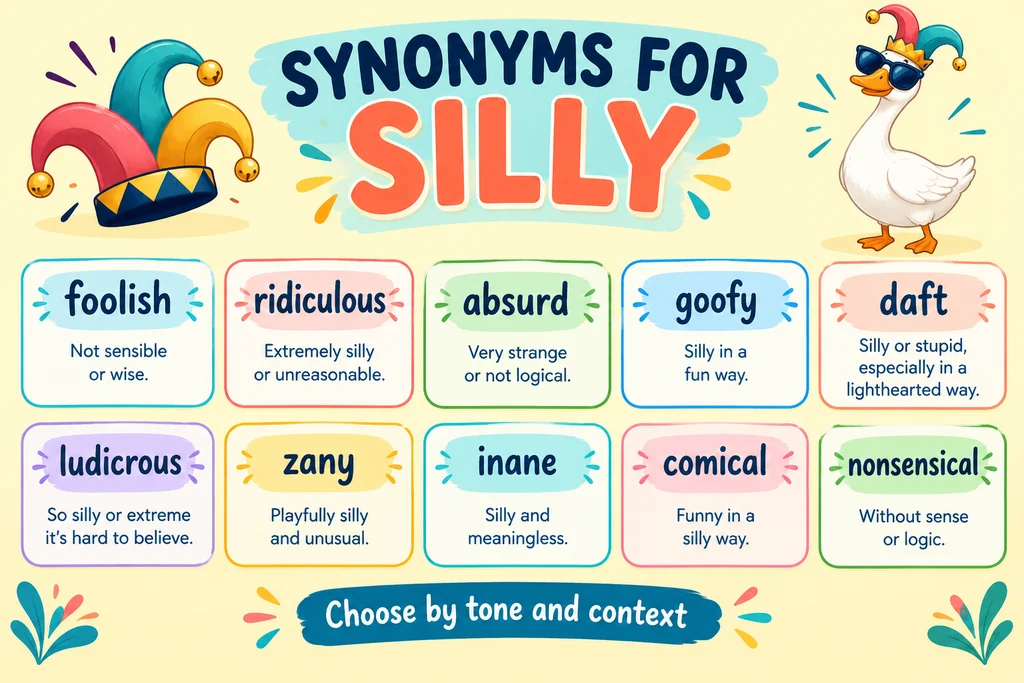
If the word “silly” is doing all the heavy lifting in your writing, it’s time to give it some backup. Whether you’re describing a friend’s goofy dance moves, a plan that made no sense, or a decision you now regret, repeating “silly” drains the life out of your sentences. The good news? The English language is packed with brilliant synonyms for silly — each with its own shade of meaning, from playful and charming to downright ridiculous.
Learning another word for silly is about more than sounding smart. The right synonym captures exactly how lighthearted, absurd, or foolish something felt — the difference between writing that gets skimmed and writing that gets remembered. If you’ve been growing your vocabulary with lists like these, you may also enjoy our synonyms for desperate or our list of synonyms for slowly.
Below, you’ll find 50 synonyms of silly grouped by tone and intensity, each with a simple meaning and a real-life example. Read on — you’ll never be stuck saying “silly” twice in the same paragraph again.
Looking for another word for silly? Top picks: goofy, absurd, ridiculous, whimsical, frivolous, and foolish.

Let’s start with the light, playful end of the spectrum — the words you’d use when “silly” means fun, not flawed.
Goofy
Meaning:
Goofy means lightheartedly foolish in a lovable, harmless way.
Examples:
- He pulled a goofy face at the camera and the whole family laughed.
- The goofy puppy chased its own tail around the yard.
Wacky
Meaning:
Wacky means amusingly strange or eccentric.
Examples:
- Their wacky science fair project used a toaster to launch paper airplanes.
- The wacky costumes stole the show at the Halloween party.
Zany
Meaning:
Zany means wildly and unpredictably funny.
Examples:
- The zany host kept interrupting himself with sound effects.
- Her zany dance moves had everyone in stitches.
Whimsical
Meaning:
Whimsical means playfully imaginative or fanciful.
Examples:
- She decorated her office with whimsical drawings of flying teapots.
- The whimsical garden was full of tiny fairy doors.
Playful
Meaning:
Playful means full of fun and good humor, not meant to be taken seriously.
Examples:
- His playful reply turned the tense meeting into a relaxed one.
- The playful kitten batted the ball across the room.
Quirky
Meaning:
Quirky means having odd but charming habits or traits.
Examples:
- Her quirky habit of naming all her plants made her apartment feel alive.
- His quirky laugh was instantly recognizable in any crowd.
Comical
Meaning:
Comical means funny enough to make people laugh out loud.
Examples:
- Two kittens fighting over one toy was a comical sight.
- The clown’s comical routine delighted the children.
Amusing
Meaning:
Amusing means entertaining and mildly humorous.
Examples:
- He told an amusing story about getting lost in his own neighborhood.
- The amusing cartoon kept the kids entertained for hours.
Humorous
Meaning:
Humorous means showing humor; not entirely serious.
Examples:
- Her humorous take on office life made the whole team smile.
- The humorous speech lightened the mood at the ceremony.
Droll
Meaning:
Droll means funny in an odd, dry, understated way.
Examples:
- His droll comments about the rain made the long bus ride bearable.
- The writer’s droll wit made the dull topic fun.
Mirthful
Meaning:
Mirthful means full of laughter and joy.
Examples:
- The mirthful crowd sang along to every song at the concert.
- Mirthful laughter filled the room during the toast.
Facetious
Meaning:
Facetious means joking when a serious tone was expected.
Examples:
- His facetious answer about studying made the teacher sigh.
- She made a facetious remark during the serious debate.
Lighthearted
Meaning:
Lighthearted means cheerful and carefree; not weighed down by worry.
Examples:
- They shared a lighthearted picnic in the park after exams.
- The lighthearted comedy was perfect for a Friday night.
Giddy
Meaning:
Giddy means playfully excited, almost dizzy with happiness.
Examples:
- The kids were giddy with excitement on the morning of the trip.
- She felt giddy after hearing the good news.
Merry
Meaning:
Merry means cheerful and lively in a lighthearted way.
Examples:
- A merry group of friends played board games until midnight.
- The merry bells rang through the village square.
Frivolous
Meaning:
Frivolous means not having any serious purpose or value.
Examples:
- She refused to spend money on frivolous gadgets she would never use.
- The committee dismissed the idea as frivolous.
Flippant
Meaning:
Flippant means treating serious things with a lack of respect.
Examples:
- His flippant attitude toward the deadline annoyed his manager.
- She gave a flippant reply to the serious question.
Trivial
Meaning:
Trivial means of little importance or worth.
Examples:
- Don’t waste your energy arguing over trivial details.
- The error was trivial and easy to fix.
Trifling
Meaning:
Trifling means too small or unimportant to be worth considering.
Examples:
- They apologized over a trifling misunderstanding about the bill.
- The trifling sum barely covered the cost of coffee.
Pointless
Meaning:
Pointless means having no purpose, reason, or useful result.
Examples:
- Arguing with him felt pointless, so she walked away.
- The meeting was pointless without the key documents.
Absurd
Meaning:
Absurd means wildly unreasonable or completely illogical.
Examples:
- The idea that the meeting would last ten minutes was simply absurd.
- It is absurd to expect a toddler to sit still for hours.
Ridiculous
Meaning:
Ridiculous means so unreasonable it deserves to be laughed at.
Examples:
- He wore a winter coat in forty-degree heat, which looked ridiculous.
- The price they asked for the old car was ridiculous.
Preposterous
Meaning:
Preposterous means completely contrary to reason or common sense.
Examples:
- The claim that the earth is flat is preposterous.
- The idea that fish can fly is simply preposterous.
Ludicrous
Meaning:
Ludicrous means so foolish it is almost laughable.
Examples:
- They charged a ludicrous amount for a bottle of water.
- The movie’s plot twists were utterly ludicrous.
Outlandish
Meaning:
Outlandish means bizarre, strange, and hard to believe.
Examples:
- Her outlandish prediction about robots made everyone laugh.
- He wore an outlandish hat covered in feathers.
Nonsensical
Meaning:
Nonsensical means having no meaning or logic.
Examples:
- The baby’s nonsensical babbling still made her parents smile.
- The instructions were nonsensical and impossible to follow.
Senseless
Meaning:
Senseless means lacking any good reason or purpose.
Examples:
- The argument was senseless and left both friends upset.
- The senseless violence shocked the entire community.
Meaningless
Meaning:
Meaningless means having no real significance or value.
Examples:
- Without context, the message was completely meaningless.
- The trophy felt meaningless without her team beside her.
Mindless
Meaning:
Mindless means done without thought or care.
Examples:
- Mindless scrolling ate up two hours of his evening.
- The job involved mindless data entry all day.
Thoughtless
Meaning:
Thoughtless means done without considering consequences or others’ feelings.
Examples:
- It was thoughtless of him to joke about her bad day.
- The thoughtless comment hurt her feelings deeply.
Careless
Meaning:
Careless means not giving enough attention to avoid mistakes.
Examples:
- A careless typo changed the meaning of the entire email.
- Careless driving caused the accident on the highway.
Reckless
Meaning:
Reckless means taking foolish risks without thinking of danger.
Examples:
- His reckless driving in the rain scared every passenger.
- The reckless decision nearly bankrupted the company.
Rash
Meaning:
Rash means acting too quickly without careful thought.
Examples:
- She made a rash decision to quit and regretted it the next day.
- He made a rash promise he could not keep.
68+ Synonyms for Slow That Instantly Upgrade Your Vocabulary
Impulsive
Meaning:
Impulsive means acting suddenly on a whim without planning.
Examples:
- His impulsive purchase of a kayak surprised the whole family.
- She made an impulsive trip to the beach on Friday.
Hasty
Meaning:
Hasty means done with too much speed and too little thought.
Examples:
- A hasty guess on the exam cost her several marks.
- The hasty repair broke down within a week.
Foolish
Meaning:
Foolish means lacking good sense or judgment.
Examples:
- It was foolish to leave the keys in the unlocked car.
- Only a foolish person would swim during the storm.
Unwise
Meaning:
Unwise means showing poor judgment; not sensible.
Examples:
- It would be unwise to invest your savings in that scheme.
- It was unwise to ignore the doctor’s advice.
Ill-advised
Meaning:
Ill-advised means not sensible; likely to have bad results.
Examples:
- His ill-advised tweet cost him a valuable business deal.
- The ill-advised shortcut added an hour to the trip.
Imprudent
Meaning:
Imprudent means not careful or wise; lacking caution.
Examples:
- An imprudent comment during the interview hurt her chances.
- It was imprudent to spend the emergency fund on a vacation.
Naive
Meaning:
Naive means lacking experience, so easily fooled or misled.
Examples:
- The naive traveler believed every stranger’s story.
- Her naive trust in the stranger cost her the wallet.
Gullible
Meaning:
Gullible means easily tricked or convinced of anything.
Examples:
- The gullible customer bought the “miracle” cream at full price.
- Gullible readers believed the fake news story instantly.
Credulous
Meaning:
Credulous means too ready to believe things without questioning them.
Examples:
- A credulous audience clapped for every exaggerated claim.
- The credulous child believed the magician’s tricks were real.
Inane
Meaning:
Inane means empty of meaning; extremely foolish.
Examples:
- The movie’s inane plot bored everyone in the theater.
- His inane jokes fell flat at the dinner party.
Fatuous
Meaning:
Fatuous means silly and pointless in a self-satisfied way.
Examples:
- His fatuous grin only made the insult worse.
- The fatuous speech was full of empty praise.
Vapid
Meaning:
Vapid means offering nothing stimulating or interesting.
Examples:
- The vapid conversation died the moment the music stopped.
- The vapid reality show offered nothing worth watching.
Vacuous
Meaning:
Vacuous means showing a lack of thought or intelligence.
Examples:
- She stared at the screen with a vacuous expression.
- The vacuous smile gave away his lack of understanding.
Asinine
Meaning:
Asinine means extremely stupid or foolish.
Examples:
- Only an asinine rule would ban laughter in a playground.
- The asinine policy wasted everyone’s time.
Idiotic
Meaning:
Idiotic means very stupid; showing a complete lack of sense.
Examples:
- Leaving the oven on all night was an idiotic mistake.
- It was idiotic to jump into the freezing lake.
Moronic
Meaning:
Moronic means extremely foolish; nearly senseless.
Examples:
- The moronic comment made the whole room go silent.
- His moronic prank ruined the entire presentation.
Scatterbrained
Meaning:
Scatterbrained means forgetful and disorganized; unable to concentrate.
Examples:
- The scatterbrained professor lost his glasses while wearing them.
- The scatterbrained assistant forgot the meeting twice.
When to Use Which Synonym for Silly
With 50 synonyms for silly in your toolbox, the trick is picking the right one. Use goofy, playful, whimsical, or lighthearted in casual writing and friendly chats — they’re warm and affectionate. For school essays and formal writing, lean on absurd, ill-advised, imprudent, or frivolous.
When something is funny but sharp, facetious, flippant, and preposterous add bite. Save idiotic, moronic, asinine for genuine criticism — they land hard. To describe poor decisions gently, unwise, rash, and naive keep your tone kind.

45+ Synonyms for Since That Make Your Writing Shine
Frequently Asked Questions
What is the best synonym for silly?
It depends on what you mean. For playful behavior, “goofy” or “playful” is perfect. For something that makes no sense, “absurd” or “ridiculous” fits best. For poor judgment, “foolish” or “unwise” is the right pick.
Is there a difference between silly and funny?
Yes. “Funny” usually means something made you laugh in a good way, while “silly” can be affectionate, critical, or dismissive depending on the context. A joke is funny; the mistake you made telling it might be silly.
Is “silly” a positive or negative word?
It can be both. Calling a child “silly” during playtime is warm and loving, but calling an idea “silly” in a business meeting is clearly dismissive. Tone and context decide everything.
What are formal synonyms for silly I can use in essays?
“Absurd,” “preposterous,” “frivolous,” “ill-advised,” and “imprudent” all work beautifully in academic writing. They carry the meaning of silly without sounding casual or childish.
What’s the difference between silly and stupid?
“Silly” is lighter and often temporary — a silly moment, a silly joke. “Stupid” is harsher and suggests a deeper lack of intelligence. Words similar to silly like “foolish” or “thoughtless” usually keep your tone kinder.
What are the opposites of silly?
Common antonyms include serious, sensible, wise, and thoughtful. Learning opposites alongside synonyms for silly will double your expressive power.
Conclusion
Words are tools, and “silly” is a blunt one. Now you have 50 sharper options — from the warmth of “goofy” and “playful” to the precision of “absurd” and “preposterous” to the firmness of “foolish” and “unwise.” The next time you reach for “silly,” pause and ask what you really mean. Pick the word that fits the moment, and your writing will feel richer and far more confident. Keep collecting words similar to silly, and watch your vocabulary — and your readers’ attention — grow.
Author

Emily Carter is a vocabulary specialist and content writer at SynonymCore. She loves breaking down the nuances of English words and helping readers find exactly the right word for every occasion.
Pingback: 45+Synonyms for Showing: Beyond Displaying and Revealing