
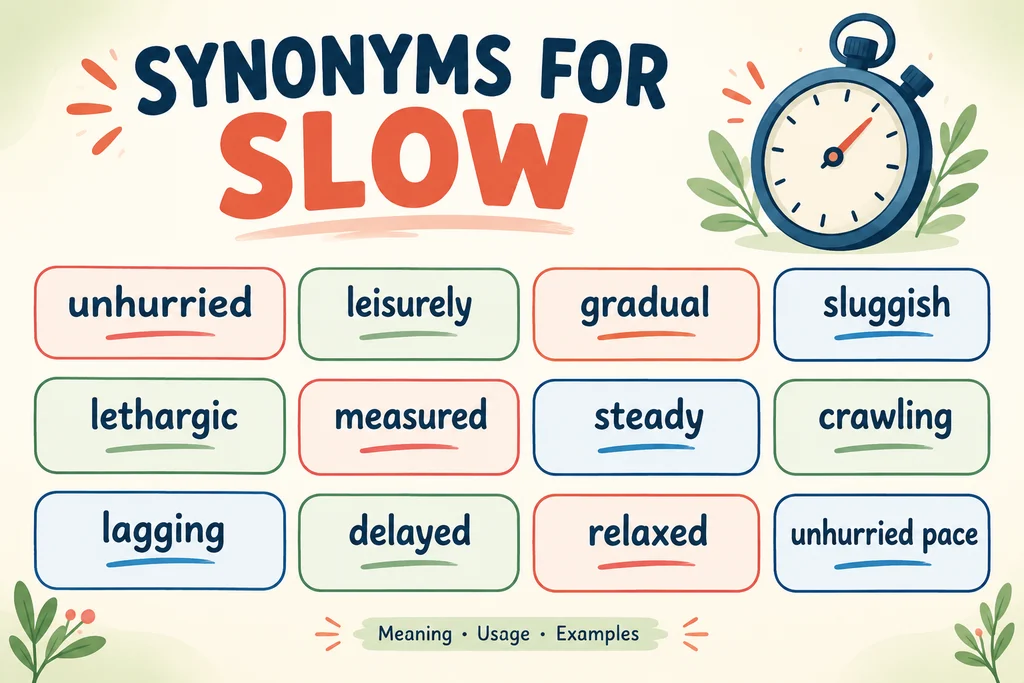
Looking for another word for slow? Top picks: unhurried, leisurely, gradual, deliberate, sluggish, and tardy. Each one carries its own shade of meaning — scroll down for all 50, with examples.
Say “slow” one more time and your sentence falls flat. It is the laziest word in your vocabulary — a colorless placeholder you grab when the traffic crawls, the Wi-Fi buffers, or the meeting drags into its third hour. But strong writing demands precision: is it a peaceful, unhurried morning, or a painful, glacial queue? That is exactly why synonyms for slow matter — they hand you fifty shades of meaning where you once had a single tired word.
Watch how one word rewrites the mood: “a leisurely stroll” feels like a vacation, while “a sluggish morning” feels like punishment — the scene never changed, only the word did. Whether you are drafting an essay, a story, or a caption that needs bite, these synonyms for slow hand you the exact flavor you need, just as exploring synonyms for pride sharpens how you write about confidence. Below you will find 50 carefully chosen alternatives, each with a simple meaning and a real-life example — and one of them is about to become your new favorite.

Unhurried
Meaning:
Unhurried means moving at a relaxed pace, with no pressure to rush.
Examples:
- We enjoyed an unhurried breakfast on the porch before starting our day.
- They enjoyed an unhurried walk along the beach.
Leisurely
Meaning:
Leisurely means slow in a pleasant, relaxed way.
Examples:
- They took a leisurely stroll through the park after dinner.
- We had a leisurely lunch at the café.
Gradual
Meaning:
Gradual means happening little by little over time.
Examples:
- Her recovery was gradual, but she improved every single week.
- The sunset brought a gradual change in colors.
Steady
Meaning:
Steady means moving at an even, constant pace without speeding up.
Examples:
- The tortoise kept a steady pace and eventually reached the pond.
- The marathon runner kept a steady rhythm throughout.
Deliberate
Meaning:
Deliberate means slow because it is careful and thoughtful.
Examples:
- He took deliberate steps, testing each stone before putting his weight on it.
- She made a deliberate choice to slow down.
Measured
Meaning:
Measured means calm and controlled, with nothing rushed.
Examples:
- She answered in a measured tone, choosing every word with care.
- He answered with measured, thoughtful pauses between words.
Methodical
Meaning:
Methodical means slow because it follows a careful, organized process.
Examples:
- The detective worked in a methodical way, examining every clue twice.
- The chef’s methodical kitchen prep saved dinner service.
Ambling
Meaning:
Ambling means walking slowly in a relaxed, casual way.
Examples:
- We spent the afternoon ambling through the farmers’ market.
- The tourists were ambling through the old town.
Sauntering
Meaning:
Sauntering means walking slowly with a confident, easy manner.
Examples:
- He came sauntering down the street like he owned the place.
- She came sauntering into the morning meeting late.
Strolling
Meaning:
Strolling means walking slowly for pleasure.
Examples:
- Couples were strolling along the river as the sun went down.
- The couple were strolling hand in hand downtown.
Plodding
Meaning:
Plodding means moving slowly and heavily, often with effort.
Examples:
- The tired hikers were plodding up the final hill.
- The exhausted factory workers were plodding toward home.
Trudging
Meaning:
Trudging means walking slowly and with difficulty, as if through mud.
Examples:
- She was trudging home through the heavy snow.
- He was trudging wearily through the deep mud.
Slogging
Meaning:
Slogging means working or moving slowly through something difficult.
Examples:
- We spent the whole day slogging through the muddy trail.
- The clerks kept slogging through the endless paperwork.
Crawling
Meaning:
Crawling means moving extremely slowly, barely making progress.
Examples:
- Traffic was crawling during the evening rush hour.
- The baby was crawling toward the bright toy.
Creeping
Meaning:
Creeping means moving very slowly and quietly.
Examples:
- The fog was creeping across the fields at dawn.
- Long shadows were creeping across the old wall.
Sluggish
Meaning:
Sluggish means lacking energy; moving slowly because of tiredness.
Examples:
- After the big lunch, everyone felt sluggish and sleepy.
- My old office computer felt sluggish this morning.
Languid
Meaning:
Languid means relaxed and slow, with little energy or enthusiasm.
Examples:
- The hot afternoon made the whole town feel languid and drowsy.
- She waved back with a languid, sleepy gesture.
Lethargic
Meaning:
Lethargic means feeling too tired to move quickly or think clearly.
Examples:
- The flu left him lethargic for nearly a week.
- The heat made the dog lethargic all day.
Torpid
Meaning:
Torpid means mentally or physically inactive; moving very slowly.
Examples:
- The lizard lay torpid on the warm rock, barely blinking.
- The bear lay torpid in its winter den.
Shuffling
Meaning:
Shuffling means moving slowly by dragging the feet.
Examples:
- The elderly man was shuffling toward the bus stop.
- The clerk was shuffling papers on her desk.
Laborious
Meaning:
Laborious means requiring so much effort that progress is slow.
Examples:
- Carrying the heavy boxes up the steep stairs was laborious.
- Writing the long thesis was laborious but rewarding.
Ponderous
Meaning:
Ponderous means slow and heavy, often awkwardly so.
Examples:
- The old truck made a ponderous turn onto the narrow road.
- The old elephant took ponderous steps toward water.
Tardy
Meaning:
Tardy means arriving or happening later than expected.
Examples:
- The train was tardy again, so I missed my connection.
- The tardy new student slipped into class quietly.
Belated
Meaning:
Belated means coming later than it should have.
Examples:
- She sent a belated birthday card with a sweet apology note.
- He offered a belated thanks for the gift.
Delayed
Meaning:
Delayed means held back; happening later than planned.
Examples:
- Our flight was delayed by three hours because of the storm.
- The heavily delayed package arrived two weeks late.
Overdue
Meaning:
Overdue means later than the time something was supposed to happen.
Examples:
- The library books are overdue, so I need to return them today.
- The monthly rent is overdue by ten days.
Late
Meaning:
Late means arriving after the expected time.
Examples:
- Sorry I’m late — the meeting ran longer than I thought.
- The very late bus made us miss dinner.
Behindhand
Meaning:
Behindhand means an old-fashioned word for being behind schedule.
Examples:
- The builders are behindhand, so the house won’t be ready in June.
- The local farmers are behindhand with the harvest.
Dilatory
Meaning:
Dilatory means slow to act; causing delay.
Examples:
- The committee’s dilatory response frustrated everyone waiting for an answer.
- The office’s dilatory clerk delayed every single form.
Dawdling
Meaning:
Dawdling means wasting time by moving or acting too slowly.
Examples:
- Stop dawdling and get your shoes on — we’re leaving!
- The chatty tourists kept dawdling at every shop.
Synonyms for Soft: Better Words for Texture, Sound, and Touch
Lollygagging
Meaning:
Lollygagging means fooling around instead of moving along; wasting time.
Examples:
- The kids were lollygagging on the way to school again.
- The bored workers were lollygagging near the gate.
Pokey
Meaning:
Pokey means an informal word for annoyingly slow.
Examples:
- This old laptop is so pokey it takes five minutes just to start.
- The old pokey elevator stopped at every floor.
Laggard
Meaning:
Laggard means someone or something that falls behind the rest.
Examples:
- The company became a laggard in the market and lost its customers.
- He was the laggard of the running group.
Protracted
Meaning:
Protracted means lasting longer than expected or necessary.
Examples:
- The negotiations turned into a protracted battle that lasted months.
- The court trial became a protracted legal battle.
Prolonged
Meaning:
Prolonged means extended over a long period of time.
Examples:
- A prolonged drought damaged crops across the entire region.
- A prolonged winter illness kept him from school.
Drawn-out
Meaning:
Drawn-out means taking too long; unnecessarily extended.
Examples:
- The drawn-out meeting could easily have been an email.
- Their drawn-out checkout ordeal took forty long minutes.
Lengthy
Meaning:
Lengthy means long in time or extent, often tiresomely so.
Examples:
- We sat through a lengthy presentation about the new policy.
- The novel’s lengthy introduction bored most young readers.
Lingering
Meaning:
Lingering means staying longer than expected; slow to leave or end.
Examples:
- A lingering cold kept her home from work for two weeks.
- A strange lingering smell filled the old kitchen.
Meandering
Meaning:
Meandering means wandering slowly without a clear direction.
Examples:
- We took a meandering path through the woods, in no hurry at all.
- The wide meandering river wound through the valley.
Rambling
Meaning:
Rambling means moving or talking in a slow, wandering way.
Examples:
- The old professor gave a rambling lecture that wandered off topic.
- The old rambling house had twelve small rooms.
Drifting
Meaning:
Drifting means moving slowly without purpose or direction.
Examples:
- The boat was drifting gently across the calm lake.
- White clouds were drifting lazily across the sky.
Halting
Meaning:
Halting means stopping and starting; not smooth or steady.
Examples:
- She gave a halting speech, pausing often to find her words.
- The nervous witness spoke in halting, broken English.
Glacial
Meaning:
Glacial means extremely slow, like a moving glacier.
Examples:
- Progress on the project was glacial — nothing had changed in weeks.
- The long line moved at a glacial pace.
Oozing
Meaning:
Oozing means flowing very slowly, like thick liquid.
Examples:
- Honey was oozing from the jar onto the counter.
- Melted cheese was oozing from the hot sandwich.
Seeping
Meaning:
Seeping means flowing slowly through small openings.
Examples:
- Rainwater was seeping through the crack in the ceiling.
- A quiet doubt was seeping into her confident mind.
Trickling
Meaning:
Trickling means flowing slowly in a thin stream.
Examples:
- Only a thin trickle of water was coming from the old faucet.
- Late guests were trickling into the wedding hall.
Inching
Meaning:
Inching means moving forward very slowly, inch by inch.
Examples:
- The car was inching forward in the bumper-to-bumper traffic.
- The tiny snail was inching along the leaf.
Snail-paced
Meaning:
Snail-paced means as slow as a snail; extremely slow.
Examples:
- The checkout line was snail-paced, so we switched to another register.
- The hotel’s snail-paced Wi-Fi tested everyone’s patience today.
Tortoise-like
Meaning:
Tortoise-like means moving at the slow, steady pace of a tortoise.
Examples:
- With tortoise-like determination, she finished the marathon anyway.
- Their tortoise-like home renovation finally reached full completion.
Painstaking
Meaning:
Painstaking means so careful and thorough that it takes a long time. When to Use Which Choosing among all these synonyms for slow comes down to the situation.
Examples:
- Restoring the old painting was painstaking work that took months.
- Her painstaking doctoral research took five full years.
When to Use Which
Choosing among all these synonyms for slow comes down to the situation. For formal writing and essays, reach for gradual, deliberate, measured, protracted, or dilatory — they sound polished and precise.
In casual chat, pokey, dawdling, lollygagging, and snail-paced feel natural and friendly. When describing physical movement, ambling, plodding, trudging, and inching paint a clear picture. For delays and lateness, use tardy, belated, delayed, or overdue. And when slowness is a good thing — a lazy morning, a careful craftsman — unhurried, leisurely, and lingering keep the tone warm.
One caution: words like sluggish and lethargic describe people too, so use them gently.

56+Synonyms for Solution: Beyond Answers and Fixes
Frequently Asked Questions
Which synonyms for slow work best in formal writing?
For essays, reports, and professional writing, use gradual, deliberate, measured, protracted, or dilatory. These carry the meaning of slow without sounding casual or slangy. Save words like pokey and lollygagging for conversation and creative writing.
What is the difference between slow and sluggish?
“Slow” is neutral — it simply describes a low speed. “Sluggish” adds a negative layer: it suggests low energy, laziness, or something not working properly, like a sluggish economy or a sluggish morning after too little sleep. If you want to stay neutral, stick with words like gradual or unhurried.
What is the opposite of slow?
The most common opposites are fast, quick, rapid, and swift. For a formal tone, rapid and swift work well; in everyday speech, fast and quick are the natural choices. Knowing the antonyms helps you contrast ideas clearly in writing.
What is a positive word for slow?
Unhurried, leisurely, and deliberate all frame slowness as something pleasant or wise. A “leisurely afternoon” sounds lovely, and a “deliberate decision” sounds smart. These are perfect when you want to celebrate a slower pace instead of criticizing it.
Can “slow” describe a person, and is it rude?
It depends on the word you choose. Calling someone “slow” to mean unintelligent is insulting, so avoid that. But describing someone’s pace — “she took slow, careful steps” — is perfectly fine. Gentler options like unhurried or deliberate keep things polite when you describe people.
What is a stronger word for very slow?
When “slow” is not slow enough, try glacial, sluggish, crawling, or snail-paced. Glacial is great for processes and progress, while snail-paced adds a touch of humor to everyday complaints about traffic or queues.
Conclusion
Slow is not one thing — it is fifty things. It can be the peace of an unhurried morning, the care of deliberate work, the frustration of a delayed train, or the humor of a snail-paced queue. The more synonyms for slow you keep in your vocabulary, the more precisely you can capture each of these moments. Try swapping one tired “slow” for a fresher word in your next essay, email, or story, and notice how much richer the sentence feels. Building vocabulary is a gradual process — and that is exactly the point.
Author

Emily Carter is a vocabulary specialist and content writer at SynonymCore. She loves breaking down the nuances of English words and helping readers find exactly the right word for every occasion.
Pingback: 50+Brilliant Synonyms for Silly That Make Your Writing Pop