
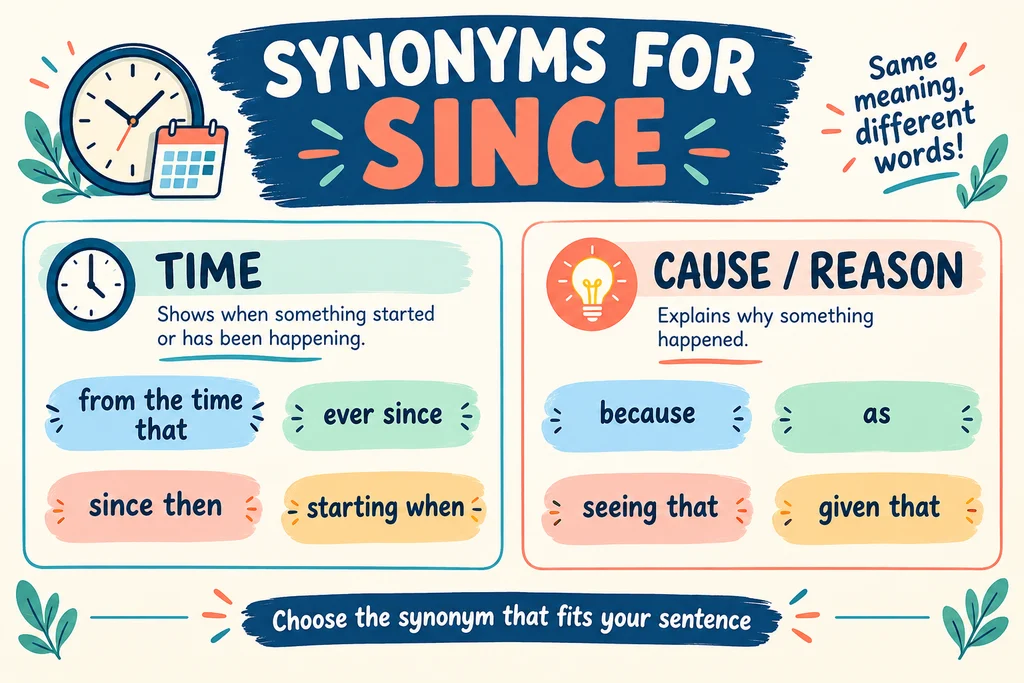
Tired of typing the word since in every other sentence? You’re not alone — it is the invisible workhorse of our emails, essays, and conversations, quietly doing double duty as a cause (“since it was raining”) and a time marker (“since 2019”). The problem is that the harder it works, the flatter our writing starts to sound, and nobody remembers a sentence that blends into the wall.
That is exactly why keeping synonyms for since in your back pocket is such an easy upgrade. Whether you are drafting an essay, polishing a work email, or just trying to stop sounding like a broken record, swapping in the right alternative makes your language richer and more precise. Below are 50 carefully chosen substitutes — from everyday words like because and as to elegant formal phrases like in light of and inasmuch as — each with a plain-English meaning and a real-life example.
But here is the real question: which of these formal picks makes even an ordinary sentence sound like it came from a seasoned editor? If you enjoy this kind of word power, you may also like our guides to synonyms for together and synonyms for give.
Looking for another word for since? Top picks: because, as, seeing that, ever since, from, and in light of. All are below, with meanings and examples.

Because
Meaning:
Because means the most direct causal replacement — clear in almost any sentence.
Examples:
- Because it was late, we took a taxi home.
- Because the shop was closed, we bought bread elsewhere.
As
Meaning:
As means a softer, slightly more polished way to give a reason.
Examples:
- As she was tired, she went to bed early.
- As the baby was sleeping, we spoke in whispers.
For
Meaning:
For means a literary, old-fashioned “because” — lovely in stories, too stiff for texts.
Examples:
- He could not speak, for his voice was shaking.
- She trembled, for the night was bitterly cold.
Seeing that
Meaning:
Seeing that means a friendly way to point out an obvious reason.
Examples:
- Seeing that everyone was hungry, I ordered pizza.
- Seeing that the bus was late, we walked home.
Seeing as
Meaning:
Seeing as means a casual, conversational way to give a reason — a close everyday match for causal “since.”
Examples:
- Seeing as it’s Friday, let’s leave a little early.
- Seeing as you’re clearly tired, I’ll drive tonight.
Considering that
Meaning:
Considering that means taking something into account as a reason.
Examples:
- Considering that he was new, he did remarkably well.
- Considering that she trained alone, her score was impressive.
Given that
Meaning:
Given that means “in view of the fact that” — slightly formal, ideal for essays and emails.
Examples:
- Given that prices are rising, we should buy now.
- Given that traffic is heavy, let’s leave soon.
Now that
Meaning:
Now that means a phrase used when a new situation explains an action.
Examples:
- Now that you’re here, we can start the meeting.
- Now that the rain has stopped, we can go out.
After all
Meaning:
After all means a gentle reminder of a reason everyone knows.
Examples:
- After all, she had warned us about the storm.
- After all, he was only trying to help.
Inasmuch as
Meaning:
Inasmuch as means formal “to the extent that” — best for serious writing.
Examples:
- He succeeded inasmuch as he never gave up.
- She is fortunate inasmuch as she has good health.
Insofar as
Meaning:
Insofar as means “to the degree that” — a close cousin of inasmuch as.
Examples:
- I agree insofar as the plan protects our budget.
- I support it insofar as it helps the poor.
Insomuch as
Meaning:
Insomuch as means an old-fashioned variant of inasmuch as — found in classic books, not modern writing.
Examples:
- They are alike insomuch as both love music.
- They differ insomuch as one strongly prefers tea.
In that
Meaning:
In that means a formal, precise phrase that explains in what way something is true.
Examples:
- She was lucky in that she found help quickly.
- He was wise in that he saved every month.
Because of
Meaning:
Because of means naming the cause as a noun phrase rather than a clause.
Examples:
- Because of the fog, the flight was delayed.
- Because of the strike, the trains stopped running.
Due to the fact that
Meaning:
Due to the fact that means a formal, weighty way to state a reason in official writing.
Examples:
- Due to the fact that costs rose, we cut the budget.
- Due to the fact that it rained, the match ended early.
Owing to
Meaning:
Owing to means “as a result of” in formal language.
Examples:
- Owing to heavy rain, the match was cancelled.
- Owing to sudden illness, she missed the wedding.
Thanks to
Meaning:
Thanks to means a warm, grateful way to name a cause.
Examples:
- Thanks to her help, I finished on time.
- Thanks to the map, we found the hotel easily.
On account of
Meaning:
On account of means a slightly old-fashioned formal “because of.”
Examples:
- On account of his age, he was given a lighter task.
- On account of the storm, schools were closed.
As a result of
Meaning:
As a result of means emphasizing the outcome of a cause.
Examples:
- As a result of the drought, the crops failed.
- As a result of the fire, the building was evacuated.
In consequence of
Meaning:
In consequence of means formal; stresses what followed from something.
Examples:
- In consequence of the error, the launch was postponed.
- In consequence of the verdict, he lost his license.
By virtue of
Meaning:
By virtue of means “because of a quality or position someone holds” — formal.
Examples:
- By virtue of her experience, she led the project.
- By virtue of his rank, he entered first.
By reason of
Meaning:
By reason of means legal-sounding and very formal — common in official documents.
Examples:
- By reason of illness, he missed the exam.
- By reason of old age, the judge retired.
On the grounds that
Meaning:
On the grounds that means used for justifications and official reasons.
Examples:
- The request was denied on the grounds that it was late.
- The claim was rejected on the grounds that it lacked proof.
In light of
Meaning:
In light of means “considering” — a favorite in professional writing.
Examples:
- In light of recent events, we changed our plans.
- In light of the forecast, we packed umbrellas.
From
Meaning:
From means the simplest marker of a starting point in time.
Examples:
- The shop is open from nine in the morning.
- The museum is open from ten to six.
After
Meaning:
After means marking what came later than a moment — use it for “from that point onward.”
Examples:
- After the storm, the streets were flooded for days.
- After dinner, they watched a movie together happily.
Following
Meaning:
Following means a slightly formal “after”; marks later events.
Examples:
- Following the announcement, shares rose sharply.
- Following the heavy rain, a bright rainbow appeared.
Subsequent to
Meaning:
Subsequent to means a very formal “after” — best for academic or legal writing.
Examples:
- Subsequent to the review, the policy was updated.
- Subsequent to the trial, new laws were passed.
Starting from
Meaning:
Starting from means clearly marking the beginning of a period.
Examples:
- Starting from Monday, the new timings apply.
- Starting from next week, all classes begin earlier.
Starting in
Meaning:
Starting in means marking a beginning by year or month.
Examples:
- Starting in 2020, she ran every single day.
- Starting in March, the days get noticeably warmer.
Beginning with
Meaning:
Beginning with means pointing to where something first started.
Examples:
- Beginning with a single store, the brand grew nationwide.
- Beginning with a joke, he won the crowd.
Beginning in
Meaning:
Beginning in means marking a start within a specific time frame.
Examples:
- Beginning in June, the days grew longer.
- Beginning in deep winter, the lake freezes over.
Ever since
Meaning:
Ever since means continuously from a past moment right up until now.
Examples:
- Ever since that trip, we’ve been close friends.
- Ever since the move, she has felt happier.
56+Synonyms for Solution: Beyond Answers and Fixes
From the time of
Meaning:
From the time of means “starting at the very moment of” — formal.
Examples:
- From the time of his arrival, things improved.
- From the time of his birth, she adored him.
From that moment on
Meaning:
From that moment on means an emotional marker — everything changed after that point.
Examples:
- From that moment on, she trusted her instincts.
- From that moment on, he never looked back.
As far back as
Meaning:
As far back as means naming a distant starting point deep in the past.
Examples:
- As far back as 1998, he was writing code.
- As far back as childhood, she loved painting.
Up to now
Meaning:
Up to now means “until this moment.”
Examples:
- Up to now, everything has gone smoothly.
- Up to now, the journey has been easy.
Until now
Meaning:
Until now means the whole stretch of time before the present.
Examples:
- Until now, I had never tried sushi.
- Until now, the dark secret stayed carefully hidden.
So far
Meaning:
So far means a casual “up to this point.”
Examples:
- So far, the results look promising.
- So far, the baby has slept through the night.
Thus far
Meaning:
Thus far means a slightly formal “so far.”
Examples:
- Thus far, no problems have been reported.
- Thus far, the bold experiment has fully succeeded.
To date
Meaning:
To date means a formal “up to the present day” — common in business updates.
Examples:
- To date, we have raised fifty thousand dollars.
- To date, no one has solved the puzzle.
As of now
Meaning:
As of now means “at this exact moment.”
Examples:
- As of now, the tickets are still available.
- As of now, the small store remains open.
Up until now
Meaning:
Up until now means the entire stretch of time before today.
Examples:
- Up until now, she had avoided the topic.
- Up until now, he had never flown abroad.
Long since
Meaning:
Long since means something that happened or ended long ago.
Examples:
- That tradition has long since disappeared.
- The old wooden bridge has long since collapsed.
From then on
Meaning:
From then on means starting at that past point and continuing afterward.
Examples:
- From then on, he woke up at five every day.
- From then on, they wrote long letters weekly.
From now on
Meaning:
From now on means starting at this moment and continuing into the future.
Examples:
- From now on, I’ll save half my salary.
- From now on, I’ll arrive ten minutes early.
Henceforth
Meaning:
Henceforth means a formal, grand “from this time forward.”
Examples:
- Henceforth, all meetings will be online.
- Henceforth, the city library will close at eight.
Henceforward
Meaning:
Henceforward means a rarer twin of henceforth — correct, though most writers pick “henceforth.”
Examples:
- The rules apply henceforward to every member.
- The new policy holds henceforward for all staff.
Thenceforth
Meaning:
Thenceforth means an old-fashioned “from that time on” — found in classic literature, not modern writing.
Examples:
- Thenceforth, the two families never spoke.
- Thenceforth, the small village lived in lasting peace.
Thereafter
Meaning:
Thereafter means a formal “after that point in time” — a staple of reports and history writing.
Examples:
- Thereafter, the company grew rapidly.
- Thereafter, the market prices fell very sharply indeed.
When to Use Which of These Synonyms for Since
Choosing among these since synonyms is mostly about tone. For formal writing and reports, reach for inasmuch as, in light of, subsequent to, thereafter, or to date. In casual chat, stick with because, as, seeing as, ever since, and so far.
For essays and exams, given that, considering that, on account of, and by virtue of show range without sounding forced. In emotional or reflective moments — a memoir, a speech, a heartfelt letter — ever since, from that moment on, and after all carry real feeling. Match the word to the room.

68+ Synonyms for Slow That Instantly Upgrade Your Vocabulary
Frequently Asked Questions About Synonyms for Since
What is the best synonym for “since” in formal writing?
For the causal sense, try in light of, given that, or inasmuch as. For the temporal sense, try subsequent to, from the time of, or to date. Just match the grammar — some need a noun phrase, others a full clause.
Is “as” always a good replacement for “since”?
Mostly, but watch out: “as” can also mean “while” (“as I was walking…”). If your sentence could be read two ways, choose because or seeing that instead.
What is the difference between “since” and “because”?
“Since” often introduces a reason the listener already accepts, while “because” states it more directly. And temporal “since” (“since Monday”) has nothing to do with cause — that is where from, ever since, and starting in take over.
Which synonym for “since” means “from a past time until now”?
Ever since is the closest match, followed by up to now, until now, so far, and to date. Use ever since to stress unbroken continuity.
Can I use “ever since” and “since” interchangeably?
Often, yes — but only in the temporal sense (“ever since we met”). “Ever since” stresses continuity, so it feels stronger. Never use it for the causal sense; “ever since you’re tired” is simply wrong.
What is the opposite of “since”?
For time, until or till (“until Monday”). For cause, there is no single opposite, but despite, in spite of, and although flip the logic of a “since” sentence.
A Final Word
Words like since are the quiet hinges of our sentences — small, hardworking, and easy to overuse. Now you have 50 synonyms for since, from the humble because to the stately henceforth, and you know exactly when each one shines. Try slipping two or three into your writing this week — your sentences will feel fresher almost immediately. Small upgrades compound fast — and a richer vocabulary shows everywhere.
Author

Sophia Lane is an English learning contributor at SynonymCore. She creates easy-to-understand guides on synonyms, antonyms, and everyday vocabulary.
Pingback: 63 Striking Synonyms for Showed That Make Your Writing Pop